
Données techniques
| Formule | C25H19NO3S |
||||||
| Poids moléculaire | 413.49 | N° CAS | 503468-95-9 | ||||
| Solubilité (25°C)* | In vitro | DMSO | 3 mg/mL (7.25 mM) | ||||
| Water | Insoluble | ||||||
| Ethanol | Insoluble | ||||||
| In Vivo (Ajoutez les solvants au produit individuellement et dans lordre.) |
|
||||||
|
* <1 mg/ml signifie légèrement soluble ou insoluble. * Veuillez noter que Selleck teste la solubilité de tous les composés en interne, et la solubilité réelle peut différer légèrement des valeurs publiées. Ceci est normal et est dû à de légères variations dun lot à lautre. * Expédition à température ambiante (les tests de stabilité montrent que ce produit peut être expédié sans aucune mesure de refroidissement.) |
|||||||
Préparation des solutions mères
Activité biologique
| Description | NU7441 (KU-57788) est un inhibiteur de DNA-PK très puissant et sélectif avec une IC50 de 14 nM. Il inhibe également mTOR et PI3K avec une IC50 de 1,7 μM et 5 μM respectivement dans des essais acellulaires, et réduit la fréquence de NHEJ tout en augmentant le taux de HDR suite au clivage de l'ADN médiatisé par Cas9. | ||||||
|---|---|---|---|---|---|---|---|
| Cibles |
|
||||||
| In vitro | Le NU7441 (KU-57788) augmente la persistance des foyers γH2AX après des dommages à l'ADN induits par les rayonnements ionisants. Il (0,5 μM ou 1 μM) augmente sensiblement l'accumulation en phase G2-M induite par les rayonnements ionisants et la doxorubicine dans les cellules SW620 et LoVo. Ce composé provoque la persistance des ruptures double brin de l'ADN induites par la doxorubicine et les rayonnements ionisants et diminue également légèrement l'activité de recombinaison homologue dans les cellules tumorales humaines M059-Fus-1 à compétence DNA-PK et M059 J déficientes en DNA-PK. Il inhibe l'hyperphosphorylation de RPA p34 induite par les UV de manière dose-dépendante dans les cellules dépourvues de polymérase η et celles l'exprimant. Le NU7441 augmente les niveaux de foyers γH2AX induits et diminue en conséquence la mort cellulaire induite dans les cellules de leucémie lymphoïde chronique. Il inhibe également l'autophosphorylation et la réparation de DNA-PKcs induites dans les cellules de leucémie lymphoïde chronique. Ce composé réduit la fréquence de NHEJ tout en augmentant le taux de HDR après le clivage de l'ADN médiatisé par Cas9. |
||||||
| In Vivo | Le NU7441 (KU-57788), administré par voie intrapéritonéale à une dose de 10 mg/kg, se maintient pendant au moins 4 heures, ne montre aucune toxicité et augmente le retard de croissance tumorale induit par 2 fois chez les souris porteuses de xénogreffes SW620. |
Protocole (de référence)
| Test cellulaire : |
|
|---|---|
| Étude animale : |
|
Références
|
Validation du produit par le client
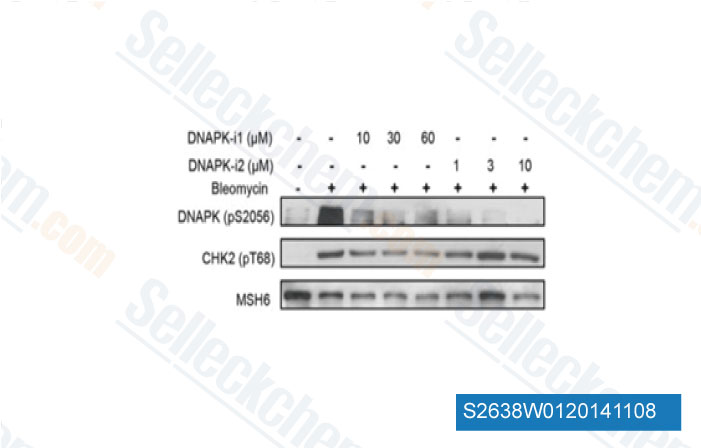
-
Données de [ Toxicol Sci , 2014 , 10.1093/toxsci/kfu207 ]
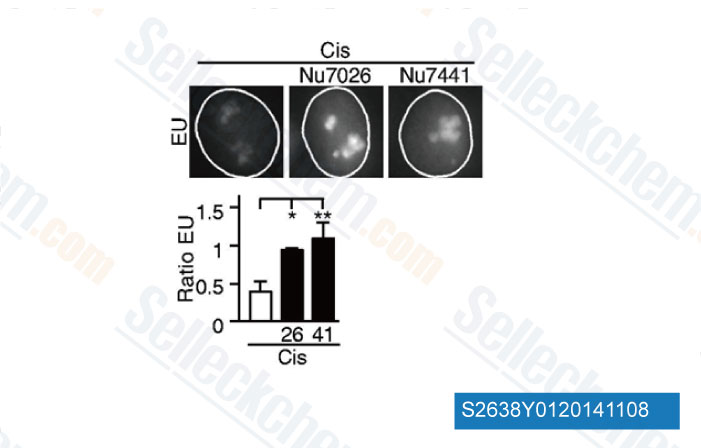
-
Données de [ Nucleic Acids Res , 2013 , 41(15), 7378-86 ]
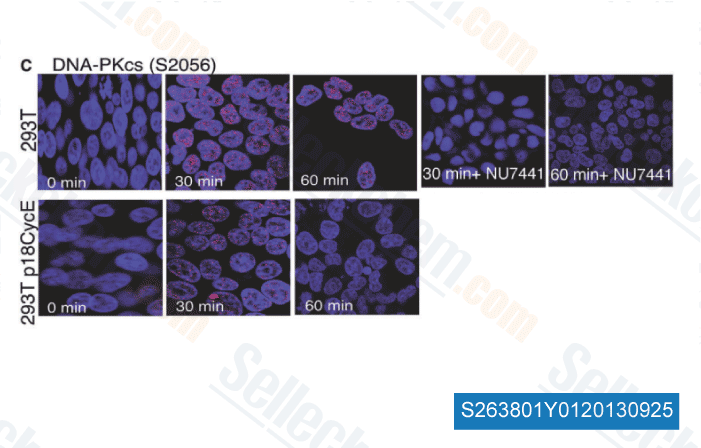
-
Données de [ Nucleic Acids Res , 2013 , 41, 10157-69 ]
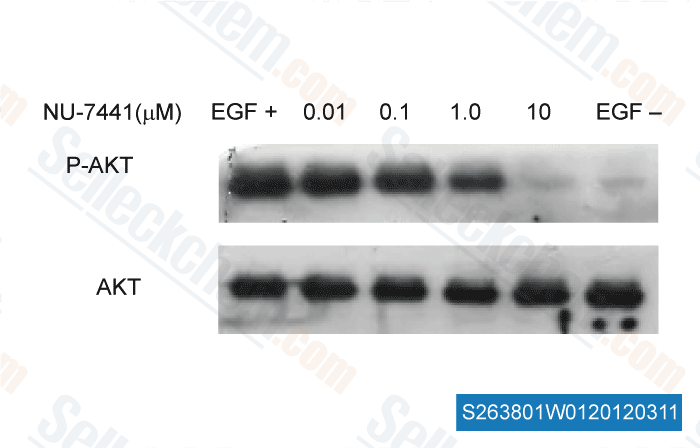
-
, , Dr. Zhang of Tianjin Medical University
De Selleck NU7441 (KU-57788) A été cité par 309 Publications
| Homologous recombination promotes non-immunogenic mitotic cell death upon DNA damage [ Nat Cell Biol, 2025, 27(1):59-72] | PubMed: 39805921 |
| Highly efficient prime editors for mammalian genome editing based on porcine retrovirus reverse transcriptase [ Trends Biotechnol, 2025, S0167-7799(25)00314-2] | PubMed: 40885667 |
| Phosphorylation-dependent WRN-RPA interaction promotes recovery of stalled forks at secondary DNA structure [ Nat Commun, 2025, 16(1):997] | PubMed: 39870632 |
| Autophosphorylation of the Tousled-like kinases TLK1 and TLK2 regulates recruitment to damaged chromatin via PCNA interaction [ Nucleic Acids Res, 2025, 53(4)gkae1279] | PubMed: 39727191 |
| Homeodomain protein PRRX1 anchors the Ku heterodimers at DNA double-strand breaks to promote nonhomologous end-joining [ Nucleic Acids Res, 2025, 53(6)gkaf200] | PubMed: 40114375 |
| ONE-STEP tagging: a versatile method for rapid site-specific integration by simultaneous reagent delivery [ Nucleic Acids Res, 2025, 53(15)gkaf809] | PubMed: 40823809 |
| The inflammasome sensor NLRP3 interacts with REV7 to maintain genome integrity through homologous recombination [ Nucleic Acids Res, 2025, 53(12)gkaf554] | PubMed: 40613708 |
| Nuclear damage-induced DNA damage response coupled with IFI16-driven ECM remodeling underlies dilated cardiomyopathy [ Theranostics, 2025, 15(12):5998-6021] | PubMed: 40365289 |
| Cross-species analysis of the nuclease Artemis highlights its evolving function in domesticating RAG-like transposons and residues that are crucial for activity [ PLoS Biol, 2025, 23(4):e3003056] | PubMed: 40245028 |
| DSCC1 restrains 53BP1/RIF1 signaling at DNA double-strand breaks to promote homologous recombination repair [ Cell Rep, 2025, 44(4):115452] | PubMed: 40117291 |
POLITIQUE DE RETOUR
La politique de retour inconditionnelle de Selleck Chemical garantit une expérience dachat en ligne fluide à nos clients. Si vous nêtes en aucun cas satisfait de votre achat, vous pouvez retourner tout article dans les 7 jours suivant sa réception. En cas de problèmes de qualité du produit, quil sagisse de problèmes liés au protocole ou au produit, vous pouvez retourner tout article dans les 365 jours suivant la date dachat initiale. Veuillez suivre les instructions ci-dessous lors du retour des produits.
EXPÉDITION ET STOCKAGE
Les produits Selleck sont transportés à température ambiante. Si vous recevez le produit à température ambiante, soyez assuré que le service dinspection de la qualité de Selleck a mené des expériences pour vérifier que le placement à température normale pendant un mois naffectera pas lactivité biologique des produits en poudre. Après réception, veuillez stocker le produit conformément aux exigences décrites dans la fiche technique. La plupart des produits Selleck sont stables dans les conditions recommandées.
NON DESTINÉ À UN USAGE HUMAIN, VÉTÉRINAIRE DIAGNOSTIQUE OU THÉRAPEUTIQUE.