
Technische gegevens
| Formule | C14H13BrN2O |
||||||||||
| Molecuulgewicht | 305.17 | CAS-nr. | 65678-07-1 | ||||||||
| Oplosbaarheid (25°C)* | In vitro | DMSO | 61 mg/mL (199.88 mM) | ||||||||
| Water | Insoluble | ||||||||||
| Ethanol | Insoluble | ||||||||||
| In Vivo (Voeg oplosmiddelen afzonderlijk en in volgorde toe aan het product.) |
|
||||||||||
|
* <1 mg/ml betekent licht oplosbaar of onoplosbaar. * Houd er rekening mee dat Selleck de oplosbaarheid van alle verbindingen intern test en de werkelijke oplosbaarheid enigszins kan afwijken van gepubliceerde waarden. Dit is normaal en is te wijten aan lichte batch-tot-batch variaties. * Verzending op kamertemperatuur (Stabiliteitstests tonen aan dat dit product zonder koelmaatregelen kan worden verzonden.) |
|||||||||||
Voorbereiden van stamoplossingen
Biologische activiteit
| Beschrijving | AG-1024 (Tyrphostin, AGS 200) remt IGF-1R-autofosforylering met een IC50 van 7 μM, is minder potent voor IR met een IC50 van 57 μM en maakt specifiek onderscheid tussen InsR en IGF-1R (vergeleken met andere tyrphostines). | ||||
|---|---|---|---|---|---|
| Doelen |
|
||||
| In vitro | AG-1024 blokkeert de IGF-1-receptor en IR-autofosforylering met een IC50 van respectievelijk 7 μM en 57 μM. Deze verbinding remt ook de receptor tyrosinekinase-activiteit ten opzichte van exogene substraten (TKA) met IC50-waarden van respectievelijk 18 μM en 80 μM. Deze chemische stof (10 μM) remt de celproliferatie op een tijdsafhankelijke manier en induceert apoptose in MCF-7-cellen na 48 uur met 20,1% en >40% in combinatie met bestraling (10 Gy), krachtiger dan bestraling (10 Gy) alleen met 11,8%, wat geassocieerd is met een downregulatie van phospho-Akt1 en bcl-2, en een upregulatie van Bax, p53 en p21. Het remt significant de proliferatie van melanoomcellen met een IC50 van <50 nM in afwezigheid van serum, door MAPK/ERK2-signalering te blokkeren, vervolgens snel pRb-defosforylering en -activering te induceren, en uiteindelijk de vorming van groeiremmende pRb-E2F-complexen. Behandeling met deze verbinding downreguleert de expressie van Bcr-Abl en P-Akt en upreguleert de DNA-PKcs-expressie in UT7-9- en Ba/F3-p210-cellen, wat leidt tot verminderde klonogene overleving en proliferatie. Het remt ook significant de proliferatie van cellen die resistent zijn tegen de BCR-ABL-remmer STI571, wat correleert met een dosisafhankelijke afname van de Bcr-Abl-eiwitexpressie. | ||||
| In Vivo | Toediening van AG-1024 in een dosis van 30 μg gedurende 10 dagen remt significant de tumorgroei van Ba/F3-p210-xenografts bij muizen. |
Protocol (uit referentie)
| Kinase-assay:[1] |
|
|---|---|
| Celassay:[2] |
|
| Dierstudie:[4] |
|
Referenties
|
Klantproductvalidatie
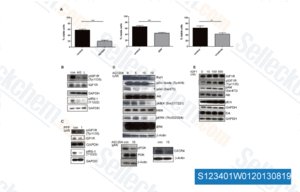
-
Gegevens van [ Blood , 2013 , 122(9), 1621-33 ]
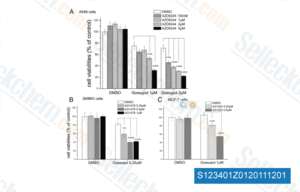
-
Gegevens van [ Mol Endocrinol , 2011 , 25, 2041-53 ]
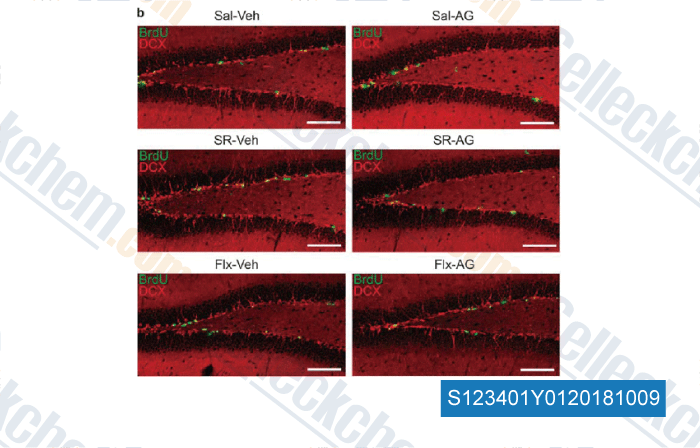
-
Gegevens van [ , , Mol Psychiatry, 2018, 23(4):833-842 ]
Sellecks AG-1024 Is geciteerd door 27 Publicaties
| A Transcriptomics Analysis of the Regulation of Lens Fiber Cell Differentiation in the Absence of FGFRs and PTEN [ Cells, 2024, 13(14)1222] | PubMed: 39056803 |
| LTK and ALK promote neuronal polarity and cortical migration by inhibiting IGF1R activity [ EMBO Rep, 2023, 24(7):e56937] | PubMed: 37291945 |
| Ras-mutant cancers are sensitive to small molecule inhibition of V-type ATPases in mice [ Nat Biotechnol, 2022, 10.1038/s41587-022-01386-z] | PubMed: 35879364 |
| Tyrphostin AG1024 Suppresses Coronaviral Replication by Downregulating JAK1 via an IR/IGF-1R Independent Proteolysis Mediated by Ndfip1/2_NEDD4-like E3 Ligase Itch [ Pharmaceuticals (Basel), 2022, 15(2)241] | PubMed: 35215353 |
| Targeting oncogenic mutations in colorectal cancer using cryptotanshinone [ PLoS One, 2021, 16(2):e0247190] | PubMed: 33596259 |
| Regulation of Hippo-YAP Signaling by Insulin-Like Growth factor-1 Receptor in the Tumorigenesis of Diffuse Large B-cell Lymphoma [ J Hematol Oncol, 2020, 13(1):77] | PubMed: 32546241 |
| Myeloid cells provide critical support for T-ALL in vivo [ The University of Texas at Austin, 2020, ] | PubMed: None |
| An Autocrine IL-6/IGF-1R Loop Mediates EMT and Promotes Tumor Growth in Non-small Cell Lung Cancer. [ Int J Biol Sci, 2019, 15(9):1882-1891] | PubMed: 31523190 |
| mTORC2-mediated PDHE1α nuclear translocation links EBV-LMP1 reprogrammed glucose metabolism to cancer metastasis in nasopharyngeal carcinoma. [ Oncogene, 2019, 38(24):4669-4684] | PubMed: 30745576 |
| A novel 5HT3 receptor–IGF1 mechanism distinct from SSRI-induced antidepressant effects [Kondo M, et al. Mol Psychiatry, 2018, 23(4):833-842] | PubMed: 28439104 |
RETOURBELEID
Selleck Chemicals onvoorwaardelijke retourbeleid zorgt voor een soepele online winkelervaring voor onze klanten. Als u op enigerlei wijze ontevreden bent met uw aankoop, kunt u elk artikel(en) binnen 7 dagen na ontvangst retourneren. In geval van problemen met de productkwaliteit, zowel protocolgerelateerde als productgerelateerde problemen, kunt u elk artikel(en) binnen 365 dagen na de oorspronkelijke aankoopdatum retourneren. Volg de onderstaande instructies bij het retourneren van producten.
VERZENDING EN OPSLAG
Selleck producten worden bij kamertemperatuur vervoerd. Als u het product op kamertemperatuur ontvangt, wees dan gerust, de Selleck kwaliteitsinspectieafdeling heeft experimenten uitgevoerd om te controleren of de normale temperatuurplaatsing van één maand de biologische activiteit van poederproducten niet beïnvloedt. Na ontvangst dient u het product op te slaan volgens de vereisten beschreven in het gegevensblad. De meeste Selleck producten zijn stabiel onder de aanbevolen omstandigheden.
NIET VOOR HUMANE, VETERINAIRE DIAGNOSTISCHE OF THERAPEUTISCHE DOELEINDEN.