
연구용
AG-14361 PARP 억제제
제품 번호: S2178
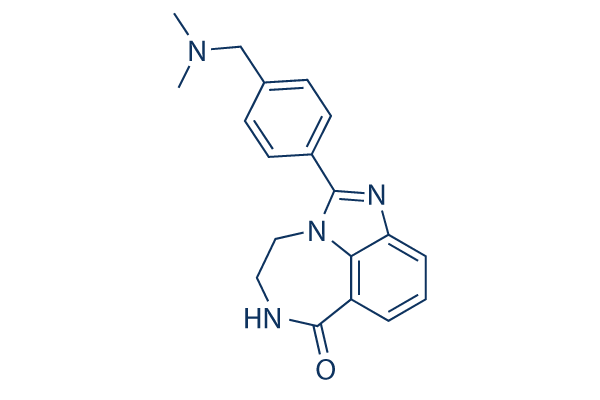
화학 구조
분자량: 320.39
품질 관리 (Quality Control)
세포 배양, 처리 및 작업 농도
(Cell Culture, Treatment & Working Concentration)
| 세포주 | 분석 유형 | 농도 | 배양 시간 | 제형 | 활성 설명 | PMID |
|---|---|---|---|---|---|---|
| LoVo cells | Function assay | Concentration that gives 50% growth inhibition in LoVo cells, activity expressed as GI50, GI50=11.2 μM | ||||
| 클릭하여 더 많은 세포주 실험 데이터 보기 | ||||||
화학 정보, 보관 및 안정성 (Chemical Information, Storage & Stability)
| 분자량 | 320.39 | 화학식 | C19H20N4O |
보관 (수령일로부터) | |
|---|---|---|---|---|---|
| CAS 번호 | 328543-09-5 | SDF 다운로드 | 원액 보관 |
|
|
| 동의어 | N/A | Smiles | CN(C)CC1=CC=C(C=C1)C2=NC3=CC=CC4=C3N2CCNC4=O | ||
용해도 (Solubility)
|
In vitro |
DMSO
: 51 mg/mL
(159.18 mM)
Ethanol : 21 mg/mL Water : Insoluble |
몰농도 계산기
|
In vivo |
|||||
생체 내 제형 계산기 (투명한 용액)
1단계: 아래 정보 입력 (권장: 실험 중 손실을 고려하여 추가 동물 포함)
2단계: 생체 내 제형 입력 (이것은 계산기일 뿐 제형이 아닙니다. 용해도 섹션에 생체 내 제형이 없는 경우 먼저 당사에 문의하십시오.)
계산 결과:
작업 농도: mg/ml;
DMSO 원액 준비 방법: mg 약물 사전 용해 μL DMSO ( 원액 농도 mg/mL, 농도가 해당 약물 배치의 DMSO 용해도를 초과하는 경우 먼저 당사에 문의하십시오. )
생체 내 제형 준비 방법: 취하다 μL DMSO 원액, 다음 추가μL PEG300, 혼합하고 투명하게 한 다음 추가μL Tween 80, 혼합하고 투명하게 한 다음 추가 μL ddH2O, 혼합하고 투명하게 합니다.
생체 내 제형 준비 방법: 취하다 μL DMSO 원액, 다음 추가 μL 옥수수 기름, 혼합하고 투명하게 합니다.
참고: 1. 다음 용매를 추가하기 전에 액체가 투명한지 확인하십시오.
2. 용매를 순서대로 추가해야 합니다. 다음 용매를 추가하기 전에 이전 추가에서 얻은 용액이 투명한 용액인지 확인해야 합니다. 와동, 초음파 또는 뜨거운 물 중탕과 같은 물리적 방법을 사용하여 용해를 도울 수 있습니다.
작용 메커니즘 (Mechanism of Action)
| 특징 |
The 1st high-potency PARP-1 inhibitor with the specificity & in vivo activity to enhance chemotherapy and radiation therapy of human cancers.
|
|---|---|
| Targets/IC50/Ki |
PARP1
(Cell-free assay) <5 nM(Ki)
|
| 시험관 내(In vitro) |
AG14361 is at least 1000-fold more potent than the benzamides. The IC50 for AG14361 is 29 nM in permeabilized SW620 cells and 14 nM in intact SW620 cells. Crystallographic analysis of AG14361 bound to the catalytic domain of chicken PARP-1 shows that the tricyclic ring system of AG14361 is located in a pocket composed of amino acid residues Trp861, His862, Gly863, Tyr896, Phe897, Ala898, Lys903, Ser904, Tyr907, and Glu988. AG14361 forms important hydrogen bonds with Ser904 and Gly863 and a water-mediated hydrogen bond with Glu988. AG14361-induced growth inhibition is not attributed to PARP-1-related effects because maximal PARP-1 inhibition is observed at much lower concentrations (≤1 μM) than the GI50. AG14361 at 0.4 μM does not affect cancer cell gene expression or growth, but it increases the antiproliferative activity, and inhibits recovery from potentially lethal γ-radiation damage in LoVo cells by 73%. In addition, 0.4 μM AG14361 does not substantially alter gene expression as shown by microarray analysis. A 17-hour exposure of A549 cells to 0.4 μM AG14361 does not change the expression of the 6800 genes. Thus, although 0.4 μM AG14361 inhibits cellular PARP-1 activity by more than 85%, it essentially does not change gene expression and cell proliferation, indicating that the cellular effects of this low concentration of AG14361 are specific for PARP-1 inhibition. Higher, growth-inhibitory concentrations of AG14361 affects gene expression, but these effects are not likely to be related to PARP-1 inhibition because cell proliferation is affected equally in PARP-/- and PARP-1+/+ cells. AG14361 is rapidly absorbed into the bloodstream and distributed to the tumor and liver with lower concentrations detected in the brain. Tissue-to-plasma concentration ratio indicates that AG14361 is retained in tumor tissue over time in both xenograft models, with tumor concentrations (≥15 μM for 2 hours) in excess of that required to inhibit PARP-1 activity in vitro. AG14361 enhances activity in all MMR-proficient cells (1.5–3.3-fold) but is more effective in MMR-deficient cells (3.7–5.2-fold potentiation), overcoming resistance. In contrast, benzylguanine only increases the efficacy in MMR-proficient cells but is ineffective in MMR-deficient cells. AG14361 enhances the growth-inhibitory and cytotoxic effects of topoisomerase I poisons. AG14361 increases the persistence of camptothecin-induced DNA single-strand breaks. |
| 키나아제 분석 |
PARP-1 활성 분석
|
|
전장 재조합 인간 PARP-1의 활성은 20 nM PARP-1, 500 μM NAD+ 및 [32P]NAD+(반응 혼합물당 0.1–0.3 μCi)와 활성화된 송아지 흉선 DNA(10 μg/mL)를 포함하는 반응 혼합물에서 25oC로 측정하며, 반응은 얼음처럼 차가운 10%(wt/vol) 트리클로로아세트산을 첨가하여 4분 후에 종료합니다. 산 불용성 물질에 통합된 반응 생성물 [32P]ADP-ribose는 Bio-Dot 미세 여과 장치를 사용하여 Whatman GF/C 유리 섬유 필터에 증착되고 PhosphorImager로 정량화됩니다. 0–600 nM 농도의 AG14361에 의한 PARP-1 활성 억제가 측정되며, AG14361에 대한 Ki는 비선형 회귀 분석을 통해 계산됩니다.
|
|
| 생체 내(In vivo) |
AG14361 treatment before irradiation statistically significantly increases the sensitivity to radiation therapy of mice bearing LoVo xenografts. AG14361 statistically significantly increases blood flow in xenografts and thus potentially increases drug delivery to tumor xenografts. In vivo, nontoxic doses of AG14361 increases the delay of LoVo xenograft growth induced by x-irradiation by 2- to 3-fold. Coadministration of AG14361 statistically significantly increases activity against LoVo xenografts, with the tumor growth delay being increased from 3 days to 9 days by AG14361 at 5 mg/kg and to 10 days by AG14361 at 15 mg/kg. The combination of AG14361 causes complete regression of SW620 xenograft tumors. PARP-1 activity, detected by pharmacodynamic assay, in SW620 xenografts is inhibited by more than 75% for at least 4 hours after intraperitoneal administration of AG14361 (10 mg/kg), consistent with the concentration of AG14361 persisting in the tumor. |
참조 |
|

제품은 연구용으로만 사용됩니다. 인체에는 사용하지 마십시오. 환자에게 판매하지 않습니다.
©Copyright 2013 Selleck Chemicals. All Rights Reserved.