
연구용
Thiabendazole P450 (e.g. CYP17) 억제제
제품 번호: S1739
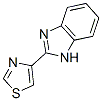
화학 구조
분자량: 201.25
품질 관리 (Quality Control)
화학 정보, 보관 및 안정성 (Chemical Information, Storage & Stability)
| 분자량 | 201.25 | 화학식 | C10H7N3S |
보관 (수령일로부터) | |
|---|---|---|---|---|---|
| CAS 번호 | 148-79-8 | SDF 다운로드 | 원액 보관 |
|
|
| 동의어 | N/A | Smiles | C1=CC=C2C(=C1)NC(=N2)C3=CSC=N3 | ||
용해도 (Solubility)
|
In vitro |
DMSO
: 40 mg/mL
(198.75 mM)
Ethanol : 1 mg/mL Water : Insoluble |
몰농도 계산기
|
In vivo |
|||||
생체 내 제형 계산기 (투명한 용액)
1단계: 아래 정보 입력 (권장: 실험 중 손실을 고려하여 추가 동물 포함)
2단계: 생체 내 제형 입력 (이것은 계산기일 뿐 제형이 아닙니다. 용해도 섹션에 생체 내 제형이 없는 경우 먼저 당사에 문의하십시오.)
계산 결과:
작업 농도: mg/ml;
DMSO 원액 준비 방법: mg 약물 사전 용해 μL DMSO ( 원액 농도 mg/mL, 농도가 해당 약물 배치의 DMSO 용해도를 초과하는 경우 먼저 당사에 문의하십시오. )
생체 내 제형 준비 방법: 취하다 μL DMSO 원액, 다음 추가μL PEG300, 혼합하고 투명하게 한 다음 추가μL Tween 80, 혼합하고 투명하게 한 다음 추가 μL ddH2O, 혼합하고 투명하게 합니다.
생체 내 제형 준비 방법: 취하다 μL DMSO 원액, 다음 추가 μL 옥수수 기름, 혼합하고 투명하게 합니다.
참고: 1. 다음 용매를 추가하기 전에 액체가 투명한지 확인하십시오.
2. 용매를 순서대로 추가해야 합니다. 다음 용매를 추가하기 전에 이전 추가에서 얻은 용액이 투명한 용액인지 확인해야 합니다. 와동, 초음파 또는 뜨거운 물 중탕과 같은 물리적 방법을 사용하여 용해를 도울 수 있습니다.
작용 메커니즘 (Mechanism of Action)
| Targets/IC50/Ki |
CYP1A2
|
|---|---|
| 시험관 내(In vitro) |
Thiabendazole provokes a strong DNA-damaging activity in the human lymphoblastoid cell line that constitutively expresses human CYP1A1 cDNA, but not in the parental line, indicating that CYP1A1 is chiefly implicated in carbaryl and thiabendazole genotoxicity. This compound provokes a dose- and time-dependent increase in CYP1A1 (EROD activity, protein and mRNA levels) in primary culture of rat hepatocytes. It results in the induction of 7-ethoxyresorufin O-deethylase and 7-pentoxyresorufin O-depentylase activities, CYP1A1, CYP1A2, CYP2B1 and CYP2B1/2 mRNA levels and CYP1A2 and CYP2B1/2 apoprotein levels. This chemical markedly induces GSTP1 mRNA levels, but has only a small effect on GSTT1 mRNA levels. It is rapidly transported by passive diffusion through the human intestinal cells by comparison with the protein-bound residues which are not able to cross the intestinal barrier. It will be firstly metabolized to 5OH-TBZ and subsequently converted to a chemically reactive metabolic intermediate binding to proteins.
|
| 생체 내(In vivo) |
Thiabendazole results in nephrosis or hydronephrosis and this organ toxicity may lead to the high dose-dependent mortality in treated mice. This compound results in hormone imbalance and this imbalance may play an important role in the changes of the reproductive or endocrine system in treated mice.
|
참조 |
|

제품은 연구용으로만 사용됩니다. 인체에는 사용하지 마십시오. 환자에게 판매하지 않습니다.
©Copyright 2013 Selleck Chemicals. All Rights Reserved.