Lapatinib Ditosylate

카탈로그 번호S1028 배치:S102810

인쇄

기술 자료

화학식

C29H26ClFN4O4S.2C7H8O3S

분자량 925.46 CAS 번호 388082-77-7
용해도 (25°C)* 시험관 내(In vitro) DMSO 100 mg/mL (108.05 mM)
Water Insoluble
Ethanol Insoluble
생체 내(In Vivo) (개별적으로 순서대로 용매를 제품에 첨가하십시오.)
Homogeneous suspension
CMC-NA
≥5mg/ml Taking the 1 mL working solution as an example, add 5 mg of this product to 1 ml of CMC-Na solution, mix evenly to obtain a homogeneous suspension with a final concentration of 5 mg/ml.
* <1 mg/ml은 약간 용해되거나 불용해됨을 의미합니다.
* Selleck은 모든 화합물의 용해도를 자체적으로 테스트하며, 실제 용해도는 게시된 값과 약간 다를 수 있습니다. 이는 정상적인 현상이며, 약간의 배치 간 변동으로 인해 발생합니다.
* 실온 배송 (안정성 테스트 결과 이 제품은 냉각 조치 없이 배송될 수 있음을 보여줍니다.)

원액 준비

생물학적 활성

설명 Lapatinib Ditosylate는 세포 없는 분석에서 IC50이 각각 10.8 및 9.2 nM인 강력한 EGFRErbB2 억제제입니다.
표적
ErbB2
(Cell-free assay)
EGFR
(Cell-free assay)
ErbB4
(Cell-free assay)
9.2 nM 10.8 nM 367 nM
시험관 내(In vitro) Lapatinib Ditosylate는 ErbB4의 활성을 367 nM의 IC50으로 약하게 억제하며, c-Src, c-Raf, MEK, ERK, c-Fms, CDK1, CDK2, p38, Tie-2 및 VEGFR2와 같은 다른 키나아제보다 EGFR 및 ErbB2에 대해 >300배의 선택성을 나타냅니다. 이 화합물은 HN5 세포에서 각각 170 nM 및 80 nM의 IC50으로 용량 의존적으로 EGFR 및 ErbB2의 수용체 자가인산화를 유의하게 억제하며, BT474 세포에서는 각각 210 nM 및 60 nM의 IC50을 보입니다. EGFR 과발현 세포의 성장을 preferentially 억제하는 OSI-774 및 Iressa (ZD1839)와 달리, EGFR 및 ErbB2 과발현 세포의 성장을 모두 억제합니다. EGFR 또는 ErbB2 과발현 세포에 대해 0.09-0.21 μM의 IC50으로 더 높은 억제 활성을 나타내며, EGFR 또는 ErbB2 수준이 낮은 세포 (IC50 3-12 μM)와 비교하여 정상 섬유아세포에 비해 약 100배의 선택성을 보입니다. 이 화학물질은 EGFR 과발현 HN5 및 A-431 세포와 ErbB2 과발현 BT474 및 N87 세포의 성장을 강력하게 억제하며, AKT 인산화 억제와 관련하여 HN5 세포의 G1기 정지 및 BT474 세포의 세포자멸사를 유의하게 유도합니다.
생체 내(In Vivo) Lapatinib Ditosylate (~100 mg/kg)의 하루 두 번 경구 투여는 BT474 및 HN5 이종이식편의 성장을 용량 의존적으로 유의하게 억제합니다.

프로토콜 (참조)

키나아제 분석:[1]
  • 시험관 내 키나아제 분석

    효소 활성 억제에 대한 IC50 값은 펩타이드 기질의 인산화 억제를 측정하여 생성됩니다. EGFR 및 ErbB2의 세포 내 키나아제 도메인은 바큘로바이러스 발현 시스템에서 정제됩니다. EGFR 및 ErbB2 반응은 96웰 폴리스티렌 둥근 바닥 플레이트에서 최종 부피 45 μL로 수행됩니다. 반응 혼합물은 50 mM 4-모르폴린프로판술폰산 (pH 7.5), 2 mM MnCl2, 10 μM ATP, 1 μCi [γ33P] ATP/반응, 50 μM 펩타이드 A [Biotin-(아미노헥사노산)-EEEEYFELVAKKK-CONH2], 1 mM 디티오트레이톨, 그리고 10 μM에서 시작하는 이 화합물의 연속 희석액을 포함하는 1 μL의 DMSO를 포함합니다. 반응은 지정된 정제된 유형-1 수용체 세포 내 도메인을 첨가하여 시작됩니다. 첨가된 효소의 양은 1 pmol/반응 (20 nM)입니다. 반응은 23°C에서 10분 후 45 μL의 0.5% 인산을 물에 첨가하여 종료됩니다. 종료된 반응 혼합물 (75 μL)은 인산셀룰로스 필터 플레이트로 옮겨집니다. 플레이트는 필터링되고 200 μL의 0.5% 인산으로 세 번 세척됩니다. 섬광 칵테일 (50 μL)이 각 웰에 첨가되고, 분석은 Packard Topcount에서 계수하여 정량화됩니다. IC50 값은 10점 용량-반응 곡선에서 생성됩니다.

세포 분석:[1]
  • 세포주

    HFF, MCF-7, T47D, A-431, HN5, BT474, N87, CaLu-3, HB4a, and HB4a c5.2

  • 농도

    Dissolved in DMSO, final concentrations ~100 μM

  • 배양 시간

    72 hours

  • 방법

    Cells are exposed to various concentrations of Lapatinib Ditosylate for 72 hours. Relative cell number is estimated using methylene blue staining. The absorbance at 620 nm is read in a Spectra microplate reader. Cell death and cell cycle analysis are assessed by propidium iodide staining and antibody detection of incorporated BrdUrd and staining with propidium iodide.

동물 연구:[1]
  • 동물 모델

    CD-1 nude female mice implanted s.c. with HN5 cells, and C.B-17 SCID female mice implanted s.c. with BT474 cells

  • 용량

    ~100 mg/kg

  • 투여

    Orally twice daily

참조

  • https://pubmed.ncbi.nlm.nih.gov/12467226/

고객 제품 검증

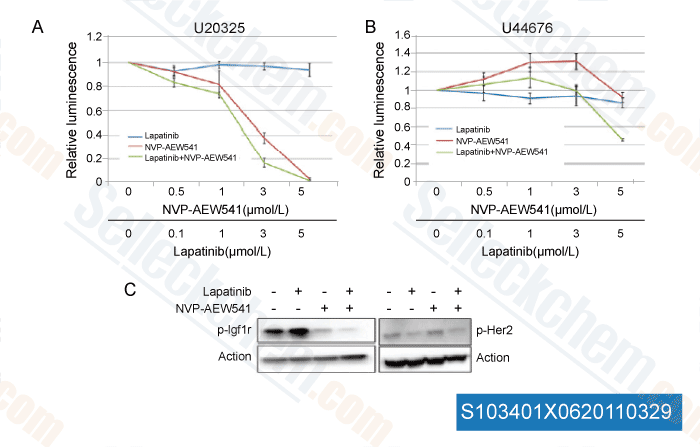
<p>Combination of NVP-AEW541 and lapatinib cooperatively inhibits the growth of NVP-AEW541 resistant murine rhabdomyosarcoma primary cell cultures with Igf1r/Her2 complexes. Cell viability assay for Naïve, untreated (U20325; A) and NVP-AEW541 innately resistant mouse rhabdomyosarcoma primary culture (U44676; B) treated with varying concentrations of NVP-AEW541, lapatinib, or a combination of both. Naïve cells (U20325) were sensitive to NVP-AEW541, but lapatinib had no cooperativity. In contrast, NVP-AEW541 at moderate doses increased cell growth in resistant cell cultures (U44676). However, this paradoxical effect was reduced by the addition of lapatinib, although lapatinib treatment alone had very little effect. C, the NVP-AEW541 resistant primary tumor cell line (U44676) was treated with DMSO, 5 μmol/L lapatinib, 5 μmol/L NVP-AEW541, and a combination of 5 μmol/L NVP-AEW541+lapatinib for 25 minutes and Western blot analysis was done on lysates for p-Igf1r and p-Her2.</p>

데이터 출처 [ Mol Cancer Ther , 2011 , 10:697-707 ]
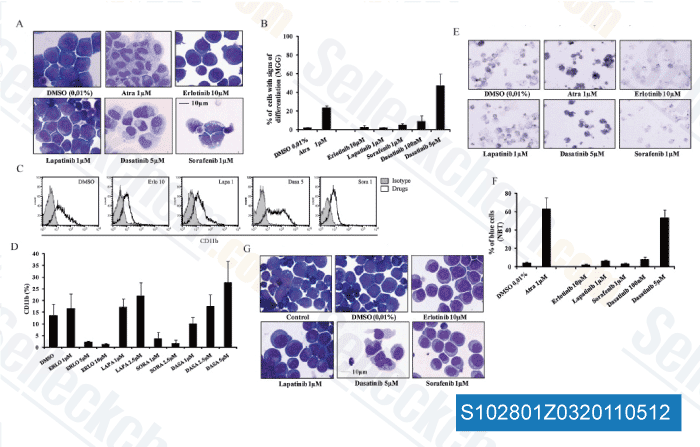
<p>Capacity of the TKI to overcome the AML-typical differentiation blockage. The myeloid cell lines MOLM-13 and HL-60 were incubated for 6 days with 0.01% DMSO (serving as a negative solvent control), 1 μM of ATRA (serving as a positive control), as well as with the indicated doses of the four TKI. (A) Representative May-Gruenwald-Giemsa staining of MOLM-13 cells, (B) quantitation of the percentage of MOLM-13 cells exhibiting at least two morphological signs of differentiation (that is a decrease in cytoplasmic basophilia, a reduction of the nucleo-cytoplasmic ratio, appearance of nuclear lobulation and/or cytoplasmic granules). Percentages were evaluated by examining at least 100 cells/condition; (C) representative FACS overlays of MOLM-13 cells depicting TKI-induced CD11b expression (black line) as compared to the isotype (shaded grey); (D) quantitation of TKI-induced CD11b-expression in MOLM-13 cells; (E) representative slides depicting morphology/staining of MOLM-13 cells assessed in the NBT-reduction assay; (F) respective quantitative assessment demonstrating the NBT-reducing capacity under the different drugs; (G) representative May-Gruenwald-Giemsa staining of HL-60 cells.</p><div><div> </div></div><p> </p>

데이터 출처 [ Biochem Pharmacol , 2011 , 82, 1457-1466 ]
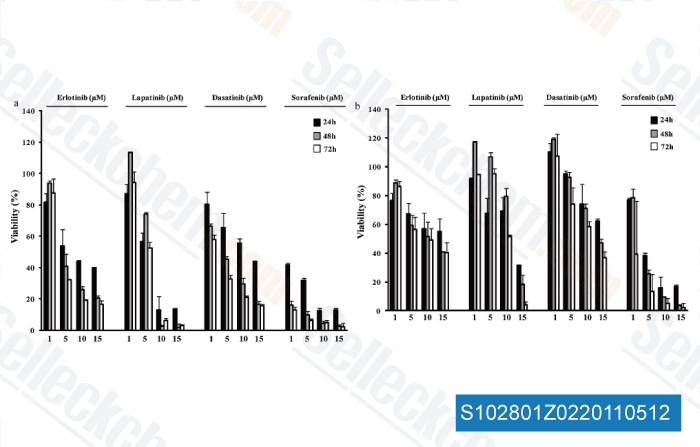
<p>Impact of the TKI erlotinib, lapatinib, dasatinib, and sorafenib on the viability of MDS/AML cells. MOLM-13 (A) and HL-60 (B) cells were incubated with the indicated doses (given in mM below the x-axis) of the 4 TKI, and cellular viability was assessed by MTT assay after 24, 48 and 72 h of incubation. Changes in viability are given as percentage of cells as compared to non-treated control samples. This experiment was repeated at least three times, yielding comparable results. Graphs show representative results of one experiment carried out in duplicates (mean   standard deviation).</p><div><div> </div></div><p> </p>

데이터 출처 [ Biochem Pharmacol , 2011 , 82, 1457-1466 ]
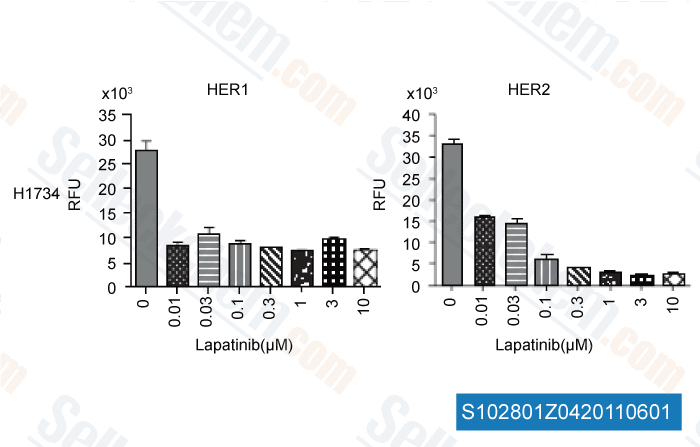
<p>Inhibition of signaling pathway activation in lung tumor cell lines by kinase inhibitors. Lung tumor cells were cultured in 10% FBS until reaching ∼80% confluence and then the cells were starved in serum-free medium for overnight, followed by 4-hour treatment with the inhibitors. Cell lysates were then prepared and used for determination of the pathway activation signals by the CEER assay.</p>

데이터 출처 [ Int J Proteomics , 2011 , 2011, 215496 ]

Sellecks Lapatinib Ditosylate 인용됨 149 출판물

Inactivation of necroptosis-promoting protein MLKL creates a therapeutic vulnerability in colorectal cancer cells [ Cell Death Dis, 2025, 16(1):118] PubMed: 39979285
Multiscale Modeling Uncovers Macrophage Infiltration and TNF-α Signaling Networks for Targeting in Inflammatory Breast Cancer Tumor Emboli [ bioRxiv, 2025, 2025.05.29.656249] PubMed: 40502021
Altered ribosomal profile in acquired resistance and reversal associates with pathological response to chemotherapy in inflammatory breast cancer [ NPJ Breast Cancer, 2024, 10(1):65] PubMed: 39075068
Patient-derived rhabdomyosarcoma cells recapitulate the genetic and transcriptomic landscapes of primary tumors [ iScience, 2024, 27(10):110862] PubMed: 39319271
Profiling of ERBB receptors and downstream pathways reveals selectivity and hidden properties of ERBB4 antagonists [ iScience, 2024, 27(2):108839] PubMed: 38303712
Massively parallel reporter assays identify enhancer elements in oesophageal Adenocarcinoma [ NAR Cancer, 2024, 6(4):zcae041] PubMed: 39417090
Overcoming brain-derived therapeutic resistance in HER2+ breast cancer brain metastasis [ bioRxiv, 2024, 2024.02.19.581073] PubMed: 38529509
Proteomic Assessment of SKBR3/HER2+ Breast Cancer Cellular Response to Lapatinib and Investigational Ipatasertib Kinase Inhibitors [ bioRxiv, 2024, 2024.04.02.587656] PubMed: 38617302
Protocol for identifying properties of ERBB receptor antagonists using the barcoded ERBBprofiler assay [ STAR Protoc, 2024, 5(2):102987] PubMed: 38635397
Analysis and modeling of cancer drug responses using cell cycle phase-specific rate effects [ Nat Commun, 2023, 14(1):3450] PubMed: 37301933

반품 정책
Selleck Chemical의 무조건 반품 정책은 고객에게 원활한 온라인 쇼핑 경험을 보장합니다. 구매에 어떤 식으로든 불만족하시면, 수령일로부터 7일 이내에 모든 품목을 반품하실 수 있습니다. 제품 품질 문제(프로토콜 관련 문제 또는 제품 관련 문제)가 발생하는 경우, 원래 구매일로부터 365일 이내에 모든 품목을 반품하실 수 있습니다. 제품 반품 시 아래 지침을 따르십시오.

배송 및 보관
Selleck 제품은 실온에서 운송됩니다. 실온에서 제품을 받으셨더라도 안심하십시오. Selleck 품질 검사 부서에서 한 달간의 상온 보관이 분말 제품의 생물학적 활성에 영향을 미치지 않음을 확인하는 실험을 수행했습니다. 수령 후, 데이터시트에 설명된 요구 사항에 따라 제품을 보관하십시오. 대부분의 Selleck 제품은 권장 조건에서 안정적입니다.

인간, 수의학 진단 또는 치료 용도로 사용하지 마십시오.