
기술 자료
| 화학식 | C37H42F2N8O4 |
||||||
| 분자량 | 700.78 | CAS 번호 | 171228-49-2 | ||||
| 용해도 (25°C)* | 시험관 내(In vitro) | DMSO | 140 mg/mL (199.77 mM) | ||||
| Water | Insoluble | ||||||
| Ethanol | Insoluble | ||||||
| 생체 내(In Vivo) (개별적으로 순서대로 용매를 제품에 첨가하십시오.) |
|
||||||
|
* <1 mg/ml은 약간 용해되거나 불용해됨을 의미합니다. * Selleck은 모든 화합물의 용해도를 자체적으로 테스트하며, 실제 용해도는 게시된 값과 약간 다를 수 있습니다. 이는 정상적인 현상이며, 약간의 배치 간 변동으로 인해 발생합니다. * 실온 배송 (안정성 테스트 결과 이 제품은 냉각 조치 없이 배송될 수 있음을 보여줍니다.) |
|||||||
원액 준비
생물학적 활성
| 설명 | Posaconazole은 주로 CYP3A4의 억제제이지만, 다른 CYP 효소의 활성을 억제하지는 않습니다; 또한 IC50이 0.25 μM인 스테롤 C14ɑ 탈메틸화효소 억제제입니다. 이 화합물의 평균 말단 제거 반감기는 15-35시간입니다. | ||
|---|---|---|---|
| 표적 |
|
||
| 시험관 내(In vitro) | Posaconazole은 강력한 트리파노시드 활성을 가지고 있습니다. 아미오다론은 이 화합물과 시너지 효과를 냅니다. 또한 T. cruzi에서 Ca2+ 항상성에 영향을 미치고 방해합니다. 이 화학 물질은 기생충 생존에 필수적인 에르고스테롤의 생합성을 차단합니다. 그것은 20 nM의 최소 억제 농도와 14 nM의 IC50으로 에피마스티고트(세포외) 단계의 증식에 명확하고 용량 의존적인 효과를 가집니다. 기생충의 임상적으로 관련된 세포내 아마스티고트 형태에 대해 이 화합물은 훨씬 더 강력합니다. 그것은 3 nM 및 0.25 nM의 최소 억제 농도 및 IC50 값을 가집니다. 플루코나졸, 보리코나졸 및 암포테리신 B에 내성을 보이는 칸디다 및 아스페르길루스 종의 분리주에 대해 활성이 있으며, 다른 트리아졸보다 접합균류에 대해 훨씬 더 활성이 있습니다. |
||
| 생체 내(In Vivo) | 감염된 동물을 아미오다론 단독으로 치료하면 기생충혈증이 감소하고, 감염 후 60일 생존율이 증가하며(미처리 대조군의 0% vs 아미오다론 치료 동물의 40%), Posaconazole과 함께 투여하면 기생충혈증 발달을 지연시킵니다. 이 화합물과 Boost Plus를 함께 투여하면 금식 상태에서 이 화합물 단독 투여에 비해 약물 노출이 증가합니다. 음식, 특히 지방 함량이 높은 식사는 이 화합물의 생체 이용률을 유의하게 증가시킵니다. 이 화합물의 전신 노출은 고지방 식사 및 무지방 식사와 함께 섭취할 때 각각 4배 및 2.6배 증가합니다. 이 화합물과 아미오다론은 낮은 부작용으로 효과적인 항 T. cruzi 치료법을 구성할 수 있습니다. 체중 ≥15 mg/kg의 1일 2회 투여 용량에서 이 화합물은 생쥐의 생존을 연장하고 조직 부담을 줄입니다. |
||
| 특징 | 현재 샤가스병 치료를 위한 가장 진보된 후보입니다. |
프로토콜 (참조)
| 세포 분석: |
|
|---|---|
| 동물 연구: |
|
참조
|
고객 제품 검증
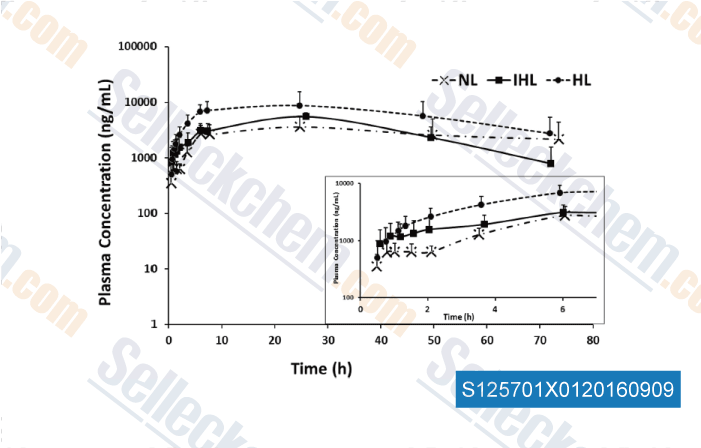
-
데이터 출처 [ , , Eur J Pharm Sci, 2016, 91:190-195. ]
Sellecks Posaconazole 인용됨 28 출판물
| Pyrvinium Pamoate Synergizes with Azoles in vitro and in vivo to Exert Antifungal Efficacy Against Candida auris and Other Candida Species [ Infect Drug Resist, 2025, 18:783-789] | PubMed: 39958982 |
| Interactions between antifungals and everolimus against Cryptococcus neoformans [ Front Cell Infect Microbiol, 2023, 13:1131641] | PubMed: 37026056 |
| The Synergistic Effect of Tacrolimus (FK506) or Everolimus and Azoles Against Scedosporium and Lomentospora Species In Vivo and In Vitro [ Front Cell Infect Microbiol, 2022, 12:864912] | PubMed: 35493742 |
| Synergistic effect of pyrvinium pamoate and posaconazole against Cryptococcus neoformans in vitro and in vivo [ Front Cell Infect Microbiol, 2022, 12:1074903] | PubMed: 36569209 |
| Terconazole, an Azole Antifungal Drug, Increases Cytotoxicity in Antimitotic Drug-Treated Resistant Cancer Cells with Substrate-Specific P-gp Inhibitory Activity [ Int J Mol Sci, 2022, 23(22)13809] | PubMed: 36430288 |
| A Preliminary in vitro and in vivo Evaluation of the Effect and Action Mechanism of 17-AAG Combined With Azoles Against Azole-Resistant Candida spp [ Front Microbiol, 2022, 13:825745] | PubMed: 35875545 |
| The synergistic effect of minocycline and azole antifungal drugs against Scedosporium and Lomentospora species [ BMC Microbiol, 2022, 22(1):21] | PubMed: 35016611 |
| The Role of Isavuconazonium Sulphate for the Treatment of Blastomycosis: A Case Series and Antifungal Susceptibility [ Open Forum Infect Dis, 2022, 9(7):ofac220] | PubMed: 35821730 |
| In Vitro and In Vivo Interactions of TOR Inhibitor AZD8055 and Azoles against Pathogenic Fungi [ Microbiol Spectr, 2022, 10(1):e0200721] | PubMed: 35019705 |
| Antifungal Activity of Minocycline and Azoles Against Fluconazole-Resistant Candida Species [ Front Microbiol, 2021, 12:649026] | PubMed: 34054751 |
반품 정책
Selleck Chemical의 무조건 반품 정책은 고객에게 원활한 온라인 쇼핑 경험을 보장합니다. 구매에 어떤 식으로든 불만족하시면, 수령일로부터 7일 이내에 모든 품목을 반품하실 수 있습니다. 제품 품질 문제(프로토콜 관련 문제 또는 제품 관련 문제)가 발생하는 경우, 원래 구매일로부터 365일 이내에 모든 품목을 반품하실 수 있습니다. 제품 반품 시 아래 지침을 따르십시오.
배송 및 보관
Selleck 제품은 실온에서 운송됩니다. 실온에서 제품을 받으셨더라도 안심하십시오. Selleck 품질 검사 부서에서 한 달간의 상온 보관이 분말 제품의 생물학적 활성에 영향을 미치지 않음을 확인하는 실험을 수행했습니다. 수령 후, 데이터시트에 설명된 요구 사항에 따라 제품을 보관하십시오. 대부분의 Selleck 제품은 권장 조건에서 안정적입니다.
인간, 수의학 진단 또는 치료 용도로 사용하지 마십시오.