
uitsluitend voor onderzoeksdoeleinden
GSK126 EZH2-remmer
Cat.Nr.S7061
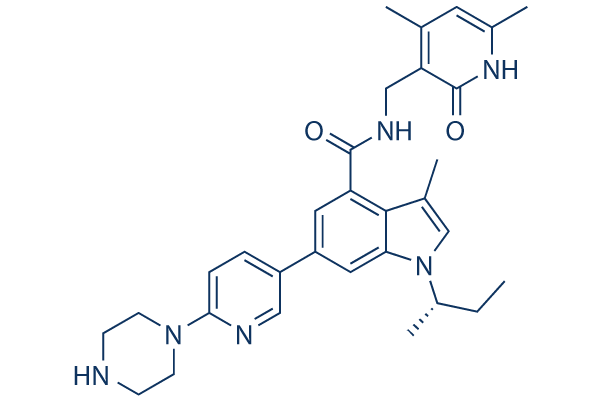
Chemische structuur
Moleculair gewicht: 526.67
Kwaliteitscontrole
| Gerelateerde doelwitten | HDAC JAK BET Histone Methyltransferase PKC PARP HIF PRMT AMPK Histone Acetyltransferase |
|---|---|
| Overige EZH2 Inhibitoren | PF-06821497 Tulmimetostat (CPI-0209) Valemetostat (DS-3201) GSK343 Lirametostat (CPI-1205) EBI-2511 EZH2/HSP90-IN-29 SHR2554 |
Celkweek, behandeling & werkconcentratie
| Cellijnen | Assaytype | Concentratie | Incubatietijd | Formulering | Activiteitsbeschrijving | PMID |
|---|---|---|---|---|---|---|
| human U87MG cells | Cytotoxic assay | 72 h | Cytotoxicity against human U87MG cells assessed as growth inhibition after 72 hrs by WST-1 assay, GI50=28.5 μM. | 24767850 | ||
| human A549 cells | Cytotoxic assay | 72 h | Cytotoxicity against human A549 cells assessed as growth inhibition after 72 hrs by WST-1 assay, GI50=18.7 μM. | 24767850 | ||
| human T98G cells | Cytotoxic assay | 72 h | Cytotoxicity against human T98G cells assessed as growth inhibition after 72 hrs by WST-1 assay, GI50=12.6 μM. | 24767850 | ||
| human Daudi cells | Cytotoxic assay | 72 h | Cytotoxicity against human Daudi cells assessed as growth inhibition after 72 hrs by WST-1 assay, GI50=11.2 μM. | 24767850 | ||
| human PC3 cells | Cytotoxic assay | 72 h | Cytotoxicity against human PC3 cells assessed as growth inhibition after 72 hrs by WST-1 assay, GI50=9.4 μM. | 24767850 | ||
| human U2932 cells | Cytotoxic assay | 72 h | Cytotoxicity against human U2932 cells assessed as growth inhibition after 72 hrs by WST-1 assay, GI50=6.7 μM. | 24767850 | ||
| human HeLa cells | Function assay | 72 h | Inhibition of EZH2 in human HeLa cells assessed as reduction in H3K27me3 levels incubated for 72 hrs by ELISA method, IC50=0.28 μM. | 26189078 | ||
| human Pfeiffer cells | Cytotoxic assay | 72 h | Cytotoxicity against human Pfeiffer cells expressing EZH2 A667G mutant assessed as growth inhibition after 72 hrs by WST-1 assay, GI50=0.18 μM. | 24767850 | ||
| infected SF9 cells | Binding affinity to EZH2 (unknown origin) expressed in baculovirus infected SF9 cells co-expressing SUZ12/EED/RbAp48 complex assessed as binding off-rate at 0.4 uM incubated for 20 mins by Q-TOF mass spectrometry | 27512831 | ||||
| A673 cells | qHTS of pediatric cancer cell lines to identify multiple opportunities for drug repurposing: Primary screen for A673 cells | 29435139 | ||||
| DAOY cells | qHTS of pediatric cancer cell lines to identify multiple opportunities for drug repurposing: Primary screen for DAOY cells | 29435139 | ||||
| Saos-2 cells | qHTS of pediatric cancer cell lines to identify multiple opportunities for drug repurposing: Primary screen for Saos-2 cells | 29435139 | ||||
| BT-37 cells | qHTS of pediatric cancer cell lines to identify multiple opportunities for drug repurposing: Primary screen for BT-37 cells | 29435139 | ||||
| RD cells | qHTS of pediatric cancer cell lines to identify multiple opportunities for drug repurposing: Primary screen for RD cells | 29435139 | ||||
| SK-N-SH cells | qHTS of pediatric cancer cell lines to identify multiple opportunities for drug repurposing: Primary screen for SK-N-SH cells | 29435139 | ||||
| BT-12 cells | qHTS of pediatric cancer cell lines to identify multiple opportunities for drug repurposing: Primary screen for BT-12 cells | 29435139 | ||||
| MG 63 (6-TG R) cells | qHTS of pediatric cancer cell lines to identify multiple opportunities for drug repurposing: Primary screen for MG 63 (6-TG R) cells | 29435139 | ||||
| NB1643 cells | qHTS of pediatric cancer cell lines to identify multiple opportunities for drug repurposing: Primary screen for NB1643 cells | 29435139 | ||||
| OHS-50 cells | qHTS of pediatric cancer cell lines to identify multiple opportunities for drug repurposing: Primary screen for OHS-50 cells | 29435139 | ||||
| Rh41 cells | qHTS of pediatric cancer cell lines to identify multiple opportunities for drug repurposing: Primary screen for Rh41 cells | 29435139 | ||||
| SK-N-MC cells | qHTS of pediatric cancer cell lines to identify multiple opportunities for drug repurposing: Primary screen for SK-N-MC cells | 29435139 | ||||
| LAN-5 cells | qHTS of pediatric cancer cell lines to identify multiple opportunities for drug repurposing: Primary screen for LAN-5 cells | 29435139 | ||||
| Klik om meer experimentele gegevens over de cellijn te bekijken | ||||||
Chemische informatie, Opslag en Stabiliteit
| Moleculair gewicht | 526.67 | Formule | C31H38N6O2 |
Opslag (Vanaf de ontvangstdatum) | |
|---|---|---|---|---|---|
| CAS-nr. | 1346574-57-9 | SDF downloaden | Opslag van stamoplossingen |
|
|
| Synoniemen | GSK2816126A, GSK2816126 | Smiles | CCC(C)N1C=C(C2=C(C=C(C=C21)C3=CN=C(C=C3)N4CCNCC4)C(=O)NCC5=C(C=C(NC5=O)C)C)C | ||
Oplosbaarheid
|
In vitro |
DMSO
: 5 mg/mL
(9.49 mM)
Ethanol : 4 mg/mL Water : Insoluble |
Molariteitscalculator
|
In vivo |
|||||
In vivo Formuleringscalculator (Heldere oplossing)
Stap 1: Voer de onderstaande informatie in (Aanbevolen: Een extra dier voor het geval van verlies tijdens het experiment)
Stap 2: Voer de in vivo formulering in (Dit is alleen de calculator, geen formulering. Neem eerst contact met ons op als er geen in vivo formulering is in het gedeelte Oplosbaarheid.)
Berekeningsresultaten:
Werkconcentratie: mg/ml;
Methode voor het bereiden van DMSO-mastervloeistof: mg geneesmiddel vooraf opgelost in μL DMSO ( Concentratie mastervloeistof mg/mL, Neem eerst contact met ons op als de concentratie de DMSO-oplosbaarheid van de partij geneesmiddel overschrijdt. )
Methode voor het bereiden van in vivo formulering: Neem μL DMSO mastervloeistof, voeg vervolgens toeμL PEG300, mengen en helder maken, voeg vervolgens toeμL Tween 80, mengen en helder maken, voeg vervolgens toe μL ddH2O, mengen en helder maken.
Methode voor het bereiden van in vivo formulering: Neem μL DMSO mastervloeistof, voeg vervolgens toe μL Maïsolie, mengen en helder maken.
Opmerking: 1. Zorg ervoor dat de vloeistof helder is voordat u het volgende oplosmiddel toevoegt.
2. Zorg ervoor dat u het/de oplosmiddel(en) in de juiste volgorde toevoegt. U moet ervoor zorgen dat de verkregen oplossing, bij de vorige toevoeging, een heldere oplossing is voordat u verdergaat met het toevoegen van het volgende oplosmiddel. Fysische methoden zoals vortexen, echografie of een warmwaterbad kunnen worden gebruikt om het oplossen te bevorderen.
Werkingsmechanisme
| Targets/IC50/Ki |
EZH2
(Cell-free assay) 9.9 nM
|
|---|---|
| In vitro |
In vitro remt GSK126 het meest potent H3K27me3, gevolgd door H3K27me2 in zowel EZH2 wild-type als mutante DLBCL-cellijnen. Deze verbinding remt ook effectief de proliferatie van EZH2-mutante DLBCL-cellijnen, en induceert transcriptionele activering van EZH2-doelgenen in gevoelige cellijnen. In A687V EZH2-mutante cellen resulteert deze behandeling in een globale afname van H3K27me3, robuuste genactivatie, caspase-activering en verminderde proliferatie. In parentale H2087-cellen remt het de expressie van VEGF-A en gefosforyleerd Ser(473)-AKT, en veroorzaakt zo de remming van celproliferatie, migratie en metastase.
|
| Kinase Assay |
EZH2 assay
|
|
Het vijfledige PRC2-complex (Flag–EZH2, EED, SUZ12, AEBP2, RbAp48) dat ofwel wild-type ofwel mutant EZH2 bevat, wordt bereid. GSK126 wordt opgelost in DMSO en getest in concentraties van 0,6 nM tot 300 nM met een uiteindelijke DMSO-concentratie van 2,5%. In tegenstelling tot wild-type EZH2 dat in vitro H3K27me0 als substraat verkiest, verkiezen EZH2 Y641-mutanten H3K27me2 en hebben ze weinig activiteit met H3K27me0 of H3K27me1. De A677G-mutant verschilt van zowel de wild-type als de Y641-mutante vormen van EZH2, doordat deze efficiënt H3K27me0, H3K27me1 en H3K27me2 methyliseert; daarom worden histone H3-peptiden (residuen 21–44; 10 μM eindconcentratie) met ofwel K27me0 (wild type, A677G EZH2), K27me1 (A677G EZH2), of K27me2 (A677G, Y641N, Y641C, Y641H, Y641S en Y641F EZH2) gebruikt als methyltransferasesubstraten. Deze verbinding wordt aan platen toegevoegd, gevolgd door toevoeging van 6 nM EZH2-complex en peptide. Aangezien de potentie van deze chemische stof op of nabij de strakke bindingslimiet van een assay bij [SAM] = Km ligt, worden IC50-waarden gemeten bij een hoge concentratie van het competitieve substraat SAM ten opzichte van zijn Km (7,5 μM SAM waarbij de SAM Km 0,3 μM is). Onder deze omstandigheden wordt de bijdrage van de enzymconcentratie relatief klein en kunnen nauwkeurige schattingen van Ki worden berekend. Reacties worden geïnitieerd met [3H]-SAM, 30 min geïncubeerd, geblust met de toevoeging van 500-voudig overmaat ongelabeld SAM, en het gemethyleerde productpeptide wordt op fosfocellulosefilters gevangen volgens het door de leverancier geleverde protocol voor MSPH Multiscreen-platen. Platen worden afgelezen op een TopCount na toevoeging van 20 μL Microscint-20 cocktail. Apparente Ki-waarden worden berekend met behulp van de Cheng–Prusoff-relatie voor een competitieve remmer. IC50=Ki (1+[S]/Km)+[E]/2, waarbij E het enzym is en S het substraat.
|
|
| In vivo |
Bij muizen met KARPAS-422 en Pfeiffer xenografts vermindert GSK126 (150 mg/kg/d, i.p.) de globale H3K27me3, verhoogt het de genexpressie en veroorzaakt zo een aanzienlijke tumorregressie.
|
Referenties |
|
Toepassingen
| Methoden | Biomarkers | Afbeeldingen | PMID |
|---|---|---|---|
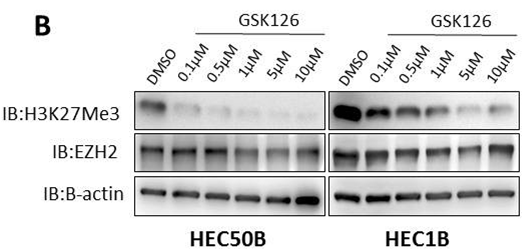
| Western blot | H3K27Me3 / EZH2 XIAP / Survivin / MCL-1 / BID / BIM / BAX / BCL-xl/ Bcl-2 β-catenin / c-Myc / LEF1 / DVL2 / DVL3 / p-GSK3β |
|
28418882 |
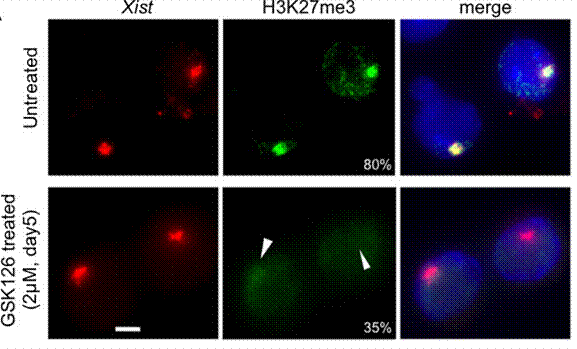
| Immunofluorescence | H3K27me3 |
|
25053977 |
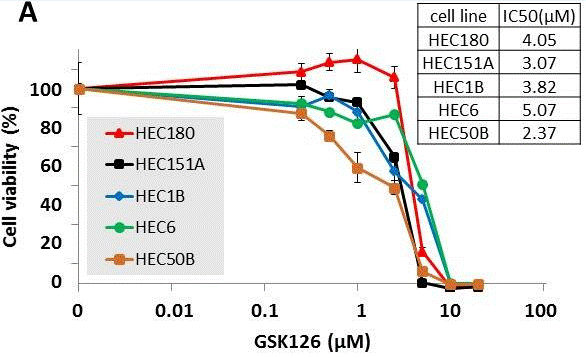
| Growth inhibition assay | Cell viability Cell proliferation |
|
28418882 |
Informatie klinische proef
(gegevens van https://clinicaltrials.gov, bijgewerkt op 2024-05-22)
| NCT-nummer | Rekrutering | Aandoeningen | Sponsor/Medewerkers | Startdatum | Fasen |
|---|---|---|---|---|---|
| NCT02082977 | Terminated | Cancer|Neoplasms |
GlaxoSmithKline |
April 24 2014 | Phase 1 |
Technische ondersteuning
Tel: +1-832-582-8158 Ext:3
Als u nog andere vragen heeft, kunt u een bericht achterlaten.
Veelgestelde vragen
Vraag 1:
Could you please suggest a vehicle for in vivo uses of this compound without oil?
Antwoord:
It could be dissolved in 4% DMSO+30% PEG 300+ddH2O (0.5mg/ml).
Vraag 2:
Does this compound require an activation step to be functional? For example, an acidic or basic environment.
Antwoord:
It does not require an activation step to be functional.

Producten zijn uitsluitend voor onderzoeksdoeleinden. Niet voor menselijk gebruik. Wij verkopen niet aan patiënten.
©Copyright 2013 Selleck Chemicals. Alle rechten voorbehouden.