Phosphatidylinositol 3-kinase (PI 3-kinase or PI3K) is a famous target which is the upstream of akt because PI3K can activate Akt when PI3K is activated by growth factors including EGF, IGF, TGF-α and so on. The activation Class IA PI3Ks by growth factors is receptor tyrosine kinase (RTK)-dependent activation. Class IB PI3K is primarily regulated by small G-proteins such as Ras. PI3K is a key enzyme involved in cell processes, apoptosis and cancer. PI3K with mTOR, akt and MEK plays a key role in cancer. [show the full text]

PI3K inhibiteurs/activateurs (PI3K Inhibitors/Activators)
| N° de cat. | Nom du produit | Informations | Citations dutilisation du produit | Validations de produit |
|---|---|---|---|---|
| S8668 | GDC-0077 (Inavolisib) | Inavolisib (GDC-0077, RG6114, RO-7113755)는 0.038 nM의 IC50을 가진 강력하고 선택적인 PI3K alpha (PI3Kα) 억제제입니다. GDC-0077은 다른 클래스 I PI3K 동형(베타, 델타 및 감마)에 비해 PI3K alpha에 대해 >300배 더 선택적이며, PIK 계열 구성원에 비해 >2000배 더 선택적입니다. GDC-0077은 PI3K의 ATP 결합 부위에 결합하여 PIP2의 PIP3로의 인산화를 억제합니다. |
|
|
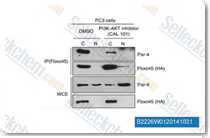
| S2226 | CAL-101 (Idelalisib) | Idelalisib (CAL-101)은 무세포 분석에서 IC50가 2.5 nM인 선택적 p110δ 억제제입니다. p110α/β/γ에 비해 p110δ에 대한 선택성이 40~300배 더 높고, C2β, hVPS34, DNA-PK 및 mTOR에 비해 p110δ에 대한 선택성이 400~4000배 더 높은 것으로 나타났습니다. Idelalisib은 또한 autophagy를 자극합니다. |
|
|
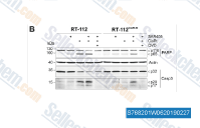
| S7682 | SAR405 | SAR405는 고도로 선택적인 PIK3C3/Vps34(KD 1.5nM)의 저분자량 키나아제 억제제로, 클래스 I 및 클래스 II PI3K뿐만 아니라 mTOR에서도 10μM까지 활성을 나타내지 않습니다. SAR405는 자가포식을 방지하고 종양 세포에서 MTOR(라파마이신의 기계적 표적) 억제와 시너지 효과를 나타냅. |
|
|
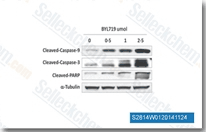
| S2814 | Alpelisib (BYL719) | Alpelisib (BYL719)는 세포 비증식성 분석에서 5 nM의 IC50을 갖는 강력하고 선택적인 PI3Kα 억제제이며, PI3Kβ/γ/δ에 대한 영향은 미미합니다. 이 화합물은 2상에 있습니다. |
|
|
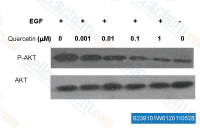
| S2391 | Quercetin (Sophoretin) | 채소, 과일 및 와인에 존재하는 천연 플라보노이드인 Quercetin은 재조합 SIRT1의 자극제이자 IC50 2.4-5.4 μM의 PI3K 억제제입니다. Quercetin은 mitophagy, apoptosis 및 보호 autophagy를 유도합니다. 4단계. |
|
|
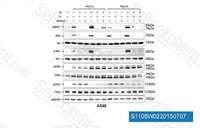
| S1105 | LY294002 | LY294002 (SF 1101, NSC 697286)는 각각 0.5 μM/0.57 μM/0.97 μM의 IC50으로 PI3Kα/δ/β를 억제하는 것으로 알려진 최초의 합성 분자이며, 워트마닌보다 용액에서 더 안정하고 자가포식체 형성을 차단합니다. 이는 Class I PI3K 및 기타 PI3K 관련 키나아제뿐만 아니라 PI3K 계열과 관련이 없어 보이는 새로운 표적에도 결합합니다. 이 화합물은 또한 98 nM의 IC50으로 CK2를 억제합니다. 이는 비특이적인 DNA-PKcs 억제제이며 autophagy 및 apoptosis를 활성화합니다. |
|
|
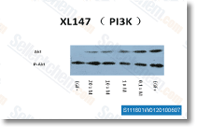
| S1118 | XL147 analogue | XL147 analogue (SAR245408)는 무세포 분석에서 PI3Kα/δ/γ에 대해 IC50 39 nM/36 nM/23 nM을 나타내는 선택적이고 가역적인 Class I PI3K 억제제이며, PI3Kβ에는 덜 강력합니다. 이 화합물은 apoptosis를 유도합니다. 1/2상. |
|
|
| E1815 | Tersolisib (STX-478) | Tersolisib (STX-478)은 PI3Kα의 고도로 강력하고 돌연변이 선택적인 알로스테릭 억제제로, 유행하는 PI3Kα 돌연변이 형태를 선택적으로 표적합니다. H1047R 변이를 포함한 일반적인 PI3Kα 나선형 및 키나아제 도메인 돌연변이에 대해 9.4 nmol/L의 IC50 값으로 강력한 효능을 보입니다. STX-478은 야생형에 비해 돌연변이 PI3Kα에 대해 14배 더 높은 선택성을 나타냅니다. 이는 대사 기능 장애를 막고 PI3Kα-돌연변이 이종이식편에서 치료 반응을 개선합니다. | ||
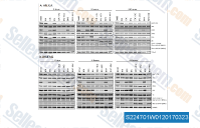
| S2247 | Buparlisib (BKM120) | Buparlisib (BKM120, NVP-BKM120)은 무세포 분석에서 각각 52 nM/166 nM/116 nM/262 nM의 IC50을 가진 p110α/β/δ/γ의 선택적 PI3K 억제제입니다. VPS34, mTOR, DNAPK에 대한 효능이 감소하고 PI4Kβ에 대한 활성은 거의 없습니다. Buparlisib은 세포자멸사를 유도합니다. 2상. |
|
|
| S7865 | 740 Y-P (PDGFR 740Y-P) | 740 Y-P (PDGFR 740Y-P, 740YPDGFR)는 PI3K의 세포 투과성 포스포펩타이드 활성제입니다. |
|
|
Phosphatidylinositol 3-kinases (PI3Ks) are a family of lipid kinases whose biological function is to phosphorylate the 3-hydroxyl group of phosphoinositide. It is proved that PI3K-dependent signaling pathway contributes to many cellular processes such as cell growth, proliferation, differentiation, motility, survival and intracellular trafficking, which might be involved in oncogenesis under certain situation[1]. When a growth factor or ligand binds to the tyrosine kinase receptors (RTK), the PI3K is activated by G protein-coupled receptors[2]. PI3Ks family is generally divided into Class I, Class II, and Class III according to their primary structure, regulation, and in vitro lipid substrate specificity[2]. Class I PI3Ks are heterodimeric molecules composed of a regulatory subunit (p85) and a catalytic subunit (p110). The regulatory subunit of PI3K could be further divided in to six subtypes: p85-α, p85-β, p55-γ, p150,p101 and p87. P85α is the most highly expressed regulatory subunit than the others. And the catalytic subunit could also further divided into four subtypes: p110-α, p110-β, p110-γ and p110-δ. The α and β isoforms of p110 are expressed in all kinds of cells, whereas δ is only found in leukocytes. The regulatory subunit p101 and catalytic subunit p110γ comprise a complex which is classified as Class IB PI3K. Other collocations of regulatory and catalytic subunits are called Class IA PI3Ks. However, class II is structurally different from Class I. There are three catalytic isoforms of Class II PI3Ks: PI3K-C2α, -C2β, and -C2γ, but no regulatory subunit. Class III is structurally similar to Class I for the reason that it is composed of a catalytic (Vps34) and a regulatory subunit (p150). Functionally, class I PI3Ks catalyze the production of phosphatidylinositol 3-phosphate (PtdIns-3,4-P), phosphatidylinositol (3,4)-bisphosphate (PtdIns-3,4-P2), and phosphatidylinositol (3,4,5)-triphosphate (PtdIns-3,4,5-P3). Class II is related to the production of PtdIns-3-P and PtdIns-3,4-P2, while class III specifically catalyzes the production of PtdIns-3,4-P2 [3-5].

Les produits sont destinés à la recherche uniquement. Non destinés à lusage humain. Nous ne vendons pas aux patients.
©Copyright 2013 Selleck Chemicals. Tous droits réservés.