
uitsluitend voor onderzoeksdoeleinden
NVP-AEW541 IGF-1R remmer
Cat.Nr.S1034
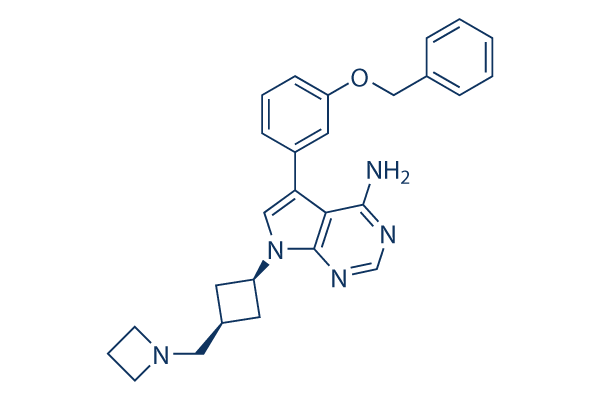
Chemische structuur
Moleculair gewicht: 439.55
Kwaliteitscontrole
| Gerelateerde doelwitten | EGFR VEGFR PDGFR FGFR c-Met Src MEK CSF-1R FLT3 HER2 |
|---|---|
| Overige IGF-1R Inhibitoren | Linsitinib (OSI-906) BMS-536924 BMS-754807 Picropodophyllin (AXL1717) GSK1904529A AG-1024 NVP-ADW742 NT157 PQ 401 MSDC-0160 |
Celkweek, behandeling & werkconcentratie
| Cellijnen | Assaytype | Concentratie | Incubatietijd | Formulering | Activiteitsbeschrijving | PMID |
|---|---|---|---|---|---|---|
| NWT-21 | Kinase assay | ~10 μM | DMSO | inhibits IGF-IR with IC50 of 0.086 ± 0.028 μM | 15050915 | |
| A14 | Kinase assay | ~10 μM | DMSO | inhibits InsR with IC50 of 2.3 ± 0.163 μM | 15050915 | |
| A431 | Kinase assay | ~10 μM | DMSO | inhibits HER1 with IC50 of >10 μM | 15050915 | |
| A31 | Kinase assay | ~10 μM | DMSO | inhibits PDGFR with IC50 of >10 μM | 15050915 | |
| GIST882 | Kinase assay | ~10 μM | DMSO | inhibits c-Kit with IC50 of >5 μM | 15050915 | |
| 32D-Bcr-Abl | Kinase assay | ~10 μM | DMSO | inhibits Bcr-Abl p210 with IC50 of >10 μM | 15050915 | |
| MCF-7 | Cytoxicity assay | DMSO | IC50=1.64 μM | 15050915 | ||
| NWT-21 | Growth inhibitory assay | DMSO | IC50=0.163 μM | 15050915 | ||
| TC-71 | Growth inhibitory assay | ~1 μM | DMSO | inhibits insulin-like growth factor-I–mediated growth | 15867386 | |
| TC-71 | Growth inhibitory assay | ~7 μM | DMSO | IC50<0.5 μM | 15867386 | |
| Saos-2 | Growth inhibitory assay | ~7 μM | DMSO | IC50<3 μM | 15867386 | |
| U-2OS | Growth inhibitory assay | ~7 μM | DMSO | IC50<0.5 μM | 15867386 | |
| SK-ES-1 | Growth inhibitory assay | ~7 μM | DMSO | IC50<0.5 μM | 15867386 | |
| SK-N-MC | Growth inhibitory assay | ~7 μM | DMSO | IC50<0.5 μM | 15867386 | |
| RD-ES | Growth inhibitory assay | ~7 μM | DMSO | IC50<0.5 μM | 15867386 | |
| SJ-Rh 30 | Growth inhibitory assay | ~7 μM | DMSO | IC50<0.5 μM | 15867386 | |
| SJ-Rh 4 | Growth inhibitory assay | ~7 μM | DMSO | IC50<0.5 μM | 15867386 | |
| 6647 | Growth inhibitory assay | ~7 μM | DMSO | IC50<0.5 μM | 15867386 | |
| SARG | Growth inhibitory assay | ~7 μM | DMSO | IC50<3 μM | 15867386 | |
| MOS | Growth inhibitory assay | ~7 μM | DMSO | IC50<4 μM | 15867386 | |
| IOR/OS7 | Growth inhibitory assay | ~7 μM | DMSO | IC50<1 μM | 15867386 | |
| IOR/OS9 | Growth inhibitory assay | ~7 μM | DMSO | IC50<6 μM | 15867386 | |
| IOR/OS10 | Growth inhibitory assay | ~7 μM | DMSO | IC50<5 μM | 15867386 | |
| IOR/OS14 | Growth inhibitory assay | ~7 μM | DMSO | IC50<4 μM | 15867386 | |
| LAP35 | Growth inhibitory assay | ~7 μM | DMSO | IC50<0.5 μM | 15867386 | |
| IOR/BRZ | Growth inhibitory assay | ~7 μM | DMSO | IC50<0.5 μM | 15867386 | |
| IOR/CAR | Growth inhibitory assay | ~7 μM | DMSO | IC50<1 μM | 15867386 | |
| IOR/NGR | Growth inhibitory assay | ~7 μM | DMSO | IC50<0.5 μM | 15867386 | |
| IOR/RCH | Growth inhibitory assay | ~7 μM | DMSO | IC50<0.5 μM | 15867386 | |
| RMZ-RC2 | Growth inhibitory assay | ~7 μM | DMSO | IC50<0.5 μM | 15867386 | |
| CCA | Growth inhibitory assay | ~7 μM | DMSO | IC50<2 μM | 15867386 | |
| RD/18 | Growth inhibitory assay | ~7 μM | DMSO | IC50<4 μM | 15867386 | |
| OVCAR-3 | Growth inhibitory assay | ~15 μM | DMSO | inhibits cell proliferation | 16300820 | |
| OVCAR-4 | Growth inhibitory assay | ~15 μM | DMSO | inhibits cell proliferation | 16300820 | |
| OVCAR-3 | Apoptosis assay | ~15 μM | DMSO | induces apoptosis | 16300820 | |
| OVCAR-4 | Apoptosis assay | ~15 μM | DMSO | induces apoptosis | 16300820 | |
| OVCAR-3 | Function assay | ~15 μM | DMSO | Decreases phosphorylation of AKT | 16300820 | |
| Huh-7 | Growth inhibitory assay | ~10 μM | DMSO | IC50=1.4 μM | 16530734 | |
| Hep-G2 | Growth inhibitory assay | ~10 μM | DMSO | IC50=1.8 μM | 16530734 | |
| Hep-3B | Growth inhibitory assay | ~10 μM | DMSO | IC50=1.9 μM | 16530734 | |
| SK-Hep-1 | Growth inhibitory assay | ~10 μM | DMSO | IC50=6.9 μM | 16530734 | |
| Huh-7 | Function assay | ~10 μM | DMSO | Induces cell cycle arrest | 16530734 | |
| Hep-G2 | Function assay | ~10 μM | DMSO | Induces cell cycle arrest | 16530734 | |
| SK-Hep-1 | Function assay | ~10 μM | DMSO | Induces cell cycle arrest | 16530734 | |
| BON | Kinase assay | ~6 μM | DMSO | induces dephosphorylation of IGF-1R | 16601284 | |
| BON | Growth inhibitory assay | ~10 μM | DMSO | IC50=6.6 μM | 16601284 | |
| CM | Growth inhibitory assay | ~5 μM | DMSO | IC50=3.3 μM | 16601284 | |
| BON | Function assay | ~7.5 μM | DMSO | induces cell cycle arrest | 16601284 | |
| CM | Function assay | ~5 μM | DMSO | induces cell cycle arrest | 16601284 | |
| BON | Apoptosis assay | ~7.5 μM | DMSO | induces Apoptosis | 16601284 | |
| CM | Apoptosis assay | ~5 μM | DMSO | induces Apoptosis | 16601284 | |
| HT-29 | Growth inhibitory assay | ~10 μM | DMSO | IC50=1.7 μM | 17007015 | |
| HCT-116 | Growth inhibitory assay | ~10 μM | DMSO | IC50=2.5 μM | 17007015 | |
| primary colorectal cancer cells | Function assay | ~5 μM | DMSO | alters the morphology of the remaining cells | 17007015 | |
| HTLA-230 | Function assay | ~8 μM | DMSO | inhibits IGF-II-mediated stimulation of IGF-IR and Akt | 17121898 | |
| KCNR | Function assay | ~8 μM | DMSO | inhibits IGF-II-mediated stimulation of IGF-IR and Akt | 17121898 | |
| SK-N-BE2c | Function assay | ~8 μM | DMSO | inhibits IGF-II-mediated stimulation of IGF-IR and Akt | 17121898 | |
| SK-N-BE | Function assay | ~8 μM | DMSO | inhibits IGF-II-mediated stimulation of IGF-IR and Akt | 17121898 | |
| LAN-5 | Function assay | ~8 μM | DMSO | inhibits IGF-II-mediated stimulation of IGF-IR and Akt | 17121898 | |
| GI-CA-N | Function assay | ~8 μM | DMSO | inhibits IGF-II-mediated stimulation of IGF-IR and Akt | 17121898 | |
| SH-EP | Function assay | ~8 μM | DMSO | inhibits IGF-II-mediated stimulation of IGF-IR and Akt | 17121898 | |
| SK-N-AS | Function assay | ~8 μM | DMSO | inhibits IGF-II-mediated stimulation of IGF-IR and Akt | 17121898 | |
| RN-GA | Function assay | ~8 μM | DMSO | inhibits IGF-II-mediated stimulation of IGF-IR and Akt | 17121898 | |
| SY-5Y(N) | Function assay | ~8 μM | DMSO | inhibits IGF-II-mediated stimulation of IGF-IR and Akt | 17121898 | |
| GI-CA-N | Growth inhibitory assay | ~8 μM | DMSO | IC50= 6.8 μM | 17121898 | |
| SH-EP | Growth inhibitory assay | ~8 μM | DMSO | IC50= 3 μM | 17121898 | |
| HTLA-230 | Growth inhibitory assay | ~8 μM | DMSO | IC50= 0.5 μM | 17121898 | |
| SK-N-BE2c | Growth inhibitory assay | ~8 μM | DMSO | IC50= 1.1 μM | 17121898 | |
| SK-N-BE2 | Growth inhibitory assay | ~8 μM | DMSO | IC50= 3 μM | 17121898 | |
| SY-5Y (N) | Growth inhibitory assay | ~8 μM | DMSO | IC50= 2.4 μM | 17121898 | |
| LAN-5 | Growth inhibitory assay | ~8 μM | DMSO | IC50= 0.4 μM | 17121898 | |
| KCNR | Growth inhibitory assay | ~8 μM | DMSO | IC50= 0.4 μM | 17121898 | |
| RN-GA | Growth inhibitory assay | ~8 μM | DMSO | IC50= 1.3 μM | 17121898 | |
| SK-N-AS | Growth inhibitory assay | ~8 μM | DMSO | induces apoptosis | 17121898 | |
| KCNR | Apoptosis assay | ~8 μM | DMSO | induces apoptosis | 17121898 | |
| GI-CA-N | Apoptosis assay | ~8 μM | DMSO | induces apoptosis | 17121898 | |
| HTLA-230 | Apoptosis assay | ~8 μM | DMSO | induces apoptosis | 17121898 | |
| SK-N-BE2c | Apoptosis assay | ~8 μM | DMSO | induces apoptosis | 17121898 | |
| SY-5Y (N) | Apoptosis assay | ~8 μM | DMSO | induces apoptosis | 17121898 | |
| HL60AR | Function assay | 160 nM | enhances the levels of p27Kip1 | 17361225 | ||
| HL60AR | Apoptosis assay | ~200 nM | induces apoptosis | 17361225 | ||
| HPAF-II | Kinase assay | ~1 μM | DMSO | inhibits IGF-I-mediated signalling | 18445520 | |
| HPAF-II | Growth inhibitory assay | ~2 μM | DMSO | inhibits cell proliferation | 18445520 | |
| HPAF-II | Function assay | ~2 μM | DMSO | inhibits basal and IGF-I-mediated pancreatic cancer cell migration | 18445520 | |
| TFK-1 | Growth inhibitory assay | ~250 nM | DMSO | IC50=0.26 μM | 20066734 | |
| EGI-1 | Growth inhibitory assay | ~250 nM | DMSO | IC50=0.28 μM | 20066734 | |
| CC-LP-1 | Growth inhibitory assay | ~250 nM | DMSO | IC50=0.15 μM | 20066734 | |
| CC-SW-1 | Growth inhibitory assay | ~250 nM | DMSO | IC50=0.54 μM | 20066734 | |
| Sk-ChA-1 | Growth inhibitory assay | ~250 nM | DMSO | IC50=0.2 μM | 20066734 | |
| Mz-ChA-1 | Growth inhibitory assay | ~250 nM | DMSO | IC50=1.39 μM | 20066734 | |
| Mz-ChA-2 | Growth inhibitory assay | ~250 nM | DMSO | IC50=0.73 μM | 20066734 | |
| ECC-1 | Kinase assay | ~10 μM | DMSO | inhibits IGF-IR activation by 98% | 21295335 | |
| Ishikawa | Kinase assay | ~10 μM | DMSO | inhibits IGF-IR activation by 93% | 21295335 | |
| USPC-1 | Kinase assay | ~10 μM | DMSO | inhibits IGF-IR activation by 100% | 21295335 | |
| USPC-2 | Kinase assay | ~10 μM | DMSO | inhibits IGF-IR activation by 96% | 21295335 | |
| ECC-1 | Growth inhibitory assay | ~10 μM | DMSO | decreases cell proliferation | 21295335 | |
| Ishikawa | Growth inhibitory assay | ~10 μM | DMSO | decreases cell proliferation | 21295335 | |
| USPC-1 | Growth inhibitory assay | ~10 μM | DMSO | decreases cell proliferation | 21295335 | |
| USPC-2 | Growth inhibitory assay | ~10 μM | DMSO | decreases cell proliferation | 21295335 | |
| Ba/F3 | Function assay | Inhibition of full length IGF-1 receptor (unknown origin) transfected in Ba/F3 cells assessed as cell proliferation, IC50=0.02μM | 26951753 | |||
| HEK293 | Function assay | 60 mins | Inhibition of full length IGF-1 receptor (unknown origin) autophosphorylation transfected in HEK293 cells pretreated for 60 mins followed by IGF-1 stimulation measured after 10 mins by quantitative Western blot analysis, IC50=0.065μM | 26951753 | ||
| HEK293 | Function assay | Displacement of [3H]-dofetilide from human ERG channel expressed in HEK293 cells, IC50=0.13μM | 26951753 | |||
| Ba/F3 | Function assay | Inhibition of full length insulin receptor (unknown origin) transfected in Ba/F3 cells assessed as cell proliferation, IC50=0.244μM | 26951753 | |||
| HEK293 | Function assay | 60 mins | Inhibition of full length insulin receptor (unknown origin) autophosphorylation transfected in HEK293 cells pretreated for 60 mins followed by IGF-1 stimulation measured after 10 mins by quantitative Western blot analysis, IC50=0.892μM | 26951753 | ||
| TC32 | qHTS assay | qHTS of pediatric cancer cell lines to identify multiple opportunities for drug repurposing: Primary screen for TC32 cells | 29435139 | |||
| NB-EBc1 | qHTS assay | qHTS of pediatric cancer cell lines to identify multiple opportunities for drug repurposing: Primary screen for NB-EBc1 cells | 29435139 | |||
| Saos-2 | qHTS assay | qHTS of pediatric cancer cell lines to identify multiple opportunities for drug repurposing: Primary screen for Saos-2 cells | 29435139 | |||
| LAN-5 | qHTS assay | qHTS of pediatric cancer cell lines to identify multiple opportunities for drug repurposing: Primary screen for LAN-5 cells | 29435139 | |||
| OHS-50 | qHTS assay | qHTS of pediatric cancer cell lines to identify multiple opportunities for drug repurposing: Primary screen for OHS-50 cells | 29435139 | |||
| RD | qHTS assay | qHTS of pediatric cancer cell lines to identify multiple opportunities for drug repurposing: Primary screen for RD cells | 29435139 | |||
| Rh41 | qHTS assay | qHTS of pediatric cancer cell lines to identify multiple opportunities for drug repurposing: Primary screen for Rh41 cells | 29435139 | |||
| Klik om meer experimentele gegevens over de cellijn te bekijken | ||||||
Chemische informatie, Opslag en Stabiliteit
| Moleculair gewicht | 439.55 | Formule | C27H29N5O |
Opslag (Vanaf de ontvangstdatum) | |
|---|---|---|---|---|---|
| CAS-nr. | 475489-16-8 | SDF downloaden | Opslag van stamoplossingen |
|
|
| Synoniemen | AEW541 | Smiles | C1CN(C1)CC2CC(C2)N3C=C(C4=C(N=CN=C43)N)C5=CC(=CC=C5)OCC6=CC=CC=C6 | ||
Oplosbaarheid
|
In vitro |
DMSO
: 88 mg/mL
(200.2 mM)
Ethanol : 24 mg/mL Water : Insoluble |
Molariteitscalculator
|
In vivo |
|||||
In vivo Formuleringscalculator (Heldere oplossing)
Stap 1: Voer de onderstaande informatie in (Aanbevolen: Een extra dier voor het geval van verlies tijdens het experiment)
Stap 2: Voer de in vivo formulering in (Dit is alleen de calculator, geen formulering. Neem eerst contact met ons op als er geen in vivo formulering is in het gedeelte Oplosbaarheid.)
Berekeningsresultaten:
Werkconcentratie: mg/ml;
Methode voor het bereiden van DMSO-mastervloeistof: mg geneesmiddel vooraf opgelost in μL DMSO ( Concentratie mastervloeistof mg/mL, Neem eerst contact met ons op als de concentratie de DMSO-oplosbaarheid van de partij geneesmiddel overschrijdt. )
Methode voor het bereiden van in vivo formulering: Neem μL DMSO mastervloeistof, voeg vervolgens toeμL PEG300, mengen en helder maken, voeg vervolgens toeμL Tween 80, mengen en helder maken, voeg vervolgens toe μL ddH2O, mengen en helder maken.
Methode voor het bereiden van in vivo formulering: Neem μL DMSO mastervloeistof, voeg vervolgens toe μL Maïsolie, mengen en helder maken.
Opmerking: 1. Zorg ervoor dat de vloeistof helder is voordat u het volgende oplosmiddel toevoegt.
2. Zorg ervoor dat u het/de oplosmiddel(en) in de juiste volgorde toevoegt. U moet ervoor zorgen dat de verkregen oplossing, bij de vorige toevoeging, een heldere oplossing is voordat u verdergaat met het toevoegen van het volgende oplosmiddel. Fysische methoden zoals vortexen, echografie of een warmwaterbad kunnen worden gebruikt om het oplossen te bevorderen.
Werkingsmechanisme
| Targets/IC50/Ki |
Insulin Receptor
(Cell-free assay) 0.14 μM
IGF-1R
(Cell-free assay) 0.15 μM
FLT3
(Cell-free assay) 0.42 μM
Tek
(Cell-free assay) 0.53 μM
FLT1
(Cell-free assay) 0.6 μM
HER4
(Cell-free assay) 1.4 μM
PDGFR
(Cell-free assay) 2.0 μM
KDR
(Cell-free assay) 2.3 μM
c-Src
(Cell-free assay) 2.4 μM
FLT4
(Cell-free assay) 2.4 μM
c-Kit
(Cell-free assay) 3.3 μM
c-Met
(Cell-free assay) 3.8 μM
HER2
(Cell-free assay) 4.1 μM
FGFR1
(Cell-free assay) 4.1 μM
PDK-1
(Cell-free assay) 4.8 μM
HER1
(Cell-free assay) 5.8 μM
|
|---|---|
| In vitro |
NVP-AEW541 remt ook InsR, Tek, Flt1 en Flt3 met een IC50 van respectievelijk 140 nM, 530 nM, 600 nM en 420 nM in gezuiverde kinasen/recombinante kinase domeinen assay. Deze verbinding is selectiever en toont 27-maal potenter dan InsR op cellulair niveau. Het onderdrukt de IGF-I-gemedieerde overleving, zachte agar en proliferatie van MCF-7-cellen met een IC50 van respectievelijk 0,162 μM, 0,105 μM en 1,64 μM. Deze chemische stof vermindert ook het niveau van gefosforyleerde IGF-1R en gefosforyleerde PKB in NWT-21-cellen. Het vertoont een groeiremmend effect op TC-71 musculoskeletale sarcoomcellen in een laag-serummedium en in een medium dat 10% FBS bevat. Deze verbinding remt de celcyclusprogressie en induceert een specifieke G1-arrestatie in sarcoomcellijnen (TC-71, SK-N-MC, SaoS-2, RD/18 en RH4). Het zou de groei van menselijke neuroblastoomcellen kunnen remmen met een IC50 van 0,4-6,8 μM. Een toename van de hypodiploïde fractie en de uitputting van de S- en G2-M-compartimenten konden in deze cellijnen worden gedetecteerd. Deze door de verbinding gestuurde remming van IGF-1R veroorzaakt een vermindering van de fosforylering van Akt, maar niet van Erk1 en Erk2 in neuroblastoomcellen. Het remt de groei van gliomacellen en verstoort de autocriene lus die wordt geïnitieerd door HIF1α-stabilisatie. Een recente studie toont aan dat deze chemische stof de proliferatie en levensvatbaarheid van PC3-, DU145- en 22Rv1-prostaatkankercellen onderdrukt, zonder de noodzaak van geassocieerde celdood. Het verlaagt de phospho-Akt-niveaus in 22Rv1- en DU415-cellen, maar niet in PC3-cellen, zonder de totale Akt-niveaus te beïnvloeden, wat aantoont dat de PTEN-status de effectiviteit van deze verbinding met essentieel Akt kan bepalen. Deze door de verbinding geïnduceerde radiosensibilisatie is afhankelijk van de Akt-activeringsstatus. Het zou de H2AX-fosforylering (een maat voor DSB's) in PC3-, DU145- en 22Rv1-cellen kunnen verhogen.
|
| Kinase Assay |
In vitro kinase assays
|
|
NVP-AEW541 wordt opgelost in DMSO (10 mM) en bewaard bij -20 °C. Verdunningen worden vers gemaakt in DMSO/water 1:1. De uiteindelijke concentratie DMSO in de enzymassays is <0,5 %. De proteïnekinase-assays worden uitgevoerd in 96-well platen bij RT en beëindigd door toevoeging van 20 μL 125 mM EDTA. Vervolgens wordt 30 μL (c-Abl, c-Src, IGF-1R) van het reactiemengsel overgebracht op Immobilon-PVDF dat gedurende 5 min is voorgeweekt met methanol, gespoeld met water, daarna gedurende 5 min geweekt met 0,5 % H3PO4 en gemonteerd op een vacuümmanifold. Na het spotten van alle monsters wordt vacuüm aangesloten en elk putje gespoeld met 200 μL 0,5 % H3PO4. Membranen worden verwijderd en 4× gewassen op een schudder met 1,0 % H3PO4, eenmaal met ethanol. Na drogen, monteren in een Packard TopCount 96-well frame en toevoegen van 10 μL/well Microscint, worden membranen geteld. IC50-waarden worden berekend door lineaire regressieanalyse van het percentage remming van deze verbinding in duplo, bij vier concentraties (meestal 0,01, 0,1, 1 en 10 μM). Eén eenheid proteïnekinase-activiteit wordt gedefinieerd als 1 nmol 33P overgedragen van [γ33P]ATP naar het substraatproteïne per minuut per mg proteïne bij 37 °C.
|
|
| In vivo |
NVP-AEW541 (50 mg/kg, p.o.) resulteert in de opheffing van basale en IGF-I-geïnduceerde receptor-, en PKB- en MAPK-fosforylering, met een T/C-waarde van 14% in het NWT-21 tumoren xenograft. Deze verbinding (50 mg/kg) veroorzaakt tumorreductie in zowel HTLA-230 als SK-N-BE2c xenografts, zonder tekenen van systemische toxiciteit. Het zou tumorinvasie kunnen remmen zowel in Matrigel-gecoate kamers als in HTLA-230 xenografts.
|
Referenties |
|
Technische ondersteuning
Tel: +1-832-582-8158 Ext:3
Als u nog andere vragen heeft, kunt u een bericht achterlaten.

Producten zijn uitsluitend voor onderzoeksdoeleinden. Niet voor menselijk gebruik. Wij verkopen niet aan patiënten.
©Copyright 2013 Selleck Chemicals. Alle rechten voorbehouden.