
réservé à la recherche
Combretastatin A4 Microtubule Associated inhibiteur
N° Cat.S7783
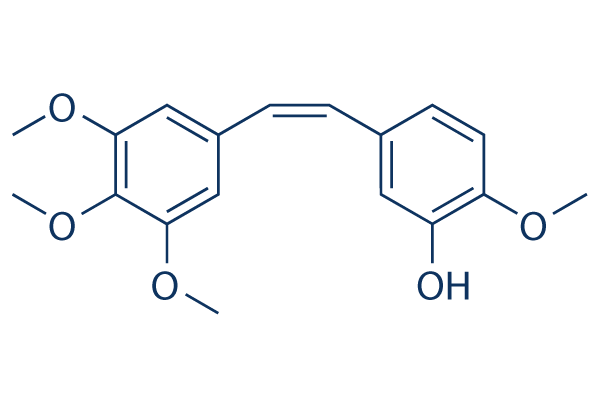
Structure chimique
Poids moléculaire: 316.35
Contrôle qualité
- Cité dans Nature Medicine pour sa qualité supérieure
- COA
- NMR
- SDS
- Fiche technique
| Cibles apparentées | Akt Wnt/beta-catenin PKC HSP ROCK Integrin Bcr-Abl Actin FAK Kinesin |
|---|---|
| Autre Microtubule Associated Inhibiteurs | Nocodazole MMAF Patupilone (Epothilone B) Lexibulin (CYT997) CW069 Epothilone A ABT-751 (E7010) TAI-1 Cucurbitacin B INH1 |
Culture cellulaire, traitement et concentration de travail
| Lignées cellulaires | Type dessai | Concentration | Temps dincubation | Formulation | Description de lactivité | PMID |
|---|---|---|---|---|---|---|
| SKMEL-5 | Growth inhibition assay | Cytotoxic concentration required to inhibit 50% cell growth in SKMEL-5 melanoma cell lines, ED50=3.00E-08 μM | ||||
| A-549 | Growth inhibition assay | Cytotoxic concentration required to inhibit 50% cell growth in A-549 lung carcinoma cell lines, ED50=1.20E-06 μM | ||||
| MCF-7 | Growth inhibition assay | Cytotoxic concentration required to inhibit 50% cell growth in MCF-7 breast carcinoma cell lines, ED50=3.80E-06 μM | ||||
| HT-29 | Growth inhibition assay | Cytotoxic concentration required to inhibit 50% cell growth in HT-29 colon adenocarcinoma cell lines, ED50=1.20E-06 μM | ||||
| MLM melanoma cell | Growth inhibition assay | Cytotoxic concentration required to inhibit 50% cell growth in MLM melanoma cell lines, ED50=1.40E-06 μM | ||||
| M14 | Cytotoxicity assay | In vitro cytotoxic activity was tested against human melanoma cancer (M14) cell line, GI50=0.0001 μM | ||||
| SK-OV3 | Cytotoxicity assay | In vitro cytotoxic activity tested against human ovarian cancer (SK-OV3) cell line, GI50=0.0001 μM | ||||
| HL60 cells | Cytotoxicity assay | 72 h | Cytotoxicity against human HL60 cells after 72 hrs by MTT assay, IC50=0.0001 μM | |||
| SK-OV-3 | Growth inhibition assay | 48 h | Growth inhibition of human SK-OV-3 after 48 hrs by SRB assay, GI50=0.00013 μM | |||
| HepG2 cells | Cytotoxicity assay | Cytotoxicity against human HepG2 cells, IC50=0.00014 μM | ||||
| ZR-75-1 | Cytotoxicity assay | Cytotoxicity against ZR-75-1 cell line, IC50=0.00024 μM | ||||
| HeLa cell | Cytotoxicity assay | Cytotoxicity against HeLa cell line, IC50=0.0003 μM | ||||
| HCT116 cell | Cytotoxicity assay | Cytotoxicity against HCT116 cell line, IC50=0.00035 μM | ||||
| KBV1 cells | Cytotoxicity assay | 72 h | Cytotoxicity against human vinblastine-resistant KBV1 cells after 72 hrs by MTT assay, IC50=0.0004 μM | |||
| SKOV3 | Cytotoxicity assay | Cytotoxicity against human SKOV3 cells by SRB assay, GI50=0.00042 μM | ||||
| SKOV3 cells | Growth inhibition assay | Growth inhibition of human SKOV3 cells by sulforhodamine B assay, GI50=0.00042 μM | ||||
| HeLa cells | Cytotoxicity assay | Cytotoxicity against human HeLa cells by MTT assay, IC50=0.00051 μM | ||||
| DU145 cells | Cytotoxicity assay | Cytotoxicity against human DU145 cells by SRB assay, GI50=0.00054 μM | ||||
| DU145 cells | Growth inhibition assay | Growth inhibition of human DU145 cells by sulforhodamine B assay, GI50=0.00054 μM | ||||
| SK-N-BE | Proliferation assay | 72 h | Antiproliferative activity in human SK-N-BE cells assessed as cell viability after 72 hrs by MTT assay, IC50=0.00058 μM | |||
| NCIH460 cells | Cytotoxicity assay | 48 h | Cytotoxicity against human NCIH460 cells after 48 hrs by SRB assay, GI50=0.0006 μM | |||
| KB-VIN10 cells | Proliferation assay | 72 h | Antiproliferative activity against human KB-VIN10 cells over-expressing P-gp 170/MDR1 after 72 hrs by methylene blue assay, IC50=0.0007 μM | |||
| HCT116 cells | Cytotoxicity assay | 72 h | Cytotoxicity against human HCT116 cells assessed as reduction of [3H]thymidine incorporation after 72 hrs by scintillation counting, IC50=0.00074 μM | |||
| DU145 cells | Cytotoxicity assay | 48 h | Cytotoxicity against human DU145 cells after 48 hrs by SRB assay, GI50=0.0008 μM | |||
| RS4:11 cells | Proliferation assay | 72 h | Antiproliferative activity against human RS4:11 cells after 72 hrs by (3-(4,5-dimethylthiazol-2-yl)-2,5-diphenyltetrazolium bromide test, IC50=0.0008 μM | |||
| HCT 116 | Growth inhibition assay | Concentration which produces 50% inhibition of growth of human colon tumor HCT 116, IC50=0.0009 μM | ||||
| HeLa cells | Cytotoxicity assay | 72 h | Cytotoxicity against human HeLa cells after 72 hrs by resazurin based fluorescence assay, IC50=0.0009 μM | |||
| BNL 1ME A.7R.1 cells | Cytotoxicity assay | Cytotoxicity against mouse BNL 1ME A.7R.1 cells, IC50=0.0009 μM | ||||
| Calu6 | Proliferation assay | 48 h | Antiproliferative activity against human Calu6 after 48 hrs by spectrophotometry, IC50=0.00094 μM | |||
| melanoma B16 cell | Growth inhibition assay | Concentration which produces 50% inhibition of growth of murine melanoma B16 cell line, IC50=0.001 μM | ||||
| DU145 cells | Cytotoxicity assay | Cytotoxicity against human DU145 cells by SRB assay, GI50=0.001 μM | ||||
| HCT116 cells | Proliferation assay | 72 h | Antiproliferative activity against human HCT116 cells after 72 hrs by MTS assay, IC50=0.001 μM | |||
| HCT15 cells | Proliferation assay | 72 h | Antiproliferative activity against human HCT15 cells after 72 hrs by MTS assay, IC50=0.001 μM | |||
| HL60 cells | Proliferation assay | 72 h | Antiproliferative activity against human HL60 cells assessed as growth inhibition after 72 hrs by MTT assay, IC50=0.001 μM | |||
| A10 cells | Growth inhibition assay | 48 h | Growth inhibition of rat A10 cells after 48 hrs by MTT assay, IC50=0.001 μM | |||
| HUVEC cells | Growth inhibition assay | 48 h | Growth inhibition of HUVEC cells after 48 hrs by MTT assay, IC50=0.001 μM | |||
| HL60 cells | Cytotoxicity assay | 72 h | Cytotoxicity against human HL60 cells after 72 hrs by MTT assay, IC50=0.001 μM | |||
| HL60 cells | Proliferation assay | 72 h | Antiproliferative activity against human HL60 cells assessed as growth inhibition after 72 hrs by MTT assay, IC50=0.001 μM | |||
| NCI-H522 cells | Growth inhibition assay | 48 h | Growth inhibition of human NCI-H522 cells after 48 hrs by SRB assay, GI50=0.001 μM | |||
| MDA-MB-435 cells | Growth inhibition assay | 48 h | Growth inhibition of human MDA-MB-435 cells after 48 hrs by SRB assay, GI50=0.001 μM | |||
| OVCAR3 | Growth inhibition assay | 48 h | Growth inhibition of human OVCAR3 cells after 48 hrs by SRB assay, GI50=0.001 μM | |||
| NCI/ADR-RES cells | Growth inhibition assay | 48 h | Growth inhibition of human NCI/ADR-RES cells after 48 hrs by SRB assay, GI50=0.001 μM | |||
| PC3 cells | Growth inhibition assay | 48 h | Growth inhibition of human PC3 cells after 48 hrs by SRB assay, GI50=0.001 μM | |||
| DU145 cells | Growth inhibition assay | 48 h | Growth inhibition of human DU145 cells after 48 hrs by SRB assay, GI50=0.001 μM | |||
| MDA-MB-231 cells | Growth inhibition assay | 48 h | Growth inhibition of human MDA-MB-231 cells after 48 hrs by SRB assay, GI50=0.001 μM | |||
| CEM cells | Cytotoxicity assay | 72 h | Cytotoxicity against human CEM cells after 72 hrs by MTT assay, IC50=0.001 μM | |||
| HCT116 cells | Cytotoxicity assay | 72 h | Cytotoxicity against human HCT116 cells after 72 hrs by MTT assay, IC50=0.001 μM | |||
| MDA-MB-435 cells | Cytotoxicity assay | 72 h | Cytotoxicity against human MDA-MB-435 cells after 72 hrs by MTT assay, IC50=0.001 μM | |||
| HaCaT cells | Proliferation assay | Antiproliferative activity against human HaCaT cells assessed as cell viability by MTT assay, IC50=0.001 μM | ||||
| HL60 cells | Proliferation assay | 72 h | Antiproliferative activity against human HL60 cells after 72 hrs by MTT assay, IC50=0.001 μM | |||
| HL60 cells | Proliferation assay | 72 h | Antiproliferative activity against human HL60 cells after 72 hrs by (3-(4,5-dimethylthiazol-2-yl)-2,5-diphenyltetrazolium bromide test, IC50=0.001 μM | |||
| HT-29 | Growth inhibition assay | Growth inhibition of human HT-29 cells by MTT assay, IC50=0.001 μM | ||||
| HL60 cells | Proliferation assay | 72 h | Antiproliferative activity against human HL60 cells after 72 hrs by MTT assay, IC50=0.001 μM | |||
| Hs578T cells | Growth inhibition assay | 48 h | Growth inhibition of human Hs578T cells after 48 hrs by SRB assay, GI50=0.001 μM | |||
| HL60 cells | Cytotoxicity assay | 72 h | Cytotoxicity against human HL60 cells after 72 hrs by MTT assay, IC50=0.001 μM | |||
| SKOV3 cells | Growth inhibition assay | Growth inhibition of human SKOV3 cells by MTT assay, IC50=0.001 μM | ||||
| MDA-MB-468 cells | Cytotoxicity assay | 4 days | Cytotoxicity against human MDA-MB-468 cells assessed as cell viability after 4 days by MTS assay, IC50=0.0011 μM | |||
| MCF7 cells | Proliferation assay | 72 h | Antiproliferative activity in human MCF7 cells assessed as cell viability after 72 hrs by MTT assay, IC50=0.00111 μM | |||
| H460 | Cytotoxicity assay | Cytotoxicity against human H460 cells by sulforhodamine B test, IC50=0.0012 μM | ||||
| H460 | Proliferation assay | Antiproliferative activity against human H460 cells, IC50=0.00124 μM | ||||
| NCI-H460 cells | Cytotoxicity assay | 72 h | Cytotoxic activity against human NCI-H460 cells after 72 hrs by sulforhodamine B test, IC50=0.0013 μM | |||
| OVCAR8 cells | Growth inhibition assay | 96 h | Growth inhibition of human OVCAR8 cells overexpressing P-glycoprotein after 96 hrs, IC50=0.0013 μM | |||
| NCI/ADR-RES cells | Cytotoxicity assay | Cytotoxicity against human NCI/ADR-RES cells assessed as growth inhibition by trypan blue exclusion assay, IC50=0.0013 μM | ||||
| OVCAR8 cells | Cytotoxicity assay | 96 h | Cytotoxicity against human OVCAR8 cells assessed as growth inhibition after 96 hrs by Giemsa staining-based light microscopy, IC50=0.0013 μM | |||
| NCI/ADR-RES cells | Cytotoxicity assay | 96 h | Cytotoxicity against human NCI/ADR-RES cells assessed as growth inhibition after 96 hrs by Giemsa staining-based light microscopy, IC50=0.0013 μM | |||
| OVCAR8 cells | Cytotoxicity assay | Cytotoxicity against human OVCAR8 cells assessed as growth inhibition by trypan blue exclusion assay, IC50=0.0013 μM | ||||
| HuTu 80 cells | Proliferation assay | 72 h | Antiproliferative activity in human HuTu 80 cells assessed as cell viability after 72 hrs by MTT assay, IC50=0.00137 μM | |||
| K562 cells | Cytotoxicity assay | Cytotoxicity against human K562 cells, IC50=0.0014 μM | ||||
| NCI/ADR (MDR) cells | Function assay | Cell cycle arrest in NCI/ADR (MDR) cells by accumulation at G2/M phase, IC50=0.0015 μM | ||||
| HUVEC | Proliferation assay | Antiproliferative activity against human HUVEC, IC50=0.0015 μM | ||||
| KB cell | Proliferation assay | Antiproliferative activity against human KB cell line by methylene blue dye assay, IC50=0.0015 μM | ||||
| KB-VIN10 cell | Proliferation assay | Antiproliferative activity against human KB-VIN10 cell line by methylene blue dye assay, IC50=0.0015 μM | ||||
| Human SH-SY5Y neuroblastoma cells | Function assay | Inhibitory concentration against Human SH-SY5Y neuroblastoma cells, IC50=0.0015 μM | ||||
| SW620 cells | Proliferation assay | 72 h | Antiproliferative activity in human SW620 cells assessed as cell viability after 72 hrs by MTT assay, IC50=0.00152 μM | |||
| Molt4/C8 cells | Proliferation assay | Antiproliferative activity against human Molt4/C8 cells, IC50=0.0016 μM | ||||
| ACHN cell | Proliferation assay | Antiproliferative activity against drug resistant ACHN cell line expressing MDR1 by Alamar Blue assay, IC50=0.0016 μM | ||||
| Molt4/C8 cells | Proliferation assay | 3 days | Antiproliferative effect against human Molt4/C8 cells after 3 days, IC50=0.0016 μM | |||
| Cliquez pour voir plus de données expérimentales sur les lignées cellulaires | ||||||
Informations chimiques, stockage et stabilité
| Poids moléculaire | 316.35 | Formule | C18H20O5 |
Stockage (À partir de la date de réception) | |
|---|---|---|---|---|---|
| N° CAS | 117048-59-6 | Télécharger le SDF | Stockage des solutions mères |
|
|
| Synonymes | N/A | Smiles | COC1=C(C=C(C=C1)C=CC2=CC(=C(C(=C2)OC)OC)OC)O | ||
Solubilité
|
In vitro |
DMSO
: 63 mg/mL
(199.14 mM)
Ethanol : 34 mg/mL Water : Insoluble |
Calculateur de molarité
|
In vivo |
|||||
Calculateur de formulation in vivo (Solution claire)
Étape 1 : Entrez les informations ci-dessous (Recommandé : Un animal supplémentaire pour tenir compte des pertes pendant lexpérience)
Étape 2 : Entrez la formulation in vivo (Ceci nest que le calculateur, pas la formulation. Veuillez nous contacter dabord sil ny a pas de formulation in vivo dans la section Solubilité.)
Résultats du calcul :
Concentration de travail : mg/ml;
Méthode de préparation du liquide maître DMSO : mg médicament prédissous dans μL DMSO ( Concentration du liquide maître mg/mL, Veuillez nous contacter dabord si la concentration dépasse la solubilité du DMSO du lot de médicament. )
Méthode de préparation de la formulation in vivo : Prendre μL DMSO liquide maître, ajouter ensuiteμL PEG300, mélanger et clarifier, ajouter ensuiteμL Tween 80, mélanger et clarifier, ajouter ensuite μL ddH2O, mélanger et clarifier.
Méthode de préparation de la formulation in vivo : Prendre μL DMSO liquide maître, ajouter ensuite μL Huile de maïs, mélanger et clarifier.
Remarque : 1. Assurez-vous que le liquide est clair avant dajouter le solvant suivant.
2. Assurez-vous dajouter le(s) solvant(s) dans lordre. Vous devez vous assurer que la solution obtenue lors de lajout précédent est une solution claire avant de procéder à lajout du solvant suivant. Des méthodes physiques telles que le vortex, les ultrasons ou le bain-marie peuvent être utilisées pour faciliter la dissolution.
Mécanisme daction
| Targets/IC50/Ki |
β-tubulin
0.4 μM(Kd)
|
|---|---|
| In vitro |
Combretastatin A4 inhibe la croissance des cellules MDA-MB-231, A549, Hela, HL-60, SF295, HCT-8, MDA-MB435, PC3M, OVCAR-8, NCI-H358M et des lymphocytes avec un IC50 de 2,8, 3,8, 0,9, 2,1, 6,2, 5,3, 7,9, 4,7, 0,37, 8 et 3,2 nM, respectivement. 1 μM de ce composé inhibe la polymérisation de la tubuline de 35%, et 10 μM bloque presque complètement la polymérisation de la tubuline. Ce produit chimique démontre une grande capacité de liaison relative, atteignant 78% de la liaison de la colchicine.
|
| Kinase Assay |
Essai de liaison compétitive utilisant LC-MS/MS
|
|
La colchicine (1,2 μM) est incubée avec de la tubuline (1,3 mg/mL) dans le tampon d'incubation (80 mM PIPES, 2,0 mM MgCl2, 0,5 mM EGTA, pH 6,9) à 37℃ pendant 1 h. Des concentrations variables (0,1 − 125 μM) de ce composé sont utilisées pour concurrencer la colchicine initialement liée à la tubuline. Après incubation, le filtrat est obtenu. La capacité de l'analogue à inhiber la liaison de la colchicine est exprimée en pourcentage de la liaison de contrôle en l'absence de tout compétiteur.
|
|
| In vivo |
Dans le modèle de tumeur mammaire NT2 et MDA-MB-231, l'administration de Combretastatin A4 (100 mg/kg, i.p.) induit une diminution significative des lipides R1 et une réduction du pO2 tumoral mesuré par oximétrie par résonance paramagnétique électronique (RPE). Ce composé (100 mg/kg, i.p.) diminue significativement la Ktrans chez les souris NMRI mâles.
|
Références |
|
Support technique
Tel: +1-832-582-8158 Ext:3
Si vous avez dautres questions, veuillez laisser un message.
Questions fréquemment posées
Question 1:
How to make solution for in vivo IP injection of it?
Réponse :
We've tested some vehicles for this compound, and found it can be dissolved in 5% DMSO+50% PEG 300+ddH2O at 30mg/ml clearly. When prepare the solution, please dissolve it in DMSO clearly first. Then add PEG, after they mixed well, then dilute with water.

Les produits sont destinés à la recherche uniquement. Non destinés à lusage humain. Nous ne vendons pas aux patients.
©Copyright 2013 Selleck Chemicals. Tous droits réservés.