
연구용
Baricitinib (LY3009104) JAK 억제제
제품 번호S2851
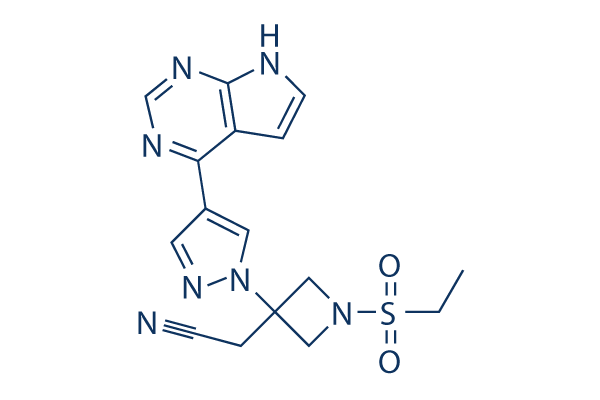
화학 구조
분자량: 371.42
품질 관리
세포 배양, 처리 및 작업 농도
| 세포주 | 분석 유형 | 농도 | 배양 시간 | 제형 | 활성 설명 | PMID |
|---|---|---|---|---|---|---|
| human CD34+ cells | Function assay | 45 mins | Inhibition of JAK2 homodimer in human CD34+ cells spiked into human whole blood assessed as inhibition of EPO-induced STAT-5 phosphorylation preincubated for 45 mins followed by EPO addition measured after 15 mins by FACS analysis, IC50=0.0878μM | 24417533 | ||
| human UT7 cells | Function assay | Inhibition of JAK2 in human UT7 cells assessed as suppression of EPO-stimulated STAT5 phosphorylation by AlphaScreen assay | 26372653 | |||
| human TF1 cells | Function assay | Inhibition of JAK1 in human TF1 cells assessed as suppression of IL6-stimulated STAT3 phosphorylation by AlphaScreen assay | 26372653 | |||
| CD34+ | Function assay | 45 mins | Inhibition of JAK2 homodimer in human CD34+ cells spiked into human whole blood assessed as inhibition of EPO-induced STAT-5 phosphorylation preincubated for 45 mins followed by EPO addition measured after 15 mins by FACS analysis, IC50 = 0.0878 μM. | 24417533 | ||
| TF1 | Function assay | Inhibition of JAK1 in human TF1 cells assessed as suppression of IL6-stimulated STAT3 phosphorylation by AlphaScreen assay, INH = 0.017 μM. | 26372653 | |||
| UT7 | Function assay | Inhibition of JAK2 in human UT7 cells assessed as suppression of EPO-stimulated STAT5 phosphorylation by AlphaScreen assay, INH = 0.31 μM. | 26372653 | |||
| HeLa | Function assay | 5 uM | 2 hrs | Inhibition of IFNgamma-induced JAK2 phosphorylation in human HeLa cells at 5 uM incubated for 2 hrs by Western blot method | 27137359 | |
| A673 | qHTS assay | qHTS of pediatric cancer cell lines to identify multiple opportunities for drug repurposing: Primary screen for A673 cells | 29435139 | |||
| SK-N-SH | qHTS assay | qHTS of pediatric cancer cell lines to identify multiple opportunities for drug repurposing: Primary screen for SK-N-SH cells | 29435139 | |||
| NB1643 | qHTS assay | qHTS of pediatric cancer cell lines to identify multiple opportunities for drug repurposing: Primary screen for NB1643 cells | 29435139 | |||
| Rh41 | qHTS assay | qHTS of pediatric cancer cell lines to identify multiple opportunities for drug repurposing: Primary screen for Rh41 cells | 29435139 | |||
| LAN-5 | qHTS assay | qHTS of pediatric cancer cell lines to identify multiple opportunities for drug repurposing: Primary screen for LAN-5 cells | 29435139 | |||
| 클릭하여 더 많은 세포주 실험 데이터 보기 | ||||||
화학 정보, 보관 및 안정성
| 분자량 | 371.42 | 화학식 | C16H17N7O2S |
보관 (수령일로부터) | |
|---|---|---|---|---|---|
| CAS 번호 | 1187594-09-7 | SDF 다운로드 | 원액 보관 |
|
|
| 동의어 | INCB028050, LY3009104 | Smiles | CCS(=O)(=O)N1CC(C1)(CC#N)N2C=C(C=N2)C3=C4C=CNC4=NC=N3 | ||
용해도
|
In vitro |
DMSO
: 74 mg/mL
(199.23 mM)
Water : Insoluble Ethanol : Insoluble |
몰농도 계산기
|
In vivo |
|||||
생체 내 제형 계산기 (투명한 용액)
1단계: 아래 정보 입력 (권장: 실험 중 손실을 고려하여 추가 동물 포함)
2단계: 생체 내 제형 입력 (이것은 계산기일 뿐 제형이 아닙니다. 용해도 섹션에 생체 내 제형이 없는 경우 먼저 당사에 문의하십시오.)
계산 결과:
작업 농도: mg/ml;
DMSO 원액 준비 방법: mg 약물 사전 용해 μL DMSO ( 원액 농도 mg/mL, 농도가 해당 약물 배치의 DMSO 용해도를 초과하는 경우 먼저 당사에 문의하십시오. )
생체 내 제형 준비 방법: 취하다 μL DMSO 원액, 다음 추가μL PEG300, 혼합하고 투명하게 한 다음 추가μL Tween 80, 혼합하고 투명하게 한 다음 추가 μL ddH2O, 혼합하고 투명하게 합니다.
생체 내 제형 준비 방법: 취하다 μL DMSO 원액, 다음 추가 μL 옥수수 기름, 혼합하고 투명하게 합니다.
참고: 1. 다음 용매를 추가하기 전에 액체가 투명한지 확인하십시오.
2. 용매를 순서대로 추가해야 합니다. 다음 용매를 추가하기 전에 이전 추가에서 얻은 용액이 투명한 용액인지 확인해야 합니다. 와동, 초음파 또는 뜨거운 물 중탕과 같은 물리적 방법을 사용하여 용해를 도울 수 있습니다.
작용 메커니즘
| Targets/IC50/Ki |
JAK2
(Cell-free assay) 5.7 nM
JAK1
(Cell-free assay) 5.9 nM
TYK2
(Cell-free assay) 53 nM
JAK3
(Cell-free assay) >400 nM
|
|---|---|
| 시험관 내(In vitro) |
Baricitinib (LY3009104)은 PBMC에서 IL-6에 의해 자극된 정식 기질 STAT3(pSTAT3)의 인산화와 그에 따른 케모카인 MCP-1 생성을 각각 44 nM 및 40 nM의 IC50 값으로 억제합니다. 이 화합물은 또한 분리된 naive T 세포에서 IL-23에 의해 자극된 pSTAT3을 20 nM의 IC50으로 억제합니다. |
| 키나아제 분석 |
생화학 분석
|
|
Baricitinib (LY3009104)에 대한 효소 분석은 재조합 에피토프 태그 키나제 도메인 (JAK1, 837-1142; JAK2, 828-1132; JAK3, 718-1124; Tyk2, 873-1187) 또는 전체 길이 효소 (cMET 및 Chk2) 및 펩타이드 기질을 사용하여 균질 시간 분해 형광 분석법으로 수행됩니다. 각 효소 반응은 이 화합물 (11점 희석), JAK, cMET 또는 Chk2 효소, 500 nM (Chk2의 경우 100 nM) 펩타이드, ATP (각 키나제에 특이적인 Km 또는 1 mM) 및 2.0% DMSO가 포함된 분석 완충액으로 수행됩니다. 계산된 IC50 값은 형광 신호의 50% 억제에 필요한 농도입니다.
|
|
| 생체 내(In vivo) |
Baricitinib (LY3009104)은 전혈에서 IL-6으로 자극된 STAT3의 인산화를 128 nM의 IC50으로 억제합니다. 이 화합물 (10 mg/kg 경구 투여)은 쥐에서 약 8시간 동안 JAK1/2 신호 전달을 (50% 이상) 억제할 것으로 예상됩니다. Baricitinib (10 mg/mL, 경구 투여)은 보조 관절염 모델에서 확립된 질병을 가진 쥐의 질병 점수를 용량 의존적으로 억제합니다. 이 치료는 대조군과 비교하여 2주간의 치료 기간 동안 1 mg/kg 용량에서 뒷발 부피 증가를 50% 억제하고, 3 mg/kg 또는 10 mg/kg 용량에서는 95% 이상 억제합니다. 이 화합물은 대조군과 비교하여 보조 관절염 모델에서 확립된 질병을 가진 쥐에서 면역 침윤, 부종 및 관절 주위 조직 외관의 복합 점수를 1 mg/kg 용량에서 27%, 3 mg/kg 용량에서 64%, 10 mg/kg 용량에서 82% 억제합니다. Baricitinib은 보조 관절염 모델에서 확립된 질병을 가진 쥐에서 용량 수준 (1, 3, 10 mg/kg) 증가에 따라 골 흡수를 15%, 61%, 67% 감소시킵니다. 이 화학 물질 (10 mg/kg, 2주간 매일, 경구 투여)은 보조 관절염 모델에서 확립된 질병을 가진 쥐에서 발목과 발목뼈의 정상적인 구조와 외관 회복을 통해 방사선학적 개선을 가져옵니다. rAIA 동물의 말초 혈액에서 pSTAT3 수치를 용량 및 시간 의존적으로 감소시킵니다. 이 약물 (10 mg/mL, 경구 투여)은 쥐 CIA 모델에서 관절 손상 복합 점수를 47% 개선합니다. Baricitinib (10 mg/kg)은 활막 (74%) 및 뼈 손상 (78%)을 줄이고 연골 손상 (43%) 및 염증 징후 (33%)를 개선하여 콜라겐 항체 유도 관절염 (CAIA) 쥐 모델에서 질병 총점에 53% 개선을 가져옵니다. 이 화합물 (10 mg/kg)은 CIA 및 CAIA 모델 모두에서 지연형 과민 반응을 48% 억제합니다. 이는 질병 완화 약물 및 생물학적 제제에 불응성인 활동성 류마티스 관절염 환자에게 효과적입니다. 이는 JAK1 및 JAK2를 우선적으로 억제하며, Tyk2에 비해 10배, JAK3에 비해 100배의 선택성을 가집니다. GLPG-0634가 ACR20에 미치는 관찰된 효과는 소규모 연구임에도 불구하고 토파시티닙에서 관찰된 것만큼 좋거나 Baricitinib보다 우수한 것으로 보입니다. 이 화학 물질은 2상 임상 연구에서 ACR20 값에 적당한 영향만 미치기 때문입니다. 이는 빈혈을 유발하는 용량 제한적 부작용을 가지고 있으며, 이는 JAK2에 대한 영향으로 attributed되었지만 분명한 효능을 보였습니다. |
참조 |
|
적용 분야
| 방법 | 바이오마커 | 이미지 | PMID |
|---|---|---|---|
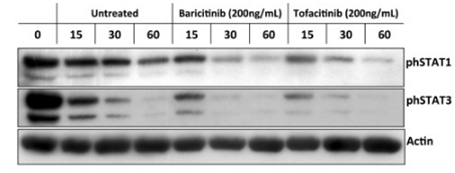
| Western blot | phSTAT1 / phSTAT3 |
|
28369741 |
임상시험 정보
(데이터 출처 https://clinicaltrials.gov, 업데이트 날짜 2024-05-22)
| NCT 번호 | 모집 | 조건 | 스폰서/협력자 | 시작일 | 단계 |
|---|---|---|---|---|---|
| NCT05914584 | Not yet recruiting | Hospital-acquired Pneumonia |
Nantes University Hospital |
July 1 2023 | Phase 2|Phase 3 |
| NCT05189106 | Recruiting | Amyotrophic Lateral Sclerosis|Alzheimer Disease|Mild Cognitive Impairment |
Massachusetts General Hospital |
December 5 2022 | Phase 1|Phase 2 |
| NCT05074420 | Recruiting | Covid19|Corona Virus Infection |
Eli Lilly and Company |
December 21 2021 | Phase 3 |
| NCT04208464 | Completed | Idiopathic Inflammatory Myopathies |
University of Manchester|Eli Lilly and Company|Clinical Trials Unit Manchester|Karolinska Institutet |
October 7 2021 | Phase 2 |
| NCT04358614 | Completed | COVID|Pneumonia |
Fabrizio Cantini|Hospital of Prato |
March 16 2020 | Phase 2|Phase 3 |
기술 지원
자주 묻는 질문
질문 1:
Do you know if it will dissolve directly into 0.5% methylcellulose (vehicle for oral gavage treatments) or is acid required to dissolve this compound?
답변:
It can be dissolved directly into 0.5% methylcellulose, as cited from the reference. We also tested dissolving it into 30% PEG400/0.5% Tween80/5% propylene glycol, and the solubility is about 30 mg/mL.

제품은 연구용으로만 사용됩니다. 인체에는 사용하지 마십시오. 환자에게 판매하지 않습니다.
©Copyright 2013 Selleck Chemicals. All Rights Reserved.