
연구용
Tigecycline Antineoplastic and Immunosuppressive Antibiotics 억제제
제품 번호: S1403
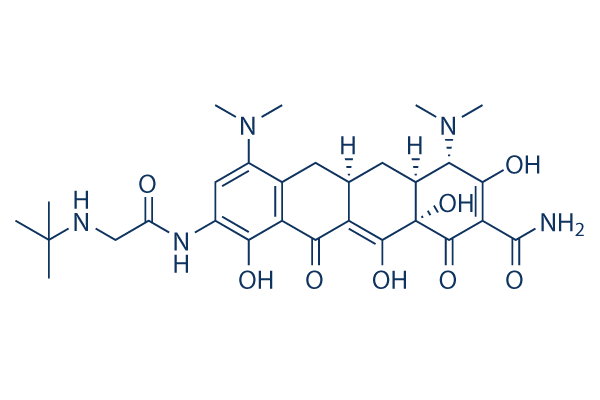
화학 구조
분자량: 585.65
품질 관리 (Quality Control)
| 관련 타겟 | Integrase Bacterial Antibiotics Anti-infection Fungal Antiviral COVID-19 Parasite Reverse Transcriptase HIV |
|---|---|
| 기타 Antineoplastic and Immunosuppressive Antibiotics 억제제 | Staurosporine (STS) Cyclosporin A Oligomycin A (MCH 32) Puromycin Dihydrochloride Nigericin sodium salt Geldanamycin (NSC 122750) Honokiol Streptozotocin (STZ) Sodium Monensin (NSC 343257) Hygromycin B |
세포 배양, 처리 및 작업 농도
(Cell Culture, Treatment & Working Concentration)
| 세포주 | 분석 유형 | 농도 | 배양 시간 | 제형 | 활성 설명 | PMID |
|---|---|---|---|---|---|---|
| THP-1 | Antibacterial assay | 24 hrs | Antibacterial activity against Staphylococcus aureus SCV isolated from cystic fibrosis patient infected in human THP-1 cells assessed as log reduction of intracellular CFU level after 24 hrs in presence of thymidine | 19188393 | ||
| 클릭하여 더 많은 세포주 실험 데이터 보기 | ||||||
화학 정보, 보관 및 안정성 (Chemical Information, Storage & Stability)
| 분자량 | 585.65 | 화학식 | C29H39N5O8 |
보관 (수령일로부터) | |
|---|---|---|---|---|---|
| CAS 번호 | 220620-09-7 | SDF 다운로드 | 원액 보관 |
|
|
| 동의어 | GAR-936, WAY-GAR-936, TBG-MINO | Smiles | CC(C)(C)NCC(=O)NC1=CC(=C2CC3CC4C(C(=O)C(=C(C4(C(=O)C3=C(C2=C1O)O)O)O)C(=O)N)N(C)C)N(C)C | ||
용해도 (Solubility)
|
In vitro |
DMSO
: 100 mg/mL
(170.75 mM)
Water : 100 mg/mL Ethanol : Insoluble |
몰농도 계산기
|
In vivo |
|||||
생체 내 제형 계산기 (투명한 용액)
1단계: 아래 정보 입력 (권장: 실험 중 손실을 고려하여 추가 동물 포함)
2단계: 생체 내 제형 입력 (이것은 계산기일 뿐 제형이 아닙니다. 용해도 섹션에 생체 내 제형이 없는 경우 먼저 당사에 문의하십시오.)
계산 결과:
작업 농도: mg/ml;
DMSO 원액 준비 방법: mg 약물 사전 용해 μL DMSO ( 원액 농도 mg/mL, 농도가 해당 약물 배치의 DMSO 용해도를 초과하는 경우 먼저 당사에 문의하십시오. )
생체 내 제형 준비 방법: 취하다 μL DMSO 원액, 다음 추가μL PEG300, 혼합하고 투명하게 한 다음 추가μL Tween 80, 혼합하고 투명하게 한 다음 추가 μL ddH2O, 혼합하고 투명하게 합니다.
생체 내 제형 준비 방법: 취하다 μL DMSO 원액, 다음 추가 μL 옥수수 기름, 혼합하고 투명하게 합니다.
참고: 1. 다음 용매를 추가하기 전에 액체가 투명한지 확인하십시오.
2. 용매를 순서대로 추가해야 합니다. 다음 용매를 추가하기 전에 이전 추가에서 얻은 용액이 투명한 용액인지 확인해야 합니다. 와동, 초음파 또는 뜨거운 물 중탕과 같은 물리적 방법을 사용하여 용해를 도울 수 있습니다.
작용 메커니즘 (Mechanism of Action)
| 시험관 내(In vitro) |
Tigecycline evades the Tet(A-E) efflux pumps, which account for most acquired resistance to tetracycline and minocycline in Enterobacteriaceae and Acinetobacter spp. This compound binds to bacterial ribosomes that have been modified by the Tet(M) protein, a mechanism that compromises all available tetracyclines, and which is frequent in Gram-positive cocci and Neisseria spp. It remains vulnerable to the chromosomally-encoded multidrug efflux pumps of Proteeae and Pseudomonas aeruginosa, and to Tet(X), a tetracycline-degrading mono-oxygenase found, albeit rarely, in Bacteroides spp. Its MICs for enterococci, staphylococci, and streptococci are mostly 0.06–0.25 mg/L, again with little or no skew to the distribution. This agent is prone to oxidation, and MIC values, particularly for the most susceptible isolates, may be raised if the drug is added to broth that has become oxygenated during storage, or if drug-containing media are stored before inoculation. It is a poor substrate for tetracycline-specific efflux pumps, and it still attaches to ribosomes that have been modified by the Tet(M) protein. This antibacterial has demonstrated activity against a wide variety of gram-positive and gram-negative pathogens, including multidrug-resistant strains. It is active against many gram-positive and -negative organisms, including methicillin-resistantStaphylococcus aureus, vancomycin-intermediate and -resistant enterococci, and extended-spectrum β-lactamase–producing Escherichia coli and Klebsiella pneumoniae. This compound exhibits antibacterial activity against a wide spectrum of aerobic and anaerobic bacteria. It is a broad-spectrum, protein-inhibiting, antibacterial agent possessing activity against strains resistant to other chemotherapeutic agents. This chemical demonstrates in vitro activities against the GISA and the methicillin-resistant and methicillin-susceptible staphylococcal strains tested (MICs at which 90% of isolates tested are inhibited [MIC90s], 0.5 to 1 μg/ml). It has MIC90s of 0.25 μg/ml for all of the S. pneumoniae strains and demonstrates similar activities against all of the S. pneumoniae strains tested. |
|---|---|
| 생체 내(In vivo) |
Tigecycline is bactericidal against methicillin-susceptible S. aureus (MSSA) in the rabbit osteomyelitis model and exhibits good, but not excellent, activity in Legionellapneumophila pneumonia in guinea pigs. This compound at 50 mg/kg twice daily was not toxic to mice. It is effective in inhibiting NSCLC growth in vivo through decreasing proliferation and increasing apoptosis of tumor cells. |
참조 |
|
적용 분야 (Applications)
| 방법 | 바이오마커 | 이미지 | PMID |
|---|---|---|---|
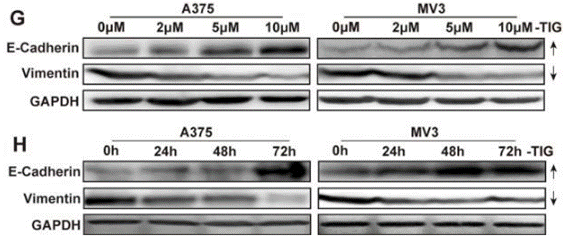
| Western blot | E-cadherin / Vimentin CDK2 / Cyclin E Cox-1 / Cox-2 / Cox-4 p-AMPKα / AMPKα / p-mTOR / mTOR / p-p70S6K / p70S6K / p-4E-BP-1 / 4E-BP1 p62 / LC3-I / LC3-II Cyclin D1 / CDK2 / p21 |
|
26621850 |
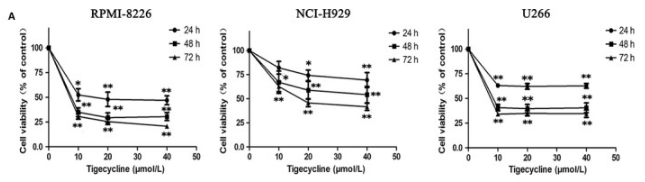
| Growth inhibition assay | Cell viability |
|
30247801 |
임상시험 정보 (Clinical Trial Information)
(데이터 출처 https://clinicaltrials.gov, 업데이트 날짜 2026-03-20)
| NCT 번호 | 모집 | 조건 | 스폰서/협력자 | 시작일 | 단계 |
|---|---|---|---|---|---|
| NCT07485010 | NOT_YET_RECRUITING | Mycobacterium Abscessus Pulmonary Disease; Mycobacterium Abscessus Infection; Non-Tuberculous Mycobacterial (NTM) Infections; Non-Tuberculous Mycobacteria Pulmonary Disease |
The University of Queensland |
2027-04 | PHASE2 |
| NCT04310930 | RECRUITING | Pulmonary Disease Due to Mycobacteria (Diagnosis) |
The University of Queensland |
2020-03-02 | PHASE2; PHASE3 |
| NCT07759453 | NOT_YET_RECRUITING | Liver Transplant; Carbapenem-resistant Enterobacterales; CRE Colonization |
IRCCS Azienda Ospedaliero-Universitaria di Bologna |
2026-10-01 | PHASE3 |
| NCT07004049 | RECRUITING | Bloodstream Infection; Ventilator Associated Bacterial Pneumonia; Hospital Acquired Bacterial Pneumonia; Carbapenem Resistant Bacterial Infection; Multidrug Resistance |
National University of Singapore |
2025-04-21 | PHASE4 |
| NCT07495150 | NOT_YET_RECRUITING | Blood-Brain Barrier; Bacterial Meningitis |
yilong Wang |
2026-04-01 | |
| NCT07524920 | NOT_YET_RECRUITING | MDR Bacteria |
Ain Shams University |
2026-04-01 | PHASE2 |

제품은 연구용으로만 사용됩니다. 인체에는 사용하지 마십시오. 환자에게 판매하지 않습니다.
©Copyright 2013 Selleck Chemicals. All Rights Reserved.