B-raf plays crucial roles in MAPK signaling pathway, ErbB signaling pathway, Insulin signaling pathway and mTOR signaling pathway which have effect on cell survival, growth and differentiation. RAF can be regulated by RAS and PKC. [show the full text]

Raf 억제제 (Raf Inhibitors)
아이소폼 선택적 제품
| Cat.No. | 제품명 | 정보 | 제품 사용 인용 | 제품 검증 |
|---|---|---|---|---|
| S2807 | Dabrafenib (GSK2118436) | Dabrafenib은 무세포 분석에서 0.7 nM의 IC50을 가진 돌연변이 BRAFV600E 특이적 억제제이며, B-Raf(wt) 및 c-Raf에 대해 각각 7배 및 9배 낮은 효능을 보인다. |
|

|
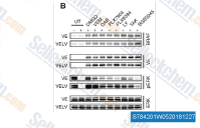
| S7842 | LY3009120 | LY3009120 (DP-4978)은 A375 세포에서 A-Raf, B-Raf 및 C-Raf에 대해 각각 44 nM, 31-47 nM 및 42 nM의 IC50을 갖는 강력한 팬-Raf 억제제입니다. 이 화합물은 Autophagy를 유도합니다. 1상. |
|
|
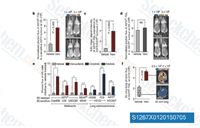
| S1267 | PLX4032 (Vemurafenib) | Vemurafenib (PLX4032, RG7204, RO5185426)는 세포 유리 분석에서 IC50 31nM을 가진 B-RafV600E의 새롭고 강력한 억제제입니다. 효소 분석에서 야생형 B-Raf에 비해 B-RafV600E에 대해 10배 선택적이며, 세포 선택성은 100배를 초과할 수 있습니다. Vemurafenib (PLX4032, RG7204)는 Autophagy를 유도합니다. |
|
|
| E1649 | Exarafenib (KIN-2787) | Exarafenib(KIN-002787, KIN-2787, RAF/KIN_2787)는 경구 투여 가능한 pan-RAF의 선택적 억제제입니다. Exarafenib은 모든 종류의 BRAF 변형을 포함하여 RAF 의존성 암에 효과적입니다. Exarafenib은 RAF 의존성 흑색종 세포주에서 MAPK 신호 전달을 억제합니다. KIN-2787은 RAF1, BRAF 및 ARAF에 대해 0.06-3.46nM의 IC50를 가지며 낮은 나노몰에서 피코몰 농도의 효능을 나타내며 비-RAF 키나제에 대한 활성은 미미합니다. | ||
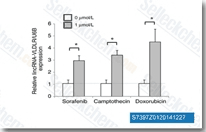
| S7397 | Sorafenib (BAY 43-9006) | Sorafenib은 세포 없는 분석에서 각각 6 nM 및 22 nM의 IC50을 갖는 Raf-1 및 B-Raf의 멀티키나아제 억제제입니다. Sorafenib은 VEGFR-2, VEGFR-3, PDGFR-β, Flt-3 및 c-KIT를 각각 90 nM, 20 nM, 57 nM, 59 nM 및 68 nM의 IC50으로 억제합니다. Sorafenib은 Autophagy 및 Apoptosis를 유도하고 항암 활성과 함께 Ferroptosis를 활성화합니다. |
|
|
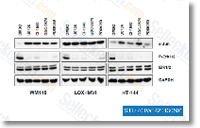
| S1104 | GDC-0879 | GDC-0877 (AR-00341677)은 A375 및 Colo205 세포에서 0.13 nM의 IC50을 가지며 c-Raf에도 활성을 보이는 새롭고 강력하며 선택적인 B-Raf 억제제입니다. 다른 단백질 키나아제에 대한 알려진 억제는 없습니다. |
|
|
| S7170 | Avutometinib (Ro5126766, CH5126766) | Avutometinib(RO5126766,CH5126766,VS 6766, CKI-27, R-7304, RG-7304)는 BRAF V600E, BRAF, CRAF 및 MEK1에 대해 각각 8.2 nM, 19 nM, 56 nM 및 160 nM의 IC50를 갖는 이중 RAF/MEK 억제제입니다. 1상. |
|
|
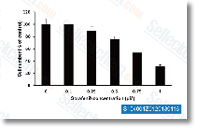
| S1040 | Sorafenib Tosylate (BAY 43-9006) | Sorafenib Tosylate는 Raf-1 및 B-Raf의 다중 키나제 억제제로, 세포 없는 분석에서 각각 6 nM 및 22 nM의 IC50를 나타냅니다. Sorafenib Tosylate는 VEGFR-2, VEGFR-3, PDGFR-β, Flt-3 및 c-KIT를 각각 90 nM, 20 nM, 57 nM, 59 nM 및 68 nM의 IC50으로 억제합니다. Sorafenib Tosylate는 항종양 활성과 함께 autophagy 및 apoptosis를 유도하고 ferroptosis를 활성화합니다. |
|
|
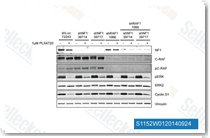
| S1152 | PLX-4720 | PLX4720은 B-RafV600E의 강력하고 선택적인 억제제로, 세포 없는 분석에서 IC50 13 nM이며, c-Raf-1(Y340D 및 Y341D 돌연변이)과 동등하게 강력하고, 야생형 B-Raf보다 B-RafV600E에 대해 10배 선택성을 갖습니다. |
|
|
| S5069 | Dabrafenib Mesylate | Dabrafenib Mesylate (GSK2118436)는 경구 생체이용 가능한 B-raf (BRAF) 단백질 억제제인 다브라페닙의 메실레이트 염 형태이며, B-Raf (V600E), B-Raf (WT) 및 C-Raf에 대해 각각 0.8 nM, 3.2 nM 및 5 nM의 IC50 값을 가집니다. |
|
|
RAF kinase signaling is highlighted in the RAS-RAF-MEK-ERK signal transduction cascade. Activated RAS kinase signaling results in the activation of RAF proteins. Following these events, MEK1 and MEK2 dual specificity protein kinases become phosphorylated and activated. It should be noted that RAF kinases display restricted substrate specificity for these MEK enzymes. The RAF family of protein-serine/threonine kinases comprise of A-RAF, B-RAF, and C-RAF oncogenes originally discovered in the early 1980s. RAF family proteins function as six dimeric members, either in homo- and heterodimer formation. Since there are four RAS members, the total number of RAS-RAF interactions is equivalent to twenty-four. And downstream, with two MEK members available the total number of interactions between RAF-MEK constituents is twelve.[1]
All RAF kinases share three conserved regions (CR): CR1, CR2, and CR3. CR1 consists of cysteine-rich domain (binds to two zinc ions) and a RAS-binding domain. These properties facilitate CR1 interaction with RAS and phospholipids in the membrane. CR2, is a serine/threonine rich domain that facilitates the binding of regulatory protein 14-3-3 upon phosphorylation – this result in inactivation. At the C-terminus is the protein kinase domain, CR3, which contains a downstream stimulatory 14-3-3 binding site. Regulating RAF kinase activity are a number of protein-protein interactions, phosphorylation, dephosphorylation and conformational changes. In their inactivated state, most RAF proteins are found in the cytosol.[1]
It was not until 2002, that B-RAF mutations were noted in cancer cells lines. Most notably, B-RAF has been associated with melanomas and papillary thyroid, ovarian, and colorectal tumors. And to a lesser degree cancers of the lung, pancreas, and bladder have also been found to have aberrant B-RAF activity. Consequently, since B-RAF mutations are involved in several different cancer types it is believed that B-RAF functions as an oncogene driver. In clinical trials, the first RAF inhibitor was Bayer’s Sorafenib (Nexavar). The compound was found to be effective in restricting tumor activity in renal cell carcinoma and hepatocellular cancers and is currently in use for these indications. Recently, PLX4032 was discovered to be a highly selective RAF inhibitor (Roche) and is currently in advanced clinical trials for testing against melanomas.[2]

제품은 연구용으로만 사용됩니다. 인체에는 사용하지 마십시오. 환자에게 판매하지 않습니다.
©Copyright 2013 Selleck Chemicals. All Rights Reserved.