The 70 kDa ribosomal protein S6 kinase (p70 S6K) is a serine/threonine kinase. Two members of S6K family are named as S6K1 and S6K2, respectively. As the downstream target of PI3K/Akt/mTOR signaling pateway, S6K could be activated in response to many stimulus such as growth factors, cytokines and nutrients. [show the full text]

S6 Kinase 억제제 (S6 Kinase Inhibitors)
| Cat.No. | 제품명 | 정보 | 제품 사용 인용 | 제품 검증 |
|---|---|---|---|---|
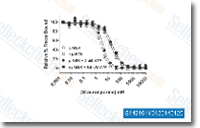
| S1421 | Staurosporine (STS) | Staurosporine (STS)은 세포 자유 분석에서 PKCα, PKCγ 및 PKCη에 대한 강력한 PKC 억제제이며 IC50은 각각 2 nM, 5 nM 및 4 nM이며, PKCδ (20 nM), PKCε (73 nM)에는 덜 강력하고 PKCζ (1086 nM)에는 거의 활성이 없습니다. 이 화합물은 또한 PKA, PKG, S6K, CaMKII 등 다른 키나아제에 대한 억제 활성을 보입니다. 3상. |
|
|
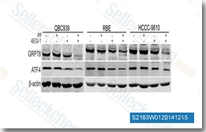
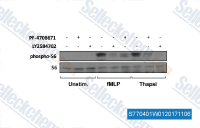
| S2163 | PF-4708671 | PF-4708671은 세포 투과성 p70 ribosomal S6 kinase (S6K1 isoform) 억제제로, 무세포 분석에서 Ki/IC50가 20 nM/160 nM이며, S6K2보다 S6K1에 대해 400배, MSK1 및 RSK1/2보다 S6K1에 대해 각각 4배 및 >20배 더 높은 선택성을 보입니다. 이 화합물은 Autophagy를 유도합니다. 보고된 최초의 S6K1 특이적 억제제입니다. |
|
|
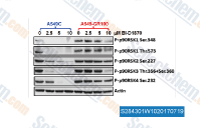
| S2843 | BI-D1870 | BI-D1870은 세포-자유 분석에서 RSK1/2/3/4에 대한 S6 리보솜의 ATP 경쟁적 억제제이며, IC50은 각각 31 nM/24 nM/18 nM/15 nM입니다. MST2, GSK-3β, MARK3, CK1 및 Aurora B보다 RSK에 대해 10-100배 높은 선택성을 보입니다. 이 화합물은 활성산소종(ROS) 생성 및 소포체(ER) 스트레스와 Autophagy 증가를 포함한 항암 특성을 나타냅니다. |
|
|
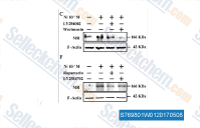
| S7698 | LY2584702 | LY2584702는 IC50이 4nM인 선택적 ATP 경쟁 p70S6K 억제제입니다. |
|
|
| S7704 | LY2584702 Tosylate | LY2584702 Tosylate는 4 nM의 IC50을 가진 선택적 ATP 경쟁적 p70S6K 억제제입니다. 1상. |
|
|
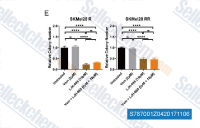
| S7870 | LJH685 | LJH685는 RSK1, RSK2, RSK3에 대해 각각 6 nM, 5 nM, 4 nM의 IC50을 갖는 강력한 팬-RSK 억제제입니다. |
|
|
| S7871 | LJI308 | LJI308은 RSK1, RSK2 및 RSK3에 대해 각각 6 nM, 4 nM 및 13 nM의 IC50을 갖는 강력한 팬-RSK(p90 리보솜 S6 키나아제) 억제제입니다. |
|
|
| S0385 | S6K-18 | S6K-18은 리보솜 단백질 S6 키나제 베타-1 (S6K1, p70S6K, p70-S6K)의 고선택적 억제제입니다. |
|
|
| S3940 | 3'-Hydroxypterostilbene | 3'-Hydroxypterostilbene (3'-HPT)은 Sphaerophysa salsula 및 Pterocarpus marsupium의 활성 성분 중 하나로, 다양한 유형의 혈액암 치료에 유용할 수 있습니다. 이 화합물은 천연 프테로스틸벤 유사체로, 세포자멸사 및 자가포식을 유도하여 인간 결장암 세포(COLO 205, HCT-116 및 HT-29 세포에 대해 각각 9.0, 40.2 및 70.9 µM의 IC50)의 성장을 효과적으로 억제합니다. 이는 PI3K/Akt/mTOR/p70S6K 및 p38 MAPK 경로를 억제하고 ERK1/2, JNK1/2 MAPK 경로를 활성화합니다. |
|
|
| E1754 | BRD7389 | BRD7389는 RSK 계열 키나아제의 억제제로, RSK1, RSK2 및 RSK3에 대해 각각 1.5 μM, 2.4 μM 및 1.2 μM의 IC50을 갖습니다. 이 화합물은 또한 원발성 인간 췌장 섬세포에서 β-세포 특이적 유전자 발현을 증가시킵니다. | ||
The 70 kDa ribosomal protein S6 kinase (p70 S6K) is a serine/threonine kinase. There are two highly homologous members in S6K family, which are named as S6K1 and S6K2, respectively. Both S6Ks belong to the AGC family of serine/threonine kinases and they could be activated in response to many stimulus, like growth factors, insulin and cytokines. In turn, S6Ks phosphorylate its substrates including the ribosomal protein S6, elF4B, and SKAR. It was found that the activity of S6Ks could be controlled by mammalian target of rapamycin (mTOR) [2]. And then, direct phosphorylation of S6K1 by mTOR was confirmed [3; 4]. Therefore, the activity of S6K presented sensitive to rapamycin [8]. However, the sensitivity of S6Ks to rapamycin was found always changing. S6Ks became insensitive to rapamycin when the site T412 was phosphorylated [9]. Until recently, raptor has been proved to be responsible for T412 phosphorylation [6]. Besides, S6K−/− animals showed short-lived and were much smaller than wild type animals. A study suggested that this phenomenon was due to the control of S6K on cell growth rather than proliferation [5]. To date, S6Ks are also related to many serious diseases. For example, S6K1 showed overexpression in breast cancer patients [1]. With the understanding of the importance of S6K in human diseases, the demand for S6K-specific inhibitors increased rapidly. Fortunately, a novel inhibitor specific for S6K1, PF-4708671, was developed to facilitate the study of the functions of S6K1, at the same time, and S6K2 [7].

제품은 연구용으로만 사용됩니다. 인체에는 사용하지 마십시오. 환자에게 판매하지 않습니다.
©Copyright 2013 Selleck Chemicals. All Rights Reserved.