
연구용
KU-0063794 mTOR 억제제
제품 번호S1226
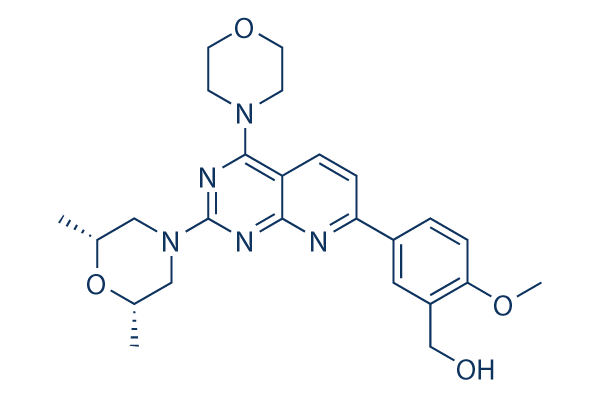
화학 구조
분자량: 465.54
품질 관리
세포 배양, 처리 및 작업 농도
| 세포주 | 분석 유형 | 농도 | 배양 시간 | 제형 | 활성 설명 | PMID |
|---|---|---|---|---|---|---|
| HepG2 | Cell Viability Assay | 0.1–50 μM | 72 h | decreases cell viability in a dose dependent manner | 26278819 | |
| HepG2 | Colony Formation Assay | 1–50 μM | 10 d | decreases the number of viable HepG2 colonies significantly | 26278819 | |
| HepG2 | Apoptosis Assay | 0.1–50 μM | 48 h | induces apoptosis in a dose dependent manner | 26278819 | |
| HepG2 | Function Assay | 5/10 μM | 24 h | dramatically inhibits phosphorylation of AKT at Ser-473 | 26278819 | |
| HepG2 | Function Assay | 5/10 μM | 24 h | downregulates the levels HIF1α and cyclin D1 | 26278819 | |
| HepG2 | Function Assay | 0.1–50 μM | 24 h | induces p62 downregulation, Beclin-1 expression and LC3B-I to LC3B-II conversion in a dose dependent manner | 26278819 | |
| HepG3 | Function Assay | 0.1–50 μM | 48 h | induces cell autophagy in a dose dependent manner | 26278819 | |
| AGS | Growth Inhibition Assay | IC50=15.0 ± 2.91 μM | 24597478 | |||
| HGC27 | Growth Inhibition Assay | IC50=15.0 ± 4.82 μM | 24597478 | |||
| MKN45 | Growth Inhibition Assay | IC50=0.82 ± 0.01 μM | 24597478 | |||
| NUGC4 | Growth Inhibition Assay | IC50=2.93 ± 0.31 μM | 24597478 | |||
| PC9 | Growth Inhibition Assay | 72 h | IC50=10.15±0.62 nM | 23874880 | ||
| PC9GR | Growth Inhibition Assay | 72 h | IC50=6.21±1.30 nM | 23874880 | ||
| H1650 | Growth Inhibition Assay | 72 h | IC50=7.61±0.62 nM | 23874880 | ||
| H1975 | Growth Inhibition Assay | 72 h | IC50=11.15±0.93 nM | 23874880 | ||
| PC9 | Function Assay | 10.15 nM | 72 h | inhibits mTOR phosphorylation status | 23874880 | |
| PC9GR | Function Assay | 6.21 nM | 72 h | inhibits mTOR phosphorylation status | 23874880 | |
| H1650 | Function Assay | 7.61 nM | 72 h | inhibits mTOR phosphorylation status | 23874880 | |
| H1975 | Function Assay | 11.15 nM | 72 h | inhibits mTOR phosphorylation status | 23874880 | |
| PC9 | Function Assay | 10.15 nM | 72 h | inhibits phosphorylation of p70S6K | 23874880 | |
| PC9GR | Function Assay | 6.21 nM | 72 h | inhibits phosphorylation of p70S6K | 23874880 | |
| H1650 | Function Assay | 7.61 nM | 72 h | inhibits phosphorylation of p70S6K | 23874880 | |
| H1975 | Function Assay | 11.15 nM | 72 h | inhibits phosphorylation of p70S6K | 23874880 | |
| LNCaP | Cell Viability Assay | 0-10 μM | 24 h | decreases cell viability in a dose dependent manner | 23840605 | |
| PC-3 | Cell Viability Assay | 0-10 μM | 24 h | decreases cell viability in a dose dependent manner | 23840605 | |
| MDA-MB-468 | Cell Viability Assay | 0-10 μM | 24 h | decreases cell viability in a dose dependent manner | 23840605 | |
| LNCaP | Function Assay | 200–800 nM | 24 h | decreases the phosphorylation level of p70S6K in a dose dependent manner | 23840605 | |
| PC-3 | Function Assay | 200–800 nM | 24 h | decreases the phosphorylation level of p70S6K in a dose dependent manner | 23840605 | |
| MDA-MB-468 | Function Assay | 200–800 nM | 24 h | decreases the phosphorylation level of p70S6K in a dose dependent manner | 23840605 | |
| Caki-1 | Function Assay | 100-2000 nM | 10-180 min | DMSO | inhibits both mTORC1 and mTORC2 as indicated by the decrease in phosphorylation of downstream effectors | 23349989 |
| 786-O | Function Assay | 100-2000 nM | 10-180 min | DMSO | inhibits both mTORC1 and mTORC2 as indicated by the decrease in phosphorylation of downstream effectors | 23349989 |
| Caki-1 | Cell Viability Assay | 300-4000 nM | 24-96 h | DMSO | suppresses the cell viability in both time and dose dependent manner | 23349989 |
| 786-O | Cell Viability Assay | 300-4000 nM | 24-96 h | DMSO | suppresses the cell viability in both time and dose dependent manner | 23349989 |
| Caki-1 | Function Assay | 2 µM | 72 h | DMSO | induces G1 cell cycle arrest and autophagy | 23349989 |
| 786-O | Function Assay | 2 µM | 72 h | DMSO | induces G1 cell cycle arrest and autophagy | 23349989 |
| HEK293 | Function assay | 2 hrs | Inhibition of recombinant FLAG-tagged mTOR expressed in HEK293 cells using biotinylated p70S6K substrate after 2 hrs by alphascreen competition assay, IC50=0.003μM | 19762236 | ||
| HBCx-10 | Function assay | 5 mg/kg | Potentiation of irinotecan-induced tumor regression against human HBCx-10 cells xenografted in immunocompromised mouse at 5 mg/kg, po qd administered on days 1 to 3 of weekly cycle | 19762236 | ||
| U87MG | Function assay | 2 hrs | Inhibition of mTORC1 in human U87MG cells assessed as phosphorylated S6 ribosomal protein (Ser235/236) level after 2 hrs by Western blotting, IC50=0.1μM | 19762236 | ||
| U87MG | Function assay | 2 hrs | Inhibition of mTORC2 in human U87MG cells assessed as phosphorylated AKT (Ser473) level after 2 hrs by Western blotting, IC50=0.15μM | 19762236 | ||
| T47D | Antiproliferative assay | 120 hrs | Antiproliferative activity against human T47D cells after 120 hrs by SRB assay, GI50=0.35μM | 19762236 | ||
| HEK293 | Function assay | Inhibition of recombinant FLAG-tagged mTOR (1362 to 2549) (unknown origin) expressed in HEK293 cells, IC50=0.0025μM | 23375793 | |||
| MDA-MB-468 | Function assay | 2 hrs | Inhibition of mTORC2 in human MDA-MB-468 cells assessed as reduction of AKT phosphorylation at Ser473 after 2 hrs, IC50=0.24μM | 23375793 | ||
| MDA-MB-468 | Function assay | 2 hrs | Inhibition of mTORC1 in human MDA-MB-468 cells assessed as reduction of pS6 phosphorylation at Ser235/236 after 2 hrs, IC50=0.66μM | 23375793 | ||
| HEK293 | Function assay | 30 mins | Inhibition of mTORC1 in HEK293 cells using GST-tagged S6K1 or Akt1 as substrate after 30 mins by immunoblotting assay, IC50=0.01μM | 29211480 | ||
| PC3 | Function assay | 100 mg/kg | Inhibition of Akt phosphorylation at Ser473 in PTEN-deficient human PC3 cells xenograft mouse model at 100 mg/kg, po single dose measured up to 8 hrs | 29211480 | ||
| PC3 | Antitumor assay | 30 mg/kg | Antitumor activity against human PC3 cells xenograft mouse model assessed as inhibition of tumor growth at 30 mg/kg, po bid in presence of 1-aminobenzotriazole | 29211480 | ||
| PC3 | Antitumor assay | 60 mg/kg | Antitumor activity against human PC3 cells xenograft mouse model assessed as inhibition of tumor growth at 60 mg/kg, po bid in presence of 1-aminobenzotriazole | 29211480 | ||
| HEK293 | Function assay | 30 mins | Inhibition of mTORC2 in HEK293 cells using GST-tagged S6K1 or Akt1 as substrate after 30 mins by immunoblotting assay, IC50=0.01μM | 29211480 | ||
| SW620 | Function assay | 20 mg/kg | Potentiation of irinotecan-induced tumor regression against human SW620 cells xenografted in immunocompromised mouse at 20 mg/kg, po qd administered on days 2 to 4 of weekly cycle | 29211480 | ||
| SJ-GBM2 | qHTS assay | qHTS of pediatric cancer cell lines to identify multiple opportunities for drug repurposing: Primary screen for SJ-GBM2 cells | 29435139 | |||
| A673 | qHTS assay | qHTS of pediatric cancer cell lines to identify multiple opportunities for drug repurposing: Primary screen for A673 cells | 29435139 | |||
| SK-N-MC | qHTS assay | qHTS of pediatric cancer cell lines to identify multiple opportunities for drug repurposing: Primary screen for SK-N-MC cells | 29435139 | |||
| BT-37 | qHTS assay | qHTS of pediatric cancer cell lines to identify multiple opportunities for drug repurposing: Primary screen for BT-37 cells | 29435139 | |||
| NB-EBc1 | qHTS assay | qHTS of pediatric cancer cell lines to identify multiple opportunities for drug repurposing: Primary screen for NB-EBc1 cells | 29435139 | |||
| OHS-50 | qHTS assay | qHTS of pediatric cancer cell lines to identify multiple opportunities for drug repurposing: Primary screen for OHS-50 cells | 29435139 | |||
| MG 63 (6-TG R) | qHTS assay | qHTS of pediatric cancer cell lines to identify multiple opportunities for drug repurposing: Primary screen for MG 63 (6-TG R) cells | 29435139 | |||
| Rh41 | qHTS assay | qHTS of pediatric cancer cell lines to identify multiple opportunities for drug repurposing: Primary screen for Rh41 cells | 29435139 | |||
| A673 | qHTS assay | qHTS of pediatric cancer cell lines to identify multiple opportunities for drug repurposing: Confirmatory screen for A673 cells) | 29435139 | |||
| BT-12 | qHTS assay | qHTS of pediatric cancer cell lines to identify multiple opportunities for drug repurposing: Confirmatory screen for BT-12 cells | 29435139 | |||
| DAOY | qHTS assay | qHTS of pediatric cancer cell lines to identify multiple opportunities for drug repurposing: Confirmatory screen for DAOY cells | 29435139 | |||
| SJ-GBM2 | qHTS assay | qHTS of pediatric cancer cell lines to identify multiple opportunities for drug repurposing: Confirmatory screen for SJ-GBM2 cells | 29435139 | |||
| U-2 OS | qHTS assay | qHTS of pediatric cancer cell lines to identify multiple opportunities for drug repurposing: Confirmatory screen for U-2 OS cells | 29435139 | |||
| Rh41 | qHTS assay | qHTS of pediatric cancer cell lines to identify multiple opportunities for drug repurposing: Confirmatory screen for Rh41 cells | 29435139 | |||
| RD | qHTS assay | qHTS of pediatric cancer cell lines to identify multiple opportunities for drug repurposing: Confirmatory screen for RD cells | 29435139 | |||
| Rh18 | qHTS assay | qHTS of pediatric cancer cell lines to identify multiple opportunities for drug repurposing: Confirmatory screen for Rh18 cells | 29435139 | |||
| Rh30 | qHTS assay | qHTS of pediatric cancer cell lines to identify multiple opportunities for drug repurposing: Confirmatory screen for Rh30 cells | 29435139 | |||
| SK-N-SH | qHTS assay | qHTS of pediatric cancer cell lines to identify multiple opportunities for drug repurposing: Confirmatory screen for SK-N-SH cells | 29435139 | |||
| 클릭하여 더 많은 세포주 실험 데이터 보기 | ||||||
화학 정보, 보관 및 안정성
| 분자량 | 465.54 | 화학식 | C25H31N5O4 |
보관 (수령일로부터) | |
|---|---|---|---|---|---|
| CAS 번호 | 938440-64-3 | SDF 다운로드 | 원액 보관 |
|
|
| 동의어 | N/A | Smiles | CC1CN(CC(O1)C)C2=NC3=C(C=CC(=N3)C4=CC(=C(C=C4)OC)CO)C(=N2)N5CCOCC5 | ||
용해도
|
In vitro |
DMSO
: 16 mg/mL
(34.36 mM)
Ethanol : 5 mg/mL Water : Insoluble |
몰농도 계산기
|
In vivo |
|||||
생체 내 제형 계산기 (투명한 용액)
1단계: 아래 정보 입력 (권장: 실험 중 손실을 고려하여 추가 동물 포함)
2단계: 생체 내 제형 입력 (이것은 계산기일 뿐 제형이 아닙니다. 용해도 섹션에 생체 내 제형이 없는 경우 먼저 당사에 문의하십시오.)
계산 결과:
작업 농도: mg/ml;
DMSO 원액 준비 방법: mg 약물 사전 용해 μL DMSO ( 원액 농도 mg/mL, 농도가 해당 약물 배치의 DMSO 용해도를 초과하는 경우 먼저 당사에 문의하십시오. )
생체 내 제형 준비 방법: 취하다 μL DMSO 원액, 다음 추가μL PEG300, 혼합하고 투명하게 한 다음 추가μL Tween 80, 혼합하고 투명하게 한 다음 추가 μL ddH2O, 혼합하고 투명하게 합니다.
생체 내 제형 준비 방법: 취하다 μL DMSO 원액, 다음 추가 μL 옥수수 기름, 혼합하고 투명하게 합니다.
참고: 1. 다음 용매를 추가하기 전에 액체가 투명한지 확인하십시오.
2. 용매를 순서대로 추가해야 합니다. 다음 용매를 추가하기 전에 이전 추가에서 얻은 용액이 투명한 용액인지 확인해야 합니다. 와동, 초음파 또는 뜨거운 물 중탕과 같은 물리적 방법을 사용하여 용해를 도울 수 있습니다.
작용 메커니즘
| Targets/IC50/Ki |
mTORC1
(Cell-free assay) ~10 nM
mTORC2
(Cell-free assay) ~10 nM
|
|---|---|
| 시험관 내(In vitro) |
mTOR 억제제 PP242와 비교할 때, KU-0063794는 PI3K 또는 76개의 다른 키나제에 대해 비활성이므로 mTOR에 대한 더 높은 특이성을 보입니다. HEK-293 세포에서 이 화합물 30 nM은 소수성 모티프(Thr389)의 인산화를 차단하고 이어서 T-루프 잔기(Thr229)의 인산화를 차단함으로써 S6K1 활성을 신속하게 제거하기에 충분합니다. 혈청 결핍 HEK-293 세포의 IGF1 자극의 경우, 이 화합물 300 nM이 S6K1 활성을 약 90% 억제하는 데 필요합니다. 이 화학 물질 100-300 nM은 또한 아미노산 유도 S6K1 및 S6 단백질의 인산화를 완전히 억제합니다. S6K1과 유사하게, mTORC1의 Ser2448 및 mTORC2의 Ser2481의 인산화를 용량 의존적 및 시간 의존적으로 억제합니다. 혈청 존재 하 또는 IGF1 자극 후, 이 화합물은 Akt의 Ser473 및 예상치 못한 Thr308의 활성 및 인산화뿐만 아니라 Akt 기질 PRAS40의 Thr246, GSK3α/GSK3β의 Ser21/Ser9 및 Foxo-1/3a의 Thr24/Thr32의 인산화를 용량 의존적으로 억제합니다. 이 화합물은 라파마이신과 달리 SGK1 활성 및 Ser422 인산화뿐만 아니라 그 생리적 기질 NDGR1을 S6K1 및 Akt 인산화와 동일한 정도로 용량 의존적으로 억제하는 반면, 포르볼 에스테르 유도 ERK 또는 RSK 인산화 및 RSK 활성화는 억제하지 않습니다. 라파마이신과 비교할 때, 이 화학 물질은 Thr37, Thr46 및 Ser65에서 4E-BP1의 완전한 탈인산화를 유도하는 데 더 중요한 효능을 보입니다. 야생형 및 mLST8 결핍 MEF 모두의 세포 성장을 억제하고 G1 세포 주기 정지를 유도하며, 라파마이신보다 더 중요합니다. |
| 키나아제 분석 |
mTOR 복합체 키나제 분석
|
|
HEK-293 세포를 Hepes 용해 완충액에 신선하게 용해합니다. 용해물(1-4 mg)은 전면역 IgG에 접합된 Protein G-Sepharose 5-20 μL와 함께 배양하여 사전 제거합니다. 그런 다음 용해물 추출물을 5-20 μL의 Protein G-Sepharose에 접합된 5-20 μg의 항-Rictor 또는 항-Raptor 항체 또는 전면역 IgG와 함께 배양합니다. 모든 항체는 Protein G-Sepharose에 공유 결합되어 있습니다. 면역침전은 진동 플랫폼에서 4 °C에서 1시간 동안 수행됩니다. 면역침전물은 Hepes 용해 완충액으로 4번 세척한 다음 Hepes 키나제 완충액으로 2번 세척합니다. S6K1 인산화에 사용되는 Raptor 면역침전물의 경우, 초기 두 번의 세척 단계에서 완충액에는 최적의 키나제 활성을 보장하기 위해 0.5 M NaCl이 포함됩니다. GST-Akt1은 PI-103 (1 μM, 1시간)과 함께 배양된 혈청 결핍 HEK-293 세포에서 분리됩니다. GST-S6K1은 라파마이신 (0.1 μM, 1시간)과 함께 배양된 혈청 결핍 HEK-293 세포에서 정제됩니다. mTOR 반응은 다양한 농도의 KU-0063794 및 GST-Akt1 (0.5 μg) 또는 GST-S6K1 (0.5 μg) 존재 하에 0.1 mM ATP 및 10 mM MgCl2를 첨가하여 시작됩니다. 반응은 진동 플랫폼에서 30 °C에서 30분 동안 수행되고 SDS 샘플 완충액을 첨가하여 중단됩니다. 반응 혼합물은 0.22 μm 기공 크기 Spin-X 필터를 통해 여과되고 샘플은 표시된 항체를 사용하여 전기영동 및 면역 블롯 분석에 제출됩니다.
|
|
| 생체 내(In vivo) |
Ku0063794는 전임상 신장 세포 암종 모델에서 종양 성장 및 mTOR 신호 전달을 억제합니다. 그러나 이 화합물은 동물 연구에서 더 효과적이지 않았습니다. 이 화학 물질의 생체 내에서 더 큰 활성이 부족한 이유에 대한 가능한 설명은 다음과 같습니다.. |
참조 |
|
적용 분야
| 방법 | 바이오마커 | 이미지 | PMID |
|---|---|---|---|
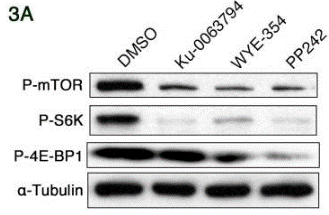
| Western blot | p-mTOR p-S6K / S6K / p-4E-BP1 / E7 / E6 / p53 |
|
24262658 |
기술 지원

제품은 연구용으로만 사용됩니다. 인체에는 사용하지 마십시오. 환자에게 판매하지 않습니다.
©Copyright 2013 Selleck Chemicals. All Rights Reserved.