
연구용
SM-164 IAP 길항제
제품 번호S7089
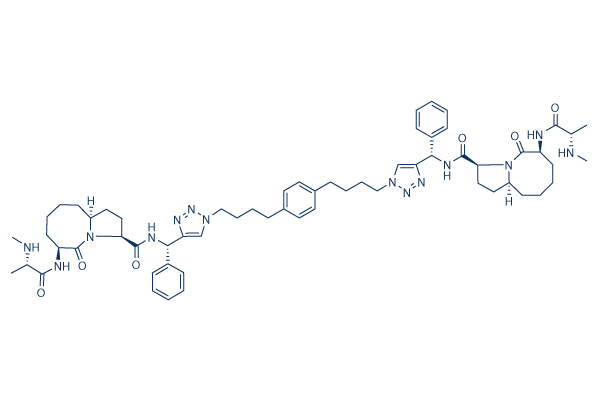
화학 구조
분자량: 1121.42
품질 관리
화학 정보, 보관 및 안정성
| 분자량 | 1121.42 | 화학식 | C62H84N14O6 |
보관 (수령일로부터) | |
|---|---|---|---|---|---|
| CAS 번호 | 957135-43-2 | -- | 원액 보관 |
|
|
| 동의어 | N/A | Smiles | CC(C(=O)NC1CCCCC2CCC(N2C1=O)C(=O)NC(C3=CC=CC=C3)C4=CN(N=N4)CCCCC5=CC=C(C=C5)CCCCN6C=C(N=N6)C(C7=CC=CC=C7)NC(=O)C8CCC9N8C(=O)C(CCCC9)NC(=O)C(C)NC)NC | ||
용해도
|
In vitro |
DMSO
: 3 mg/mL
(2.67 mM)
Water : Insoluble Ethanol : Insoluble |
몰농도 계산기
|
In vivo |
|||||
생체 내 제형 계산기 (투명한 용액)
1단계: 아래 정보 입력 (권장: 실험 중 손실을 고려하여 추가 동물 포함)
2단계: 생체 내 제형 입력 (이것은 계산기일 뿐 제형이 아닙니다. 용해도 섹션에 생체 내 제형이 없는 경우 먼저 당사에 문의하십시오.)
계산 결과:
작업 농도: mg/ml;
DMSO 원액 준비 방법: mg 약물 사전 용해 μL DMSO ( 원액 농도 mg/mL, 농도가 해당 약물 배치의 DMSO 용해도를 초과하는 경우 먼저 당사에 문의하십시오. )
생체 내 제형 준비 방법: 취하다 μL DMSO 원액, 다음 추가μL PEG300, 혼합하고 투명하게 한 다음 추가μL Tween 80, 혼합하고 투명하게 한 다음 추가 μL ddH2O, 혼합하고 투명하게 합니다.
생체 내 제형 준비 방법: 취하다 μL DMSO 원액, 다음 추가 μL 옥수수 기름, 혼합하고 투명하게 합니다.
참고: 1. 다음 용매를 추가하기 전에 액체가 투명한지 확인하십시오.
2. 용매를 순서대로 추가해야 합니다. 다음 용매를 추가하기 전에 이전 추가에서 얻은 용액이 투명한 용액인지 확인해야 합니다. 와동, 초음파 또는 뜨거운 물 중탕과 같은 물리적 방법을 사용하여 용해를 도울 수 있습니다.
작용 메커니즘
| 특징 |
The potency of bivalent SM-164 in binding, functional, and cellular assays is 2−3 orders of magnitude higher than its corresponding monovalent Smac mimetics.
|
|---|---|
| Targets/IC50/Ki |
XIAP
(Cell-free assay) 1.39 nM
|
| 시험관 내(In vitro) |
SM-164는 두 BIR 도메인을 포함하는 XIAP에 1.39 nM의 IC50로 결합하며, 이는 일가 counterparts 및 천연 Smac AVPI 펩타이드보다 각각 300배 및 7000배 더 강력합니다. 이 화합물은 세포 XIAP를 표적화하고 HL-60 백혈병 세포주에서 1 nM만큼 낮은 농도에서도 효과적으로 Apoptosis를 유도합니다. 이 화학물질은 암세포에서 카스파제-8 및 카스파제-3 의존성 Apoptosis를 유도합니다. 또한 TNFα 의존성 Apoptosis 및 cIAP-1 분해를 유도합니다. 유방암, 전립선암, 대장암의 TRAIL 민감성 및 TRAIL 저항성 암세포주 모두에서 시험관 내 TRAIL과 고도로 시너지 효과를 나타냅니다. 이 화합물은 카스파제-8 매개 외인성 Apoptosis 경로의 증폭을 통해 암세포에서 TRAIL 유도 Apoptosis를 강화합니다. |
| 키나아제 분석 |
결합 분석.
|
|
XIAP BIR3 단백질에 대한 FP 기반 분석법이 설명되어 있습니다. 간략하게, 5-카르복시플루오레세인은 변이된 Smac 펩타이드의 라이신 측쇄에 서열과 함께 접합되며, 이 형광 표지된 펩타이드(SM5F로 명명)는 XIAP BIR3에 대한 FP 기반 결합 분석에서 형광 트레이서로 사용됩니다. 이 형광 트레이서의 Kd 값은 XIAP BIR3에 대해 17.9 nM로 결정됩니다. 경쟁 결합 실험에서, 시험 화합물은 분석 완충액(100 mM 인산 칼륨, pH 7.5; 100 μg/ml 소 감마 글로불린; 0.02 % 아지드화 나트륨)에서 30 nM XIAP BIR3 단백질과 5 nM SM5F와 함께 배양됩니다. cIAP-1 BIR3 단백질에 대한 SM5F의 Kd 값은 4.1 nM로 결정됩니다. 경쟁 결합 실험에서, 10 nM cIAP-1 BIR3 단백질과 2 nM SM5F 트레이서가 사용됩니다. cIAP-2 BIR3 단백질에 대한 SM5F의 Kd 값은 6.6 nM로 결정됩니다. 경쟁 결합 실험에서, 25 nM cIAP-2 BIR3 단백질과 2 nM SM5F 트레이서가 사용됩니다. BIR2 및 BIR3 도메인을 모두 포함하는 XIAP에 대한 Smac 모방체의 결합 친화도를 결정하기 위해, Smac-1F로 명명된 이가 형광 표지된 트레이서를 사용하여 FP 기반 경쟁 결합 분석이 확립됩니다. BIR2 및 BIR3 도메인을 포함하는 XIAP에 대한 이가 표지된 트레이서의 Kd 값은 2.3 nM로 결정됩니다. 경쟁 결합 실험에서, 시험 화합물은 BIR2 및 BIR3 도메인(잔기 120-356)을 모두 포함하는 3 nM XIAP 단백질과 동일한 분석 완충액에서 1 nM과 함께 배양됩니다.
|
|
| 생체 내(In vivo) |
SM-164는 MDA-MB-231 이종이식 종양 조직에서 급속한 cIAP-1 분해 및 강력한 Apoptosis를 유도하고 종양 퇴행을 달성하지만, 정상 마우스 조직에는 독성이 없습니다. 이 화합물은 종양 조직에서 cIAP1 분해를 유도하고 TRAIL의 생체 내 항종양 활동을 극적으로 향상시키며, 이 화학물질과 TRAIL의 조합은 동물에 대한 독성 없이 종양 퇴행을 달성합니다. |
참조 |
|
기술 지원

제품은 연구용으로만 사용됩니다. 인체에는 사용하지 마십시오. 환자에게 판매하지 않습니다.
©Copyright 2013 Selleck Chemicals. All Rights Reserved.