
연구용
GSK126 EZH2 억제제
제품 번호S7061
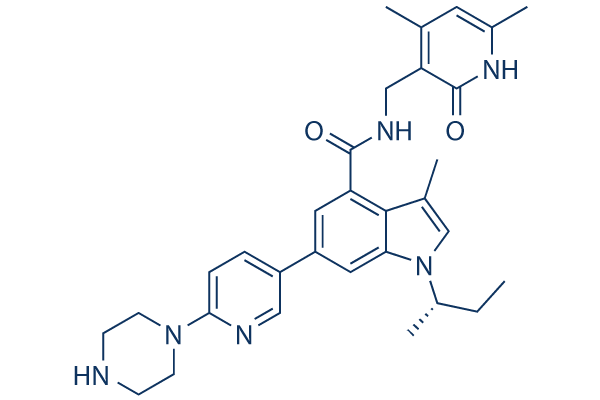
화학 구조
분자량: 526.67
품질 관리
세포 배양, 처리 및 작업 농도
| 세포주 | 분석 유형 | 농도 | 배양 시간 | 제형 | 활성 설명 | PMID |
|---|---|---|---|---|---|---|
| human U87MG cells | Cytotoxic assay | 72 h | Cytotoxicity against human U87MG cells assessed as growth inhibition after 72 hrs by WST-1 assay, GI50=28.5 μM. | 24767850 | ||
| human A549 cells | Cytotoxic assay | 72 h | Cytotoxicity against human A549 cells assessed as growth inhibition after 72 hrs by WST-1 assay, GI50=18.7 μM. | 24767850 | ||
| human T98G cells | Cytotoxic assay | 72 h | Cytotoxicity against human T98G cells assessed as growth inhibition after 72 hrs by WST-1 assay, GI50=12.6 μM. | 24767850 | ||
| human Daudi cells | Cytotoxic assay | 72 h | Cytotoxicity against human Daudi cells assessed as growth inhibition after 72 hrs by WST-1 assay, GI50=11.2 μM. | 24767850 | ||
| human PC3 cells | Cytotoxic assay | 72 h | Cytotoxicity against human PC3 cells assessed as growth inhibition after 72 hrs by WST-1 assay, GI50=9.4 μM. | 24767850 | ||
| human U2932 cells | Cytotoxic assay | 72 h | Cytotoxicity against human U2932 cells assessed as growth inhibition after 72 hrs by WST-1 assay, GI50=6.7 μM. | 24767850 | ||
| human HeLa cells | Function assay | 72 h | Inhibition of EZH2 in human HeLa cells assessed as reduction in H3K27me3 levels incubated for 72 hrs by ELISA method, IC50=0.28 μM. | 26189078 | ||
| human Pfeiffer cells | Cytotoxic assay | 72 h | Cytotoxicity against human Pfeiffer cells expressing EZH2 A667G mutant assessed as growth inhibition after 72 hrs by WST-1 assay, GI50=0.18 μM. | 24767850 | ||
| infected SF9 cells | Binding affinity to EZH2 (unknown origin) expressed in baculovirus infected SF9 cells co-expressing SUZ12/EED/RbAp48 complex assessed as binding off-rate at 0.4 uM incubated for 20 mins by Q-TOF mass spectrometry | 27512831 | ||||
| A673 cells | qHTS of pediatric cancer cell lines to identify multiple opportunities for drug repurposing: Primary screen for A673 cells | 29435139 | ||||
| DAOY cells | qHTS of pediatric cancer cell lines to identify multiple opportunities for drug repurposing: Primary screen for DAOY cells | 29435139 | ||||
| Saos-2 cells | qHTS of pediatric cancer cell lines to identify multiple opportunities for drug repurposing: Primary screen for Saos-2 cells | 29435139 | ||||
| BT-37 cells | qHTS of pediatric cancer cell lines to identify multiple opportunities for drug repurposing: Primary screen for BT-37 cells | 29435139 | ||||
| RD cells | qHTS of pediatric cancer cell lines to identify multiple opportunities for drug repurposing: Primary screen for RD cells | 29435139 | ||||
| SK-N-SH cells | qHTS of pediatric cancer cell lines to identify multiple opportunities for drug repurposing: Primary screen for SK-N-SH cells | 29435139 | ||||
| BT-12 cells | qHTS of pediatric cancer cell lines to identify multiple opportunities for drug repurposing: Primary screen for BT-12 cells | 29435139 | ||||
| MG 63 (6-TG R) cells | qHTS of pediatric cancer cell lines to identify multiple opportunities for drug repurposing: Primary screen for MG 63 (6-TG R) cells | 29435139 | ||||
| NB1643 cells | qHTS of pediatric cancer cell lines to identify multiple opportunities for drug repurposing: Primary screen for NB1643 cells | 29435139 | ||||
| OHS-50 cells | qHTS of pediatric cancer cell lines to identify multiple opportunities for drug repurposing: Primary screen for OHS-50 cells | 29435139 | ||||
| Rh41 cells | qHTS of pediatric cancer cell lines to identify multiple opportunities for drug repurposing: Primary screen for Rh41 cells | 29435139 | ||||
| SK-N-MC cells | qHTS of pediatric cancer cell lines to identify multiple opportunities for drug repurposing: Primary screen for SK-N-MC cells | 29435139 | ||||
| LAN-5 cells | qHTS of pediatric cancer cell lines to identify multiple opportunities for drug repurposing: Primary screen for LAN-5 cells | 29435139 | ||||
| 클릭하여 더 많은 세포주 실험 데이터 보기 | ||||||
화학 정보, 보관 및 안정성
| 분자량 | 526.67 | 화학식 | C31H38N6O2 |
보관 (수령일로부터) | |
|---|---|---|---|---|---|
| CAS 번호 | 1346574-57-9 | SDF 다운로드 | 원액 보관 |
|
|
| 동의어 | GSK2816126A, GSK2816126 | Smiles | CCC(C)N1C=C(C2=C(C=C(C=C21)C3=CN=C(C=C3)N4CCNCC4)C(=O)NCC5=C(C=C(NC5=O)C)C)C | ||
용해도
|
In vitro |
DMSO
: 5 mg/mL
(9.49 mM)
Ethanol : 4 mg/mL Water : Insoluble |
몰농도 계산기
|
In vivo |
|||||
생체 내 제형 계산기 (투명한 용액)
1단계: 아래 정보 입력 (권장: 실험 중 손실을 고려하여 추가 동물 포함)
2단계: 생체 내 제형 입력 (이것은 계산기일 뿐 제형이 아닙니다. 용해도 섹션에 생체 내 제형이 없는 경우 먼저 당사에 문의하십시오.)
계산 결과:
작업 농도: mg/ml;
DMSO 원액 준비 방법: mg 약물 사전 용해 μL DMSO ( 원액 농도 mg/mL, 농도가 해당 약물 배치의 DMSO 용해도를 초과하는 경우 먼저 당사에 문의하십시오. )
생체 내 제형 준비 방법: 취하다 μL DMSO 원액, 다음 추가μL PEG300, 혼합하고 투명하게 한 다음 추가μL Tween 80, 혼합하고 투명하게 한 다음 추가 μL ddH2O, 혼합하고 투명하게 합니다.
생체 내 제형 준비 방법: 취하다 μL DMSO 원액, 다음 추가 μL 옥수수 기름, 혼합하고 투명하게 합니다.
참고: 1. 다음 용매를 추가하기 전에 액체가 투명한지 확인하십시오.
2. 용매를 순서대로 추가해야 합니다. 다음 용매를 추가하기 전에 이전 추가에서 얻은 용액이 투명한 용액인지 확인해야 합니다. 와동, 초음파 또는 뜨거운 물 중탕과 같은 물리적 방법을 사용하여 용해를 도울 수 있습니다.
작용 메커니즘
| Targets/IC50/Ki |
EZH2
(Cell-free assay) 9.9 nM
|
|---|---|
| 시험관 내(In vitro) |
In vitro에서 GSK126은 EZH2 야생형 및 돌연변이 DLBCL 세포주 모두에서 H3K27me3를 가장 강력하게 억제하며, 이어서 H3K27me2를 억제합니다. 이 화합물은 또한 EZH2 돌연변이 DLBCL 세포주의 증식을 효과적으로 억제하고, 민감한 세포주에서 EZH2 표적 유전자의 전사 활성화를 유도합니다. A687V EZH2 돌연변이 세포에서 이 치료는 H3K27me3의 전반적인 감소, 강력한 유전자 활성화, 카스파제 활성화 및 증식 감소를 초래합니다. 모세포 H2087에서는 VEGF-A 및 인산화된 Ser(473)-AKT의 발현을 억제하여 세포 증식, 이동 및 전이를 억제합니다.
|
| 키나아제 분석 |
EZH2 분석
|
|
야생형 또는 돌연변이 EZH2를 포함하는 5개 구성원 PRC2 복합체(Flag–EZH2, EED, SUZ12, AEBP2, RbAp48)를 준비합니다. GSK126은 DMSO에 용해되어 0.6 nM에서 300 nM 농도로, 최종 DMSO 농도는 2.5%로 테스트됩니다. 시험관 내에서 H3K27me0를 기질로 선호하는 야생형 EZH2와 달리, EZH2 Y641 돌연변이는 H3K27me2를 선호하며 H3K27me0 또는 H3K27me1에 대한 활성은 거의 없습니다. A677G 돌연변이는 H3K27me0, H3K27me1 및 H3K27me2를 효율적으로 메틸화한다는 점에서 야생형 및 Y641 돌연변이 형태의 EZH2 모두와 다릅니다. 따라서 K27me0(야생형, A677G EZH2), K27me1(A677G EZH2) 또는 K27me2(A677G, Y641N, Y641C, Y641H, Y641S 및 Y641F EZH2)를 가진 히스톤 H3 펩타이드(잔기 21–44; 최종 10μM)가 methyltransferase 기질로 사용됩니다. 이 화합물은 플레이트에 첨가된 후 6 nM EZH2 복합체와 펩타이드가 첨가됩니다. 이 화학 물질의 효능은 [SAM] = Km에서 수행되는 분석의 강한 결합 한계에 있거나 그 근처에 있으므로, IC50 값은 경쟁 기질 SAM의 Km(SAM Km은 0.3 μM이고 SAM은 7.5 μM)에 비해 높은 농도에서 측정됩니다. 이러한 조건에서 효소 농도의 기여는 상대적으로 작아지며 정확한 Ki 추정치를 계산할 수 있습니다. 반응은 [3H]-SAM으로 시작하여 30분 동안 배양하고, 500배 초과의 비표지 SAM을 첨가하여 퀀칭하고, 메틸화된 생성물 펩타이드는 MSPH Multiscreen 플레이트용 공급업체 제공 프로토콜에 따라 포스포셀룰로스 필터에 포획됩니다. 플레이트는 20 μL Microscint-20 칵테일을 추가한 후 TopCount에서 판독됩니다. 겉보기 Ki 값은 경쟁 억제제에 대한 Cheng–Prusoff 관계를 사용하여 계산됩니다. IC50=Ki (1+[S]/Km)+[E]/2, 여기서 E는 효소이고 S는 기질입니다.
|
|
| 생체 내(In vivo) |
KARPAS-422 및 Pfeiffer 이종이식을 이식한 마우스에서 GSK126 (150 mg/kg/d, i.p.)은 전반적인 H3K27me3를 감소시키고 유전자 발현을 증가시켜 현저한 종양 퇴행을 유발합니다.
|
참조 |
|
적용 분야
| 방법 | 바이오마커 | 이미지 | PMID |
|---|---|---|---|
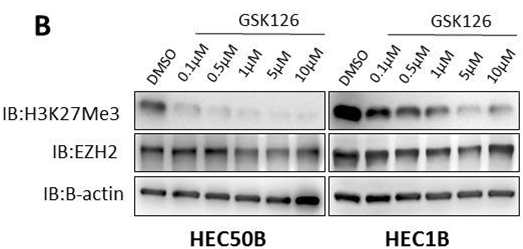
| Western blot | H3K27Me3 / EZH2 XIAP / Survivin / MCL-1 / BID / BIM / BAX / BCL-xl/ Bcl-2 β-catenin / c-Myc / LEF1 / DVL2 / DVL3 / p-GSK3β |
|
28418882 |
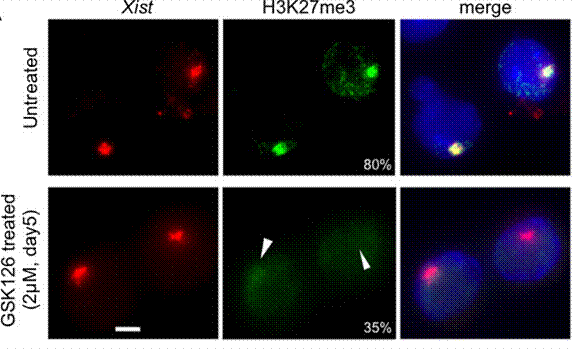
| Immunofluorescence | H3K27me3 |
|
25053977 |
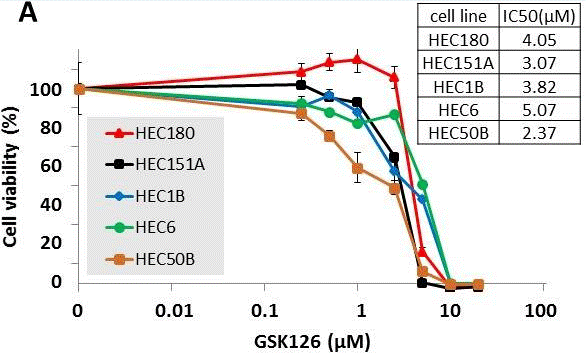
| Growth inhibition assay | Cell viability Cell proliferation |
|
28418882 |
임상시험 정보
(데이터 출처 https://clinicaltrials.gov, 업데이트 날짜 2024-05-22)
| NCT 번호 | 모집 | 조건 | 스폰서/협력자 | 시작일 | 단계 |
|---|---|---|---|---|---|
| NCT02082977 | Terminated | Cancer|Neoplasms |
GlaxoSmithKline |
April 24 2014 | Phase 1 |
기술 지원
자주 묻는 질문
질문 1:
Could you please suggest a vehicle for in vivo uses of this compound without oil?
답변:
It could be dissolved in 4% DMSO+30% PEG 300+ddH2O (0.5mg/ml).
질문 2:
Does this compound require an activation step to be functional? For example, an acidic or basic environment.
답변:
It does not require an activation step to be functional.

제품은 연구용으로만 사용됩니다. 인체에는 사용하지 마십시오. 환자에게 판매하지 않습니다.
©Copyright 2013 Selleck Chemicals. All Rights Reserved.