
연구용
Quisinostat (JNJ-26481585) Dihydrochloride HDAC 억제제
제품 번호S1096
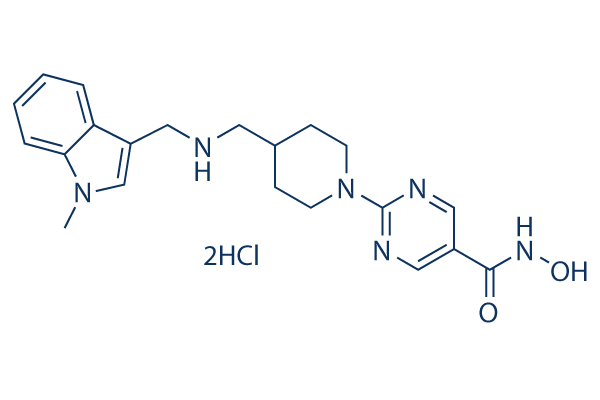
화학 구조
분자량: 467.39
품질 관리
세포 배양, 처리 및 작업 농도
| 세포주 | 분석 유형 | 농도 | 배양 시간 | 제형 | 활성 설명 | PMID |
|---|---|---|---|---|---|---|
| A549 cells | Cell viability assay | 24, 48, or 72 h | the IC50 values of cells for 48 and 72 h of quisinostat treatment were 82.4 and 42.0 nM, respectively. | 27423454 | ||
| RH30 cells | Function assay | 15 nM | 24 h and 30 h | GSK690 and JNJ-26481585 cooperated to induce cleavage of the initiator caspase-9 into its active p35 and p37 fragments and of the effector caspase-3 into its active p12 and p17 fragments | 28617441 | |
| RD cells | Function assay | 15 nM | 24 h and 30 h | GSK690 and JNJ-26481585 cooperated to induce cleavage of the initiator caspase-9 into its active p35 and p37 fragments and of the effector caspase-3 into its active p12 and p17 fragments | 28617441 | |
| HepG2 | Cell viability assay | 5, 10, 20, 40, 80, 160 and 320 nM | 24, 48, 72 h | The IC50 values of cells for quisinostat treatment at 48 and 72 h were 81.2 and 30.8 nM, respectively. | 28849080 | |
| HuT78 | Function assay | 10 nM | increases the level of acetylated lysine K10 of histone H3 | 30012418 | ||
| Sf9 | Function assay | Inhibition of full length recombinant human HDAC1 expressed in baculovirus infected Sf9 cells using RHKK-Ac as substrate by fluorescence analysis, IC50 = 0.00011 μM. | 27606546 | |||
| Sf9 | Function assay | Inhibition of full length recombinant human HDAC2 expressed in baculovirus infected Sf9 cells using RHKK-Ac as substrate by fluorescence analysis, IC50 = 0.00033 μM. | 27606546 | |||
| Sf9 | Function assay | Inhibition of full length recombinant human HDAC3/NCOR2 expressed in baculovirus infected Sf9 cells using RHKK-Ac as substrate by fluorescence analysis, IC50 = 0.00486 μM. | 27606546 | |||
| HUT78 | Function assay | 18 hrs | Pro-apoptotic activity in human HUT78 cells after 18 hrs by caspase-Glo 3/7 assay, EC50 = 0.0065 μM. | 30122227 | ||
| BL21 (DE3) | Function assay | Binding affinity to human His-thioredoxin-tagged HDAC8 expressed in Escherichia coli BL21 (DE3) cells by ITC method, Kd = 0.0227 μM. | 30347148 | |||
| BL21 (DE3) | Function assay | Binding affinity to Schistosoma mansoni His-tagged HDAC8 expressed in Escherichia coli BL21 (DE3) cells by ITC method, Kd = 0.0284 μM. | 30347148 | |||
| BL21 (DE3) | Function assay | Inhibition of human His-thioredoxin-tagged HDAC8 expressed in Escherichia coli BL21 (DE3) cells using Fluor de Lys (R)-HDAC8 as substrate by fluorometric method, IC50 = 0.0644 μM. | 30347148 | |||
| Sf9 | Function assay | Inhibition of full length recombinant human HDAC6 expressed in baculovirus infected Sf9 cells using RHKK-Ac as substrate by fluorescence analysis, IC50 = 0.0768 μM. | 27606546 | |||
| BL21 (DE3) | Function assay | Inhibition of human His-thioredoxin-tagged HDAC8 mL6 mutant expressed in Escherichia coli BL21 (DE3) cells using Fluor de Lys (R)-HDAC8 as substrate by fluorometric method, IC50 = 0.093 μM. | 30347148 | |||
| BL21 (DE3) | Function assay | Inhibition of human His-thioredoxin-tagged HDAC8 mL1/mL6 mutant expressed in Escherichia coli BL21 (DE3) cells using Fluor de Lys (R)-HDAC8 as substrate by fluorometric method, IC50 = 0.094 μM. | 30347148 | |||
| BL21 (DE3) | Function assay | Inhibition of human His-thioredoxin-tagged HDAC8 mL6/L179I mutant expressed in Escherichia coli BL21 (DE3) cells using Fluor de Lys (R)-HDAC8 as substrate by fluorometric method, IC50 = 0.169 μM. | 30347148 | |||
| BL21 (DE3) | Function assay | Inhibition of human His-thioredoxin-tagged HDAC8 mL1/mL6/L179I mutant expressed in Escherichia coli BL21 (DE3) cells using Fluor de Lys (R)-HDAC8 as substrate by fluorometric method, IC50 = 0.217 μM. | 30347148 | |||
| BL21 (DE3) | Function assay | Inhibition of Schistosoma mansoni His-tagged HDAC8 expressed in Escherichia coli BL21 (DE3) cells using Fluor de Lys (R)-HDAC8 as substrate by fluorometric method, IC50 = 0.3034 μM. | 30347148 | |||
| TC32 | qHTS assay | qHTS of pediatric cancer cell lines to identify multiple opportunities for drug repurposing: Primary screen for TC32 cells | 29435139 | |||
| U-2 OS | qHTS assay | qHTS of pediatric cancer cell lines to identify multiple opportunities for drug repurposing: Primary screen for U-2 OS cells | 29435139 | |||
| A673 | qHTS assay | qHTS of pediatric cancer cell lines to identify multiple opportunities for drug repurposing: Primary screen for A673 cells | 29435139 | |||
| DAOY | qHTS assay | qHTS of pediatric cancer cell lines to identify multiple opportunities for drug repurposing: Primary screen for DAOY cells | 29435139 | |||
| Saos-2 | qHTS assay | qHTS of pediatric cancer cell lines to identify multiple opportunities for drug repurposing: Primary screen for Saos-2 cells | 29435139 | |||
| BT-37 | qHTS assay | qHTS of pediatric cancer cell lines to identify multiple opportunities for drug repurposing: Primary screen for BT-37 cells | 29435139 | |||
| RD | qHTS assay | qHTS of pediatric cancer cell lines to identify multiple opportunities for drug repurposing: Primary screen for RD cells | 29435139 | |||
| SK-N-SH | qHTS assay | qHTS of pediatric cancer cell lines to identify multiple opportunities for drug repurposing: Primary screen for SK-N-SH cells | 29435139 | |||
| BT-12 | qHTS assay | qHTS of pediatric cancer cell lines to identify multiple opportunities for drug repurposing: Primary screen for BT-12 cells | 29435139 | |||
| MG 63 (6-TG R) | qHTS assay | qHTS of pediatric cancer cell lines to identify multiple opportunities for drug repurposing: Primary screen for MG 63 (6-TG R) cells | 29435139 | |||
| NB1643 | qHTS assay | qHTS of pediatric cancer cell lines to identify multiple opportunities for drug repurposing: Primary screen for NB1643 cells | 29435139 | |||
| OHS-50 | qHTS assay | qHTS of pediatric cancer cell lines to identify multiple opportunities for drug repurposing: Primary screen for OHS-50 cells | 29435139 | |||
| BT-12 | qHTS assay | qHTS of pediatric cancer cell lines to identify multiple opportunities for drug repurposing: Confirmatory screen for BT-12 cells | 29435139 | |||
| DAOY | qHTS assay | qHTS of pediatric cancer cell lines to identify multiple opportunities for drug repurposing: Confirmatory screen for DAOY cells | 29435139 | |||
| fibroblast cells | qHTS assay | qHTS of pediatric cancer cell lines to identify multiple opportunities for drug repurposing: Primary screen for control Hh wild type fibroblast cells | 29435139 | |||
| SK-N-SH | qHTS assay | qHTS of pediatric cancer cell lines to identify multiple opportunities for drug repurposing: Confirmatory screen for SK-N-SH cells | 29435139 | |||
| Rh41 | qHTS assay | qHTS of pediatric cancer cell lines to identify multiple opportunities for drug repurposing: Primary screen for Rh41 cells | 29435139 | |||
| A673 | qHTS assay | qHTS of pediatric cancer cell lines to identify multiple opportunities for drug repurposing: Confirmatory screen for A673 cells) | 29435139 | |||
| Rh30 | qHTS assay | qHTS of pediatric cancer cell lines to identify multiple opportunities for drug repurposing: Primary screen for Rh30 cells | 29435139 | |||
| MG 63 (6-TG R) | qHTS assay | qHTS of pediatric cancer cell lines to identify multiple opportunities for drug repurposing: Confirmatory screen for MG 63 (6-TG R) cells | 29435139 | |||
| fibroblast cells | qHTS assay | qHTS of pediatric cancer cell lines to identify multiple opportunities for drug repurposing: Confirmatory screen for control Hh wild type fibroblast cells | 29435139 | |||
| Rh30 | qHTS assay | qHTS of pediatric cancer cell lines to identify multiple opportunities for drug repurposing: Confirmatory screen for Rh30 cells | 29435139 | |||
| U-2 OS | qHTS assay | qHTS of pediatric cancer cell lines to identify multiple opportunities for drug repurposing: Confirmatory screen for U-2 OS cells | 29435139 | |||
| OHS-50 | qHTS assay | qHTS of pediatric cancer cell lines to identify multiple opportunities for drug repurposing: Confirmatory screen for OHS-50 cells | 29435139 | |||
| SK-N-SH | qHTS assay | qHTS of pediatric cancer cell lines to identify multiple opportunities for drug repurposing: Orthogonal 3D viability screen for SK-N-SH cells | 29435139 | |||
| Rh41 | qHTS assay | qHTS of pediatric cancer cell lines to identify multiple opportunities for drug repurposing: Confirmatory screen for Rh41 cells | 29435139 | |||
| RD | qHTS assay | qHTS of pediatric cancer cell lines to identify multiple opportunities for drug repurposing: Confirmatory screen for RD cells | 29435139 | |||
| Daoy | qHTS assay | qHTS of pediatric cancer cell lines to identify multiple opportunities for drug repurposing: Orthogonal 3D viability screen for Daoy cells | 29435139 | |||
| TC32 | qHTS assay | qHTS of pediatric cancer cell lines to identify multiple opportunities for drug repurposing: Orthogonal 3D viability screen for TC32 cells | 29435139 | |||
| MG 63 (6-TG R) | qHTS assay | qHTS of pediatric cancer cell lines to identify multiple opportunities for drug repurposing: Orthogonal 3D viability screen for MG 63 (6-TG R) cells | 29435139 | |||
| SJ-GBM2 | qHTS assay | qHTS of pediatric cancer cell lines to identify multiple opportunities for drug repurposing: Primary screen for SJ-GBM2 cells | 29435139 | |||
| SK-N-MC | qHTS assay | qHTS of pediatric cancer cell lines to identify multiple opportunities for drug repurposing: Primary screen for SK-N-MC cells | 29435139 | |||
| NB-EBc1 | qHTS assay | qHTS of pediatric cancer cell lines to identify multiple opportunities for drug repurposing: Primary screen for NB-EBc1 cells | 29435139 | |||
| LAN-5 | qHTS assay | qHTS of pediatric cancer cell lines to identify multiple opportunities for drug repurposing: Primary screen for LAN-5 cells | 29435139 | |||
| Rh18 | qHTS assay | qHTS of pediatric cancer cell lines to identify multiple opportunities for drug repurposing: Primary screen for Rh18 cells | 29435139 | |||
| NB1643 | qHTS assay | qHTS of pediatric cancer cell lines to identify multiple opportunities for drug repurposing: Confirmatory screen for NB1643 cells | 29435139 | |||
| SJ-GBM2 | qHTS assay | qHTS of pediatric cancer cell lines to identify multiple opportunities for drug repurposing: Confirmatory screen for SJ-GBM2 cells | 29435139 | |||
| Rh18 | qHTS assay | qHTS of pediatric cancer cell lines to identify multiple opportunities for drug repurposing: Confirmatory screen for Rh18 cells | 29435139 | |||
| Saos-2 | qHTS assay | qHTS of pediatric cancer cell lines to identify multiple opportunities for drug repurposing: Confirmatory screen for Saos-2 cells | 29435139 | |||
| SJ-GBM2 | qHTS assay | qHTS of pediatric cancer cell lines to identify multiple opportunities for drug repurposing: Orthogonal 3D viability screen for SJ-GBM2 cells | 29435139 | |||
| RD | qHTS assay | qHTS of pediatric cancer cell lines to identify multiple opportunities for drug repurposing: Orthogonal 3D viability screen for RD cells | 29435139 | |||
| 클릭하여 더 많은 세포주 실험 데이터 보기 | ||||||
화학 정보, 보관 및 안정성
| 분자량 | 467.39 | 화학식 | C21H28Cl2N6O2 |
보관 (수령일로부터) | |
|---|---|---|---|---|---|
| CAS 번호 | 875320-31-3 | -- | 원액 보관 |
|
|
| 동의어 | N/A | Smiles | CN1C=C(C2=CC=CC=C21)CNCC3CCN(CC3)C4=NC=C(C=N4)C(=O)NO.Cl.Cl | ||
용해도
|
In vitro |
DMSO
: 79 mg/mL
(169.02 mM)
Water : Insoluble Ethanol : Insoluble |
몰농도 계산기
|
In vivo |
|||||
생체 내 제형 계산기 (투명한 용액)
1단계: 아래 정보 입력 (권장: 실험 중 손실을 고려하여 추가 동물 포함)
2단계: 생체 내 제형 입력 (이것은 계산기일 뿐 제형이 아닙니다. 용해도 섹션에 생체 내 제형이 없는 경우 먼저 당사에 문의하십시오.)
계산 결과:
작업 농도: mg/ml;
DMSO 원액 준비 방법: mg 약물 사전 용해 μL DMSO ( 원액 농도 mg/mL, 농도가 해당 약물 배치의 DMSO 용해도를 초과하는 경우 먼저 당사에 문의하십시오. )
생체 내 제형 준비 방법: 취하다 μL DMSO 원액, 다음 추가μL PEG300, 혼합하고 투명하게 한 다음 추가μL Tween 80, 혼합하고 투명하게 한 다음 추가 μL ddH2O, 혼합하고 투명하게 합니다.
생체 내 제형 준비 방법: 취하다 μL DMSO 원액, 다음 추가 μL 옥수수 기름, 혼합하고 투명하게 합니다.
참고: 1. 다음 용매를 추가하기 전에 액체가 투명한지 확인하십시오.
2. 용매를 순서대로 추가해야 합니다. 다음 용매를 추가하기 전에 이전 추가에서 얻은 용액이 투명한 용액인지 확인해야 합니다. 와동, 초음파 또는 뜨거운 물 중탕과 같은 물리적 방법을 사용하여 용해를 도울 수 있습니다.
작용 메커니즘
| 특징 |
An orally bioavailable, second-generation, hydroxamic acid-based HDAC inhibitor.
|
|---|---|
| Targets/IC50/Ki |
HDAC1
(Cell-free assay) 0.11 nM
HDAC2
(Cell-free assay) 0.33 nM
HDAC11
(Cell-free assay) 0.37 nM
HDAC10
(Cell-free assay) 0.46 nM
HDAC4
(Cell-free assay) 0.64 nM
HDAC5
(Cell-free assay) 3.69 nM
HDAC8
(Cell-free assay) 4.26 nM
HDAC3
(Cell-free assay) 4.86 nM
|
| 시험관 내(In vitro) |
JNJ-26481585는 모든 폐암, 유방암, 결장암, 전립선암, 뇌암 및 난소암 종양 세포주와 같은 고형 및 혈액암 세포주에서 광범위한 항증식 활성을 나타내며, IC50은 3.1-246 nM 범위로, 테스트된 다양한 인간 암 세포주에서 R306465, CRA-24781 또는 mocetinostat보다 더 강력합니다. 최근 연구에 따르면 JNJ-26481585는 낮은 나노몰 농도에서 Mcl-1 고갈 및 Hsp72 유도를 통해 골수종 세포 사멸을 촉진합니다. |
| 키나아제 분석 |
HDAC 활성 분석
|
|
모든 경우에, 전체 길이 HDAC 단백질은 바큘로바이러스에 감염된 Sf9 세포를 사용하여 발현됩니다. 또한, HDAC3은 인간 NCOR2와 복합체로 공동 발현됩니다. HDAC1 함유 세포 복합체의 활성을 평가하기 위해, 면역침전된 HDAC1 복합체는 [3H]아세틸-표지된 히스톤 H4 펩타이드 단편 [biotin-(6-aminohexanoic)Gly-Ala-(acetyl[3H])Lys-Arg-His-Arg-Lys-Val-NH2]와 50μL 효소 분석 완충액 (25mM HEPES (pH 7.4), 1 M 수크로스, 0.1 mg/mL BSA 및 0.01% (v/v) Triton X-100) 총 부피에서 배양됩니다. 배양은 37 °C에서 45분 (면역침전물) 또는 실온에서 30분 동안 수행됩니다. 기질 첨가 전에, HDAC 억제제는 증가하는 농도로 첨가되고 실온에서 10분 동안 사전 배양됩니다. 배양 후, 반응은 35μL 정지 완충액 (1 M HCl 및 0.4 M 아세트산)으로 정지됩니다. 방출된 [3H]아세트산은 800μL 에틸 아세테이트로 추출되고 신틸레이션 계수로 정량화됩니다. 웨스턴 블롯 분석에 의해 표시된 바와 같이 동일한 양의 HDAC1이 면역침전됩니다. HDAC1 활성 결과는 단일 용해물에 대한 세 가지 독립적인 실험의 평균 ± SD로 제시됩니다.
|
|
| 생체 내(In vivo) |
HDAC1 반응성 A2780 난소 종양 스크리닝 모델에서, JNJ-26481585를 최대 허용 용량(10 mg/kg i.p. 및 40 mg/kg p.o.)으로 3일간 투여하면 HDAC1 조절 형광을 유도하며, 이는 종양 성장 억제를 예측합니다. 또한, JNJ-26481585는 C170HM2 대장암 간 전이의 성장에 대해 더 강력한 억제 효과를 보입니다. |
참조 |
|
적용 분야
| 방법 | 바이오마커 | 이미지 | PMID |
|---|---|---|---|
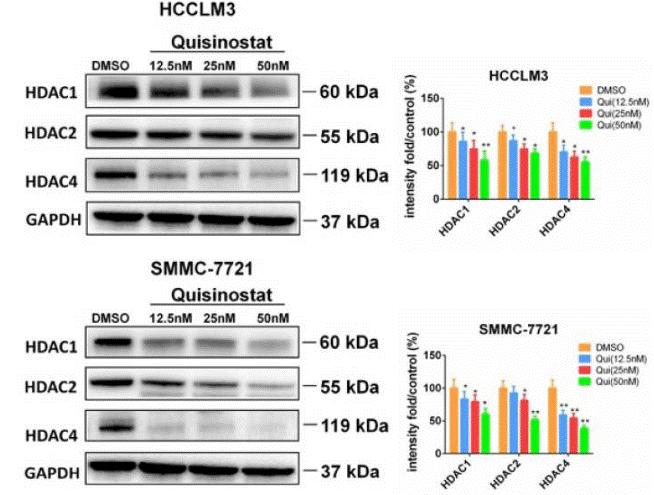
| Western blot | HDAC1 / HDAC2 / HDAC4 p21 / CDK2 / CDK4 / CDK6 / Cyclin D1 / Cyclin E1 / Cyclin A2 Caspase-3/ Cleaved caspase-3 / caspase-9 / Cleaved caspase-9 / PARP / Cleaved PARP / Bcl-xl / Bcl2 / Bax / Survivin PI3K-p110 / PI3K-p85 / p-AKT / JNK / p-JNK / p-c-Jun |
|
30443188 |
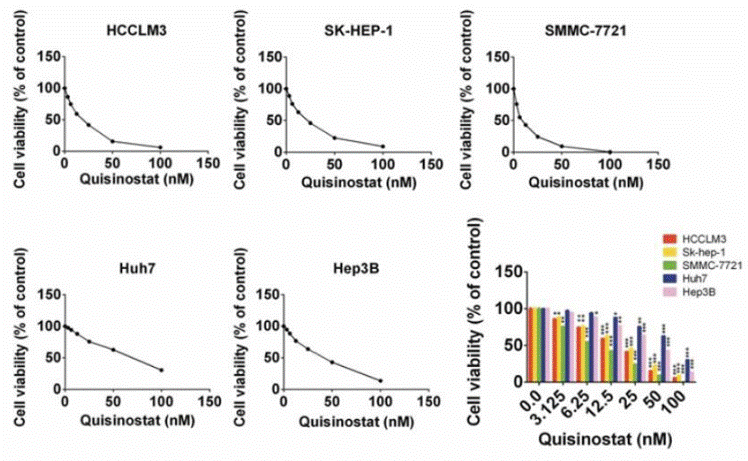
| Growth inhibition assay | Cell viability |
|
30443188 |
임상시험 정보
(데이터 출처 https://clinicaltrials.gov, 업데이트 날짜 2024-05-22)
| NCT 번호 | 모집 | 조건 | 스폰서/협력자 | 시작일 | 단계 |
|---|---|---|---|---|---|
| NCT02948075 | Completed | Ovarian Cancer |
NewVac LLC|Janssen Pharmaceutica N.V. Belgium |
September 2015 | Phase 2 |
| NCT01464112 | Completed | Multiple Myeloma |
Janssen Research & Development LLC |
September 16 2011 | Phase 1 |
| NCT00676728 | Terminated | Advanced or Refractory Leukemia|Myelodysplastic Syndromes |
Johnson & Johnson Pharmaceutical Research & Development L.L.C. |
December 2008 | Phase 1 |
| NCT00677105 | Completed | Lymphoma|Neoplasms |
Johnson & Johnson Pharmaceutical Research & Development L.L.C.|Janssen Pharmaceutica N.V. Belgium |
August 2007 | Phase 1 |
기술 지원
자주 묻는 질문
질문 1:
I was thinking of resuspending it in 10% hydroxy-propyl-β-cyclodextrin, 25mg/ml mannitol, in sterile water (final pH 8.7). Is this a good vehicle to use? What is the solubility of this compound in such a vehicle?
답변:
This vehicle can be used for in vivo studies. The following papers also used this vehicle: 1. http://www.nature.com/leu/journal/v23/n10/full/leu2009121a.html; 2. http://cancerres.aacrjournals.org/content/69/13/5307.long (The solvent contains 10% hydroxypropyl-β-cyclodextrin, 0.8% HCl (0.1 N), 0.9 % NaOH (0.1 N), 3.4% mannitol and pyrogen-free water). Its solubility is 2mg/ml.

제품은 연구용으로만 사용됩니다. 인체에는 사용하지 마십시오. 환자에게 판매하지 않습니다.
©Copyright 2013 Selleck Chemicals. All Rights Reserved.