
연구용
Eprenetapopt (APR-246) p53 활성제
제품 번호S7724
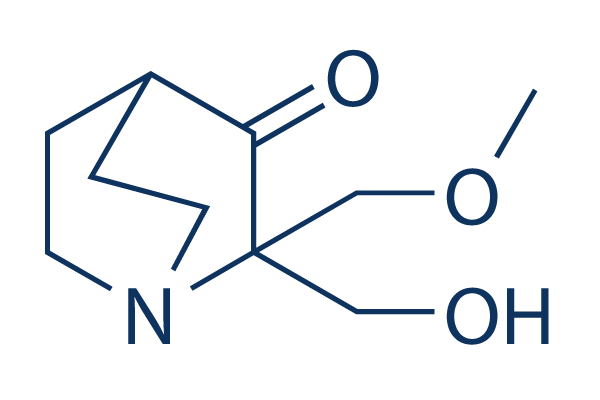
화학 구조
분자량: 199.25
품질 관리
세포 배양, 처리 및 작업 농도
| 세포주 | 분석 유형 | 농도 | 배양 시간 | 제형 | 활성 설명 | PMID |
|---|---|---|---|---|---|---|
| NALM-6 | Cell viability assay | high sensitivity and cell death induction in all TP53mut leukemias, but low APR-246 sensitivity in TP53wt ALL | 31073076 | |||
| UoCB-6 | Cell viability assay | high sensitivity and cell death induction in all TP53mut leukemias, but low APR-246 sensitivity in TP53wt ALL | 31073076 | |||
| EU-3 | Cell viability assay | high sensitivity and cell death induction in all TP53mut leukemias, but low APR-246 sensitivity in TP53wt ALL | 31073076 | |||
| MUTZ-5 | Cell viability assay | high sensitivity and cell death induction in all TP53mut leukemias, but low APR-246 sensitivity in TP53wt ALL | 31073076 | |||
| KOPN-8 | Cell viability assay | high sensitivity and cell death induction in all TP53mut leukemias, but low APR-246 sensitivity in TP53wt ALL | 31073076 | |||
| RS4;11 | Cell viability assay | high sensitivity and cell death induction in all TP53mut leukemias, but low APR-246 sensitivity in TP53wt ALL | 31073076 | |||
| SKBR3 | Cell cycle assay | 5 µM | 2 weeks | lapatinib in combination with APR-246 caused a lower level of G1 arrest and an increase in the sub-G1 fraction | 30743996 | |
| BT549 | Cell viability assay | IC50=3.1 μM | 30196236 | |||
| MDA-MB-468 | Cell viability assay | IC50=5 μM | 30196236 | |||
| MDA-MB-231 | Cell viability assay | IC50=4.1 μM | 30196236 | |||
| HCC1143 | Cell viability assay | IC50=6.8 μM | 30196236 | |||
| MDA-MB-453 | Cell viability assay | IC50=0.9 μM | 30196236 | |||
| SKBR3 | Cell viability assay | IC50=5.1 μM | 30196236 | |||
| UACC812 | Cell viability assay | IC50=11.3 μM | 30196236 | |||
| MCF7 | Cell viability assay | IC50=31.1 μM | 30196236 | |||
| MCF10A | Cell viability assay | IC50=5.2 μM | 30196236 | |||
| UMSCC10A | Cell viability assay | 0-50 μM | 72 h | suppressed cell survival and bore a modest effect on the killing of HNSCC cells | 29348462 | |
| FaDu | Cell viability assay | 0-50 μM | 72 h | suppressed cell survival and bore a modest effect on the killing of HNSCC cells | 29348462 | |
| TC32 | qHTS assay | qHTS of pediatric cancer cell lines to identify multiple opportunities for drug repurposing: Primary screen for TC32 cells | 29435139 | |||
| DAOY | qHTS assay | qHTS of pediatric cancer cell lines to identify multiple opportunities for drug repurposing: Primary screen for DAOY cells | 29435139 | |||
| SJ-GBM2 | qHTS assay | qHTS of pediatric cancer cell lines to identify multiple opportunities for drug repurposing: Primary screen for SJ-GBM2 cells | 29435139 | |||
| A673 | qHTS assay | qHTS of pediatric cancer cell lines to identify multiple opportunities for drug repurposing: Primary screen for A673 cells | 29435139 | |||
| SK-N-MC | qHTS assay | qHTS of pediatric cancer cell lines to identify multiple opportunities for drug repurposing: Primary screen for SK-N-MC cells | 29435139 | |||
| BT-37 | qHTS assay | qHTS of pediatric cancer cell lines to identify multiple opportunities for drug repurposing: Primary screen for BT-37 cells | 29435139 | |||
| NB-EBc1 | qHTS assay | qHTS of pediatric cancer cell lines to identify multiple opportunities for drug repurposing: Primary screen for NB-EBc1 cells | 29435139 | |||
| Saos-2 | qHTS assay | qHTS of pediatric cancer cell lines to identify multiple opportunities for drug repurposing: Primary screen for Saos-2 cells | 29435139 | |||
| SK-N-SH | qHTS assay | qHTS of pediatric cancer cell lines to identify multiple opportunities for drug repurposing: Primary screen for SK-N-SH cells | 29435139 | |||
| NB1643 | qHTS assay | qHTS of pediatric cancer cell lines to identify multiple opportunities for drug repurposing: Primary screen for NB1643 cells | 29435139 | |||
| LAN-5 | qHTS assay | qHTS of pediatric cancer cell lines to identify multiple opportunities for drug repurposing: Primary screen for LAN-5 cells | 29435139 | |||
| BT-12 | qHTS assay | qHTS of pediatric cancer cell lines to identify multiple opportunities for drug repurposing: Primary screen for BT-12 cells | 29435139 | |||
| OHS-50 | qHTS assay | qHTS of pediatric cancer cell lines to identify multiple opportunities for drug repurposing: Primary screen for OHS-50 cells | 29435139 | |||
| MG 63 (6-TG R) | qHTS assay | qHTS of pediatric cancer cell lines to identify multiple opportunities for drug repurposing: Primary screen for MG 63 (6-TG R) cells | 29435139 | |||
| Rh41 | qHTS assay | qHTS of pediatric cancer cell lines to identify multiple opportunities for drug repurposing: Primary screen for Rh41 cells | 29435139 | |||
| 클릭하여 더 많은 세포주 실험 데이터 보기 | ||||||
화학 정보, 보관 및 안정성
| 분자량 | 199.25 | 화학식 | C10H17NO3 |
보관 (수령일로부터) | |
|---|---|---|---|---|---|
| CAS 번호 | 5291-32-7 | SDF 다운로드 | 원액 보관 |
|
|
| 동의어 | PRIMA-1MET | Smiles | COCC1(C(=O)C2CCN1CC2)CO | ||
용해도
|
In vitro |
DMSO
: 40 mg/mL
(200.75 mM)
Water : 40 mg/mL Ethanol : 40 mg/mL |
몰농도 계산기
|
In vivo |
|||||
생체 내 제형 계산기 (투명한 용액)
1단계: 아래 정보 입력 (권장: 실험 중 손실을 고려하여 추가 동물 포함)
2단계: 생체 내 제형 입력 (이것은 계산기일 뿐 제형이 아닙니다. 용해도 섹션에 생체 내 제형이 없는 경우 먼저 당사에 문의하십시오.)
계산 결과:
작업 농도: mg/ml;
DMSO 원액 준비 방법: mg 약물 사전 용해 μL DMSO ( 원액 농도 mg/mL, 농도가 해당 약물 배치의 DMSO 용해도를 초과하는 경우 먼저 당사에 문의하십시오. )
생체 내 제형 준비 방법: 취하다 μL DMSO 원액, 다음 추가μL PEG300, 혼합하고 투명하게 한 다음 추가μL Tween 80, 혼합하고 투명하게 한 다음 추가 μL ddH2O, 혼합하고 투명하게 합니다.
생체 내 제형 준비 방법: 취하다 μL DMSO 원액, 다음 추가 μL 옥수수 기름, 혼합하고 투명하게 합니다.
참고: 1. 다음 용매를 추가하기 전에 액체가 투명한지 확인하십시오.
2. 용매를 순서대로 추가해야 합니다. 다음 용매를 추가하기 전에 이전 추가에서 얻은 용액이 투명한 용액인지 확인해야 합니다. 와동, 초음파 또는 뜨거운 물 중탕과 같은 물리적 방법을 사용하여 용해를 도울 수 있습니다.
작용 메커니즘
| Targets/IC50/Ki |
Mutant p53
|
|---|---|
| 시험관 내(In vitro) |
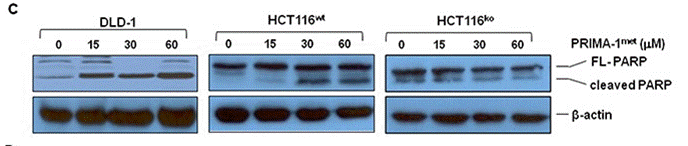
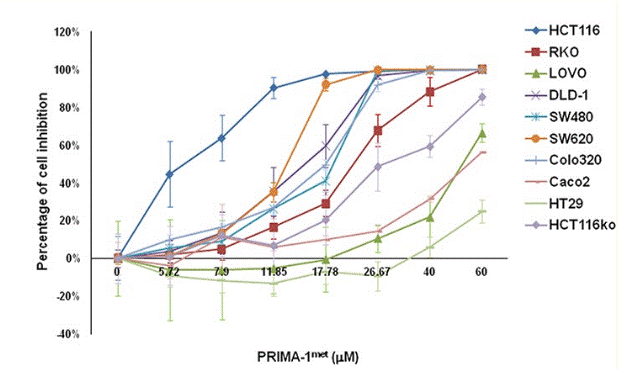
PRIMA-1MET으로도 알려진 Eprenetapopt (APR-246)은 돌연변이 p53을 재활성화하고 Apoptosis를 유도하는 최초의 임상 단계 화합물입니다. 이는 활성 화합물인 메틸렌 퀴누클리디논(MQ)으로 전환되는 전구약물로, MQ는 돌연변이 p53의 시스테인 잔기에 결합하여 야생형 형태를 회복시키는 마이클 수용체입니다. 이 화합물은 p53을 재활성화할 뿐만 아니라 용량 의존적으로 세포 내 글루타티온 수치를 감소시킵니다. ROS 및 소포체(ER) 스트레스를 유도하고 티오레독신 환원효소 1(TrxR1)을 억제함으로써 p53 독립적인 방식으로 Apoptosis를 유발할 수 있습니다. 또한 APR-246은 GSH/ROS 균형을 손상시킴으로써 p53 상태와 무관하게 골수종 세포에서 세포 사멸을 유도하는 것으로 보고되었습니다. PRIMA-1Met/APR-246은 시험관 내에서 돌연변이 p53을 발현하는 SCLC 세포주의 성장을 효율적으로 억제하고 Apoptosis를 유도했으며, 이는 단편화된 DNA를 가진 세포의 비율 증가, caspase-3 활성화, PARP 절단, Bax 및 Noxa 상향 조절 및 Bcl-2 하향 조절과 관련이 있었습니다. |
| 생체 내(In vivo) |
혈액암 및 전립선암에 대한 1/2상 임상 용량 탐색 연구에서 Eprenetapopt (APR-246)은 우수한 안전성 프로파일을 보였으며, 임상적 및 p53 의존적 생물학적 반응이 모두 관찰되었습니다. 동물 연구에서 잘 용인되었으며, 이 화합물로 단일 치료 시 공격적으로 성장하는 A2780-CP20 종양 이종이식편을 가진 생쥐에서 종양 성장을 21% 억제했습니다. |
참조 |
|
적용 분야
| 방법 | 바이오마커 | 이미지 | PMID |
|---|---|---|---|
| Western blot | FL-PARP / Cleaved PARP p-p53 |
|
26452133 |
| Growth inhibition assay | Cell viability |
|
26452133 |
임상시험 정보
(데이터 출처 https://clinicaltrials.gov, 업데이트 날짜 2024-05-22)
| NCT 번호 | 모집 | 조건 | 스폰서/협력자 | 시작일 | 단계 |
|---|---|---|---|---|---|
| NCT04383938 | Completed | Bladder Cancer|Gastric Cancer|Non Small Cell Lung Cancer|NSCLC|Urothelial Carcinoma|Advanced Solid Tumor |
Aprea Therapeutics |
June 25 2020 | Phase 1|Phase 2 |
| NCT04214860 | Completed | Myeloid Malignancy |
Aprea Therapeutics |
December 13 2019 | Phase 1 |
| NCT03391050 | Terminated | Melanoma |
Aprea Therapeutics|Jules Bordet Institute |
January 18 2018 | Phase 1|Phase 2 |
| NCT02999893 | Terminated | Oesophageal Carcinoma |
Peter MacCallum Cancer Centre Australia |
April 11 2017 | Phase 1|Phase 2 |
기술 지원

제품은 연구용으로만 사용됩니다. 인체에는 사용하지 마십시오. 환자에게 판매하지 않습니다.
©Copyright 2013 Selleck Chemicals. All Rights Reserved.