
연구용
Y-27632 Dihydrochloride ROCK 억제제
제품 번호S1049
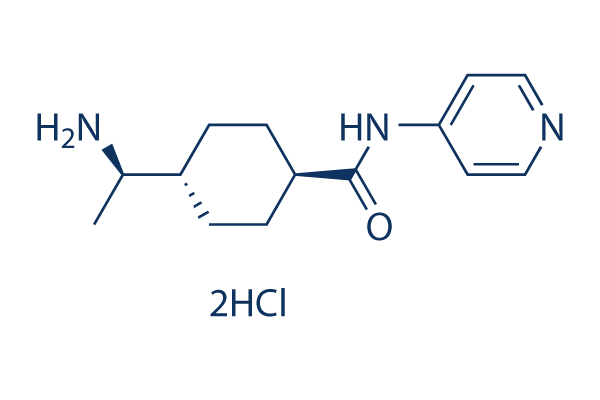
화학 구조
분자량: 320.26
품질 관리
함께 자주 사용되는 제품 Y-27632 Dihydrochloride
세포 배양, 처리 및 작업 농도
| 세포주 | 분석 유형 | 농도 | 배양 시간 | 제형 | 활성 설명 | PMID |
|---|---|---|---|---|---|---|
| Salivary gland stem cells | Function Assay | 10 µM | 7 d | Reduces SGSC senescence | 25804560 | |
| HT22 | Cytotoxic Assay | 10 µM | 13 h | Protects against glutamate-induced neuronal death | 22810835 | |
| Swiss3T3 | Colony-forming Assay | 10 µM | 13 d | Increases prostate cell colony-forming activity | 21464902 | |
| TSGH 8301 | Migration Assay | 20 µM | 1 h | Increases cell migration | 19896475 | |
| Cynomolgus monkey embryonic stem cells | Cytotoxic Assay | 20 µM | 24 h | Promotes cyES cell survival | 18940855 | |
| PC 12 | Function Assay | 10 μM | 24 h | Attenuates catecholamine biosynthesis | 16219424 | |
| C2C12 | Function Assay | 10 μM | 6 h | Prevents the serine phosphorylation of IRS-1 induced by insulin and/or TNF-α | 16267124 | |
| Pancreatic acinar cells | Function Assay | 10 μM | 70 min | Potentiates CCK-stimulated pancreatic enzyme secretion | 12745080 | |
| Rat hepatic stellate cells | Function Assay | 30 μM | 48 h | Diminishes the phosphorylation of Erk2, and decreases new DNA synthesis | 10845663 | |
| LNCaP | Growth Inhibition Assay | 25 μM | 17 h | Does not inhibit cell growth | 10720471 | |
| PC3 | Growth Inhibition Assay | 25 μM | 17 h | Does not inhibit cell growth | 10720471 | |
| PC3 | Migration Assay | 25 μM | 1 h | Inhibits the BMFB-CM and the EGF-stimulated migration | 10720471 | |
| PC3 | Function Assay | 25 μM | 1 h | Induces morphological changes | 10720471 | |
| Rat Vascular Smooth Muscle Cells | Function Assay | 10 μM | 2 h | Inhibits angiotensin II-induced hypertrophy | 10642317 | |
| Stellate Cell | Function Assay | 25 μM | 15 min | Inhibits formation of F-actin stress fibers and phosphorylation of myosin light chain | 10600496 | |
| Neonatal rat ventricular myocytes | Function Assay | 10 μM | 48 h | Inhibits ET-1-induced increases in protein synthesis, cell size and myofibrillar organization | 10386613 | |
| LS174T | Growth Inhibition Assay | 10 μM | 18 d | Moderately inhibits cell growth | 10021386 | |
| HCT116 | Growth Inhibition Assay | 10 μM | 18 d | Strongly inhibits cell growth | 10021386 | |
| HCT15 | Growth Inhibition Assay | 10 μM | 18 d | Does not inhibit cell growth | 10021386 | |
| SW620 | Growth Inhibition Assay | 10 μM | 18 d | Does not inhibit cell growth | 10021386 | |
| Src-2 | Growth Inhibition Assay | 10 μM | 18 d | Does not inhibit cell growth | 10021386 | |
| Src-1 | Growth Inhibition Assay | 10 μM | 18 d | Does not inhibit cell growth | 10021386 | |
| NIH3T3 | Growth Inhibition Assay | 10 μM | 18 d | Does not inhibit cell growth | 10021386 | |
| Src-4 | Growth Inhibition Assay | 10 μM | 18 d | Does not inhibit cell growth | 10021386 | |
| Src-1 | Growth Inhibition Assay | 10 μM | 18 d | Does not inhibit cell growth | 10021386 | |
| Ras-4 | Growth Inhibition Assay | 10 μM | 18 d | Strongly inhibits cell growth | 10021386 | |
| Ras-2 | Growth Inhibition Assay | 10 μM | 18 d | Strongly inhibits cell growth | 10021386 | |
| mNET1-e | Growth Inhibition Assay | 10 μM | 18 d | Strongly inhibits cell growth | 10021386 | |
| mNET1-d | Growth Inhibition Assay | 10 μM | 18 d | Strongly inhibits cell growth | 10021386 | |
| Dbl-e | Growth Inhibition Assay | 10 μM | 18 d | Moderately inhibits cell growth | 10021386 | |
| Dbl-d | Growth Inhibition Assay | 10 μM | 18 d | Strongly inhibits cell growth | 10021386 | |
| NIH3T3 | Growth Inhibition Assay | 10 μM | 18 d | Does not inhibit cell growth | 10021386 | |
| Mesothelial cells from rat mesentery | Invasive Assay | 30 μM | 20 h | Blocks invasive activity | 9930872 | |
| CCL39 | Function Assay | 30 μM | 30 min | Completely abolishes activation of Na-H exchanger NHE1 by integrins | 9693382 | |
| HeLa | Function Assay | 10 μM | 30 min | Inhibits the formation of stress fibers and the assembly of vinculin-containing focal adhesions | 9668072 | |
| N1E-115 | Function Assay | 10 μM | 2 h | DMSO | Inhibits the assembly of microtubules and intermediate filaments to form extended processes | 9647654 |
| Swiss 3T3 cells | Function Assay | 10 μM | 2 h | DMSO | Inhibits the assembly of microtubules and intermediate filaments to form extended processes | 9647654 |
| 클릭하여 더 많은 세포주 실험 데이터 보기 | ||||||
화학 정보, 보관 및 안정성
| 분자량 | 320.26 | 화학식 | C14H21N3O.2HCl |
보관 (수령일로부터) | |
|---|---|---|---|---|---|
| CAS 번호 | 129830-38-2 | SDF 다운로드 | 원액 보관 |
|
|
| 동의어 | N/A | Smiles | CC(C1CCC(CC1)C(=O)NC2=CC=NC=C2)N.Cl.Cl | ||
용해도
|
In vitro |
DMSO
: 64 mg/mL
(199.83 mM)
Water : 64 mg/mL Ethanol : 4 mg/mL |
몰농도 계산기
|
In vivo |
|||||
생체 내 제형 계산기 (투명한 용액)
1단계: 아래 정보 입력 (권장: 실험 중 손실을 고려하여 추가 동물 포함)
2단계: 생체 내 제형 입력 (이것은 계산기일 뿐 제형이 아닙니다. 용해도 섹션에 생체 내 제형이 없는 경우 먼저 당사에 문의하십시오.)
계산 결과:
작업 농도: mg/ml;
DMSO 원액 준비 방법: mg 약물 사전 용해 μL DMSO ( 원액 농도 mg/mL, 농도가 해당 약물 배치의 DMSO 용해도를 초과하는 경우 먼저 당사에 문의하십시오. )
생체 내 제형 준비 방법: 취하다 μL DMSO 원액, 다음 추가μL PEG300, 혼합하고 투명하게 한 다음 추가μL Tween 80, 혼합하고 투명하게 한 다음 추가 μL ddH2O, 혼합하고 투명하게 합니다.
생체 내 제형 준비 방법: 취하다 μL DMSO 원액, 다음 추가 μL 옥수수 기름, 혼합하고 투명하게 합니다.
참고: 1. 다음 용매를 추가하기 전에 액체가 투명한지 확인하십시오.
2. 용매를 순서대로 추가해야 합니다. 다음 용매를 추가하기 전에 이전 추가에서 얻은 용액이 투명한 용액인지 확인해야 합니다. 와동, 초음파 또는 뜨거운 물 중탕과 같은 물리적 방법을 사용하여 용해를 도울 수 있습니다.
작용 메커니즘
| Targets/IC50/Ki |
ROCK1 (p160ROCK)
(Cell-free assay) 140 nM(Ki)
ROCK2
(Cell-free assay) 300 nM(Ki)
|
|---|---|
| 시험관 내(In vitro) |
Y-27632 2HCl은 ROCK-II를 억제하는 반면, Ki가 각각 26 μM, 25 μM 및 > 250 μM인 PKC, cAMP 의존성 단백질 키나아제 및 미오신 경쇄 키나아제(MLCK)에 대해서는 거의 활성을 보이지 않으며, 다른 Rho-family GTPase 멤버인 Cdc42에 의해 활성화되는 PKA에 대해서도 마찬가지입니다. 이 화합물은 페닐에프린, 히스타민, 아세틸콜린, 세로토닌, 엔도텔린 및 트롬복산을 포함한 다양한 작용제에 의해 유도되는 평활근 수축을 IC50 0.3-1 μM으로 억제하며, Ca2+ 민감화를 선택적으로 억제합니다. 이는 배양 세포에서 Rho-유도, p160ROCK-매개 스트레스 섬유 형성을 억제합니다. 이 화학 처리는 농도 의존적으로 Rho-매개 액토미오신 활성화와 MM1 세포의 LPA-자극 침습 활성을 모두 차단합니다. 이 화합물 처리는 풍부한 축삭돌기 형성 시작에 충분할 뿐만 아니라, 축삭 발생의 초기 단계 동안 축삭 성숙을 촉진하며, 축삭 신장은 크게 유지합니다. 인간 배아 줄기(hES) 세포에서 10 μM의 이 화학 처리는 무혈청 현탁(SFEB) 배양에서도 해리 유도 세포사멸을 현저히 감소시키고, 클로닝 효율을 증가시키며(~1%에서 ~27%로), 유전자 전달 후 서브클로닝을 용이하게 하고, SFEB 배양 hES 세포가 생존하여 Bf1+ 피질 및 기저 종뇌 전구세포로 분화하도록 합니다. |
| 키나아제 분석 |
인산화 반응
|
|
p160ROCK은 태그된 전장 단백질로 COS 세포에서 발현되며, 항태그 항체를 사용하여 면역침전됩니다. p160ROCK (30 ng)은 40 μM [γ-32P]ATP (3.3 Ci/mmol) 및 3 μg의 히스톤 (HF2A), 탈인산화 카제인 또는 MBP와 함께 다양한 농도의 이 화합물 존재 하에 30 °C에서 총 31 μL 부피로 배양됩니다. 0, 5, 10, 20분 간격으로 7 μL의 시료를 취하여 동량의 2 × Laemmli 시료 버퍼와 혼합한 후 SDS-PAGE에 적용합니다. 겔은 코마시 블루로 염색하고 건조한 후 Bioimage Analyzer BAS2000으로 분석합니다. p160ROCK 활성을 50% 억제하는 데 필요한 이 화학 물질의 농도(IC50 값)를 얻습니다. Ki 값은 Ki = IC50/(1 + S/Km) 방정식에 따라 계산되며, 여기서 S와 Km은 ATP에 대한 농도와 Km 값을 나타냅니다.
|
|
| 생체 내(In vivo) |
Y-27632 2HCl 30 mg/kg 경구 투여는 자발적 고혈압 쥐, 신장성 고혈압 쥐, 그리고 데옥시코르티코스테론 아세테이트(DOCA)-염분 고혈압 쥐에서 용량 의존적으로 혈압을 유의하게 감소시킵니다. 이 화합물을 이식된 펌프를 통해 시간당 0.55 μL의 속도로 11일 동안 지속적으로 투여했을 때, 종양 세포 침윤(쥐에서 Val14-RhoA를 발현하는 MM1 세포)이 유의하게 지연됩니다. ROCK을 억제함으로써, 이 화학 처리는 폐순환에서 저산소증 유발 혈관신생 및 혈관 재형성을 약화시킵니다. 이 화합물로 전처리하는 것은 에를리히 복수 암종을 가진 알비노 마우스에서 종양 형성에 대한 보호 효과를 가집니다. |
참조 |
|
적용 분야
| 방법 | 바이오마커 | 이미지 | PMID |
|---|---|---|---|
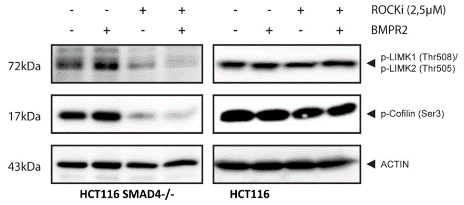
| Western Blot | p-LIMK1(Thr508) p-LIMK2(Thr505) p-Cofilin(Ser3) CDK2 KRT7 ROCK2 E-cadherin p-MLC2(Ser19) |
|
24704720 |
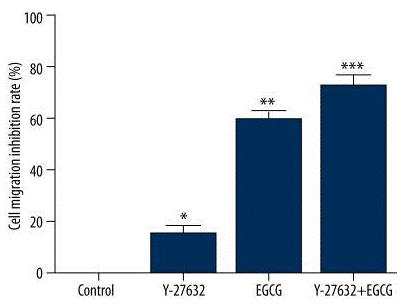
| Transwell migration assay | cell migration inhibition |
|
27694793 |
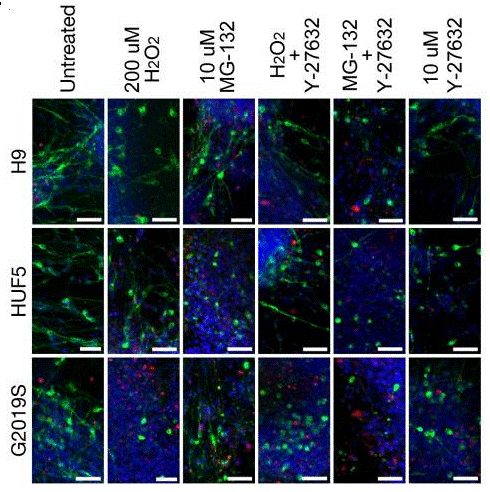
| Immunofluorescence | Neurotoxicity Assay E-cadherin beta-catenin Phalloidin |
|
21362567 |
| Growth inhibition assay | cell proliferation |
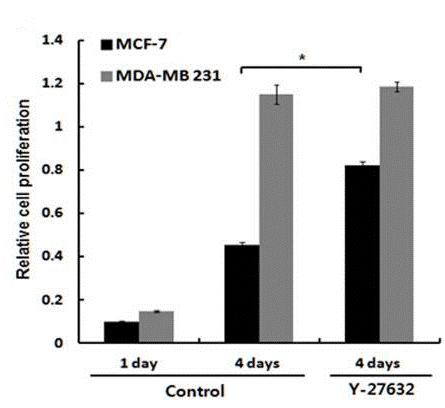
|
24523903 |
| ELISA | caspase-9 |
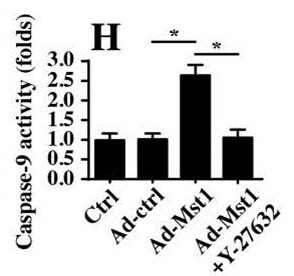
|
30320378 |
기술 지원
자주 묻는 질문
질문 1:
Is there any data about the Amax (maximum attraction luminosity) and extinction coefficient of it?
답변:
The wavelength used to test its HPLC is 260nm, while the extinction coefficient is unknown.
질문 2:
Could it be used in cell culture? Do you have any reference for this application?
답변:
Yes. It can be used in cell culture certainly. Here is the reference website: http://molpharm.aspetjournals.org/content/57/5/976.full.

제품은 연구용으로만 사용됩니다. 인체에는 사용하지 마십시오. 환자에게 판매하지 않습니다.
©Copyright 2013 Selleck Chemicals. All Rights Reserved.